

What if you could jumpstart real fat loss in four weeks without stepping foot in a gym?
No gimmicks.
Just four weeks of timed home workouts, built-up intensity, and smart recovery that fit busy days.
This plan gives daily schedules, exact reps and rests, and simple progressions so you know what to do each day and how to push safely.
Stick with it, track your sessions, and you’ll improve conditioning and lean down in a way that’s doable and repeatable.
Week 1 Full Home Workout Schedule and Daily Instructions

Day 1 starts with a full-body circuit that’ll wake up your metabolism without frying your system. Budget 25 minutes. You’re doing 3 rounds of bodyweight squats (15 reps), push-ups (10 reps), alternating lunges (20 total), and high knees (30 seconds). Rest 60 seconds between rounds. Keep it controlled. Form beats speed every time.
Day 2 is cardio intervals. Your heart rate’s going up, and you’re burning through stored glycogen. Set a timer for 20 minutes. Rotate between jumping jacks (45 seconds), mountain climbers (30 seconds), and rest (30 seconds). Repeat till the clock runs out. You should feel it, but you’re not gasping for air. If you can still breathe through your nose, you’re in the right zone.
Day 3 brings upper body and core work. Plan for 30 minutes. Complete 4 rounds of incline push-ups (12 reps), plank hold (45 seconds), standing or kneeling shoulder taps (20 total), and bicycle crunches (20 reps). Rest 45 seconds between rounds. Wrists bothering you during planks? Drop to your forearms.
Day 4 is lower body conditioning, 25 minutes. You’ll do 3 rounds of glute bridges (20 reps), reverse lunges (16 total), wall sit (60 seconds), and standing calf raises (25 reps). Rest 60 seconds between rounds. The wall sit’s gonna burn. That’s normal. If you need to bail early, drop to 40 seconds and build back up next week.
Day 5 mixes strength and cardio into one 35-minute circuit. Run through 3 rounds of burpees (8 reps), bodyweight squats (20 reps), push-ups (12 reps), high knees (45 seconds), plank to downward dog (10 reps), and Russian twists (30 total). Rest 90 seconds between rounds. This one will feel harder than the earlier sessions. That’s the point.
Day 6 is active recovery. Go for a 30 to 45 minute walk at a comfortable pace, or spend 20 minutes doing light stretching and mobility work. Hip openers, hamstring stretches, gentle spinal twists. No need to track reps or rounds. Just move and breathe.
Day 7 is complete rest. No workout. Your body’s adapting to the new stimulus, and that happens during recovery, not during the session itself. If you feel restless, a 10 minute walk is fine. Don’t push it.
Week 2 Progression Plan with Increased Intensity

Day 1 repeats the Week 1 full-body circuit but with small upgrades. Bump your squat reps to 18, push-ups to 12, and lunges to 24 total. Cut rest between rounds to 50 seconds. Same 3 round structure, but the density climbs. If 12 push-ups is too much, do 10 regular and 2 from your knees.
Day 2 extends your interval session to 25 minutes and introduces jump squats. Alternate 45 seconds of jump squats, 30 seconds of burpees, and 20 seconds of rest. Repeat the sequence for the full session. Your work intervals are longer now, and the explosive movements will spike your heart rate faster than Week 1.
Day 3 adds volume to the upper body circuit. Push to 5 rounds instead of 4, and extend your plank hold to 60 seconds. Shoulder taps increase to 24 total, and bicycle crunches go to 25 reps. Rest drops to 40 seconds between rounds. You’ll feel fatigue set in earlier. That’s progress.
Day 4 introduces single leg work to challenge balance and activate stabilizers. Perform 3 rounds of single leg glute bridges (12 each side), split squats (10 each side), wall sit (75 seconds), and single leg calf raises (20 each side). Rest 50 seconds between rounds. Keep a chair nearby if balance is shaky at first.
Day 5 cranks up the combined circuit to 40 minutes. Add a fifth exercise, step-ups onto a sturdy box or stair (20 total reps), and increase burpees to 10 reps. Everything else stays the same, but you’re now completing 4 full rounds with 75 seconds of rest between. This session will test your conditioning base.
Day 6 remains active recovery, but consider adding a short yoga flow or foam rolling session if you have access to a roller. Aim for 25 to 35 minutes of low intensity movement. Your muscles are working harder this week, so focus on mobility around your hips, shoulders, and thoracic spine.
Day 7 is rest. Same deal as Week 1. If soreness is high, light stretching for 10 minutes is helpful. No structured workout. Let your nervous system recover.
Here’s what changed from Week 1 to Week 2:
You added 3 to 5 reps on most exercises. Work intervals got longer (30 to 45 seconds where applicable). Rest periods got shorter (60 to 50 or 40 seconds). You introduced plyometric movements (jump squats, burpees in interval format). Total session time increased on key days (20 to 25 minutes, 35 to 40 minutes).
Week 3 Strength-Focused Fat Loss Workouts

Week 3 shifts the training bias toward strength and unilateral stability while keeping metabolic demand high. Sessions run a bit longer and movements get more technical. You’ll need to focus.
| Day | Focus | Key Exercises |
|---|---|---|
| 1 | Lower-body strength | Split squats, single-leg glute bridges, reverse lunges, calf raises |
| 2 | Cardio intervals | Burpees, high knees, jump squats, mountain climbers |
| 3 | Upper-body and core | Elevated push-ups, plank variations, shoulder taps, dead bugs |
| 4 | Full-body circuit | Squats, push-ups, lunges, plank-to-downward dog, Russian twists |
| 5 | Conditioning circuit | Burpees, step-ups, split squat jumps, bicycle crunches, high knees |
| 6 | Active recovery | Walking, stretching, light mobility flow |
| 7 | Complete rest | None |
Day 1 runs 30 minutes and focuses entirely on single leg and unilateral lower body work. Perform 4 rounds of Bulgarian split squats (10 each leg), single leg glute bridges (15 each side), reverse lunges with a pause at the bottom (12 each side), and single leg calf raises (25 each side). Rest 60 seconds between rounds. These movements will expose imbalances fast.
Day 2 maintains the 25 minute interval structure but tightens rest to 15 seconds. Cycle through burpees (10 reps), high knees (40 seconds), jump squats (12 reps), and mountain climbers (30 seconds). Repeat for the full session. The shorter rest will keep your heart rate elevated and force your body to recover under load.
Day 3 extends the upper body session to 35 minutes with elevated push-up variations. Complete 5 rounds of feet elevated push-ups (10 reps), side plank hold (45 seconds each side), shoulder taps (30 total), and dead bugs (20 total). Rest 45 seconds between rounds. If feet elevated push-ups are too tough, do them flat and add a 2 second pause at the bottom.
Day 4 is a full-body circuit lasting 35 minutes. Run 4 rounds of bodyweight squats (25 reps), push-ups (15 reps), walking lunges (24 total), plank to downward dog (12 reps), and Russian twists (40 total). Rest 60 seconds between rounds. This session tests your work capacity across multiple movement patterns.
Day 5 peaks at 40 minutes with a dense conditioning circuit. Perform 3 rounds of burpees (12 reps), step-ups (24 total), split squat jumps (16 total), bicycle crunches (30 reps), and high knees (60 seconds). Rest 90 seconds between rounds. By round 3, your legs will feel heavy. Push through with controlled form.
Day 6 is active recovery. Same guidelines as Week 2. Consider a longer walk (45 to 60 minutes) or a gentle yoga session focusing on hip flexors, hamstrings, and chest openers. Keep intensity low.
Day 7 remains complete rest. No exceptions this week. Your training volume is climbing, and your body needs the downtime to rebuild stronger.
Week 4 Peak Fat Loss and Conditioning Workouts

Week 4 introduces the highest intensity and longest sessions of the plan. You’ll use HIIT intervals, longer circuits, and a final challenge workout to close out the month. Fatigue’s coming. But so are results if you’ve stayed consistent.
Day 1 is a 40 minute HIIT lower body session using a 20/10 interval format. Work for 20 seconds at maximum effort, rest for 10 seconds, and repeat for 8 rounds per exercise. Rotate through jump squats, reverse lunges, single leg glute bridges, and burpees. Rest 2 minutes between exercise blocks. This format will spike your heart rate fast and keep it there.
Day 2 shifts to upper body HIIT with the same 20/10 structure, lasting 35 minutes. Cycle through push-ups, plank shoulder taps, tricep dips (using a chair or step), and mountain climbers. Complete 8 rounds per movement with 2 minutes of rest between blocks. Keep your core tight during every exercise. Fatigue will make you want to sag.
Day 3 is a 40 minute full-body conditioning circuit. Perform 4 rounds of burpee variations (tuck jump burpees, 10 reps), walking lunges (30 total), push-ups (18 reps), high knees (60 seconds), Russian twists (50 total), and jump squats (15 reps). Rest 90 seconds between rounds. This session combines everything you’ve built over the past three weeks.
Day 4 uses a descending ladder format over 30 minutes. Start with 20 reps of squats, 15 push-ups, 10 burpees, and a 60 second plank. Then do 18 squats, 12 push-ups, 8 burpees, and a 50 second plank. Keep descending by 2 reps per round until you hit 10 squats, 6 push-ups, 4 burpees, and a 30 second plank. Rest only as needed. Track your total time and try to beat it if you repeat this plan.
Day 5 is your final challenge workout, a 45 minute endurance circuit. Complete 5 rounds of step-ups (30 total), split squat jumps (20 total), plank to downward dog (15 reps), bicycle crunches (40 reps), burpees (15 reps), and high knees (90 seconds). Rest 2 minutes between rounds. This one will hurt. That’s the point. Finish strong.
Day 6 is active recovery. After four weeks of progressive loading, your body’s earned a long, slow walk or a full-body stretching session. Spend 30 to 45 minutes moving gently. Focus on breathing and mental recovery as much as physical.
Day 7 is complete rest. Congrats, you’ve finished the plan. Use this day to reflect on what worked, what didn’t, and whether you’re ready to run it back with heavier progressions or pivot to a different training block.
Here are six peak intensity exercises that defined Week 4:
20/10 HIIT intervals (maximum effort for 20 seconds, 10 seconds rest, 8 rounds per movement). Tuck jump burpees. Descending ladder circuits (start high reps, reduce each round). Split squat jumps under fatigue (after step-ups or lunges). 90 second high knees during a 5 round circuit. 45 minute endurance session combining strength and cardio without extended rest.
Nutrition Guidelines for a 4-Week Fat Loss Plan
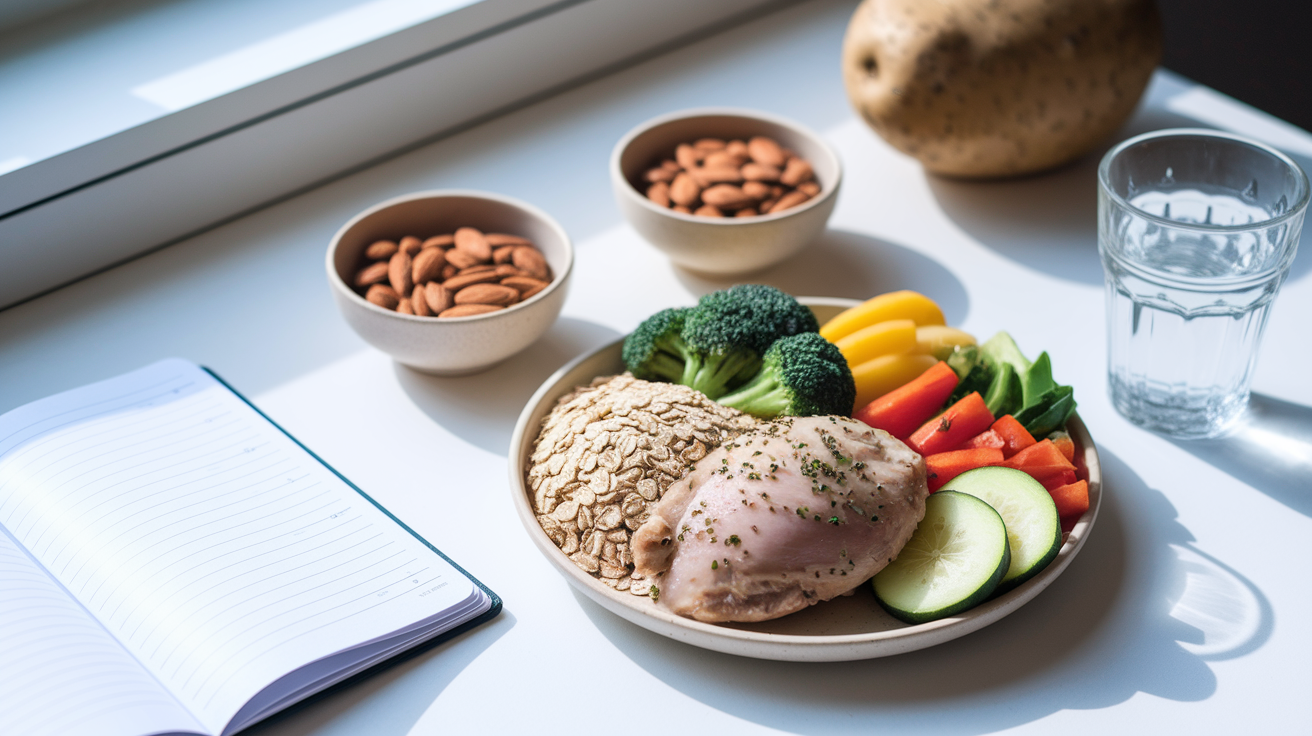
Fat loss happens when you consistently consume fewer calories than you burn. A 20 to 30% reduction from your maintenance intake is a sustainable starting point. For most people, that’s roughly 300 to 500 calories below baseline. Pair that deficit with 1.6 to 2.2 grams of protein per kilogram of bodyweight to preserve muscle while losing fat.
Whole food carbohydrate sources like oats, rice, potatoes, and fruit should make up the majority of your carb intake. These foods provide fiber, micronutrients, and steady energy without the blood sugar swings that come from processed options. Time your larger carb servings around your training sessions to fuel performance and support recovery.
Hydration often gets ignored, but it directly impacts your energy, digestion, and workout quality. Aim for 2 to 3 liters of water daily, more if you’re sweating heavily or live in a warm climate. If your urine is dark yellow by mid-afternoon, you’re behind. Drink more.
Here are eight actionable nutrition tips to support your four weeks:
Eat protein at every meal (eggs, chicken, fish, Greek yogurt, beans, tofu). Build meals around a fist sized portion of protein, a palm sized portion of carbs, and a thumb sized portion of fats. Prep 2 to 3 meals in advance each week to avoid decision fatigue when you’re tired. Swap high calorie snacks (chips, cookies) for lower calorie, high protein options (hard boiled eggs, cottage cheese, beef jerky). Avoid liquid calories unless they’re part of a planned protein shake. Track your intake for at least one week to understand portion sizes and identify hidden calorie sources. Schedule treat meals (not cheat days) once per week to stay sane and socially flexible. Sleep and stress management matter. Both directly influence hunger hormones and food choices.
Tracking Progress and Adjusting the Plan

The scale tells you one piece of the story. It’s not the full picture. Weight fluctuates daily due to water retention, digestion, and hormones. Weekly weigh-ins, taken at the same time under the same conditions (first thing in the morning, after using the bathroom, before eating), give you a clearer trend line.
Progress photos every 7 to 14 days show changes the scale can’t capture. Stand in the same spot, wear the same clothing, use the same lighting, and take front, side, and back shots. Compare week 1 to week 4, not day to day. Tape measurements around your waist, hips, and upper arms add another layer of data, especially if you’re building muscle while losing fat.
Track these six methods to measure results:
Weekly bodyweight (same day, same time, same conditions). Progress photos every 1 to 2 weeks (front, side, back angles). Waist, hip, and upper arm circumference with a fabric tape measure. Workout performance (reps completed, rounds finished, total session time). Energy levels and sleep quality (subjective but useful for spotting overtraining). How your clothes fit (belts, jeans, shirts, a simple everyday gauge).
Rest, Recovery, and Injury Prevention at Home

Sleep isn’t negotiable. Aim for 7 to 8 hours per night. That’s when your body repairs muscle tissue, balances hunger hormones, and consolidates the adaptations you triggered during training. If you’re consistently getting less than 7 hours, your fat loss results will stall no matter how hard you work.
Warm-ups and cooldowns aren’t optional add-ons. Spend 3 to 5 minutes before each session doing light cardio and dynamic stretches (arm circles, leg swings, hip openers). After your workout, spend 5 minutes walking slowly and stretching the muscles you just worked. This reduces injury risk and helps clear metabolic byproducts.
Mobility work doesn’t need to be complicated. Focus on your hips, ankles, shoulders, and thoracic spine. Those are the areas that tighten fastest when you’re training hard. Spend 10 to 15 minutes twice a week on basic stretches and controlled joint rotations. Pigeon pose, hip flexor stretches, and cat-cow spinal flows cover most of what you need.
Here are five warning signs of overtraining:
Persistent soreness that doesn’t improve after 48 to 72 hours of rest. Declining performance (fewer reps, slower times, heavier perceived effort). Disrupted sleep (trouble falling asleep or waking up frequently despite being tired). Increased resting heart rate (5 to 10 beats per minute higher than your baseline). Constant fatigue, irritability, or loss of motivation to train.
If you notice two or more of these, take an extra rest day and reassess your recovery habits. More work isn’t always better. Sometimes the smartest thing you can do is back off for 48 hours and come back stronger.
Final Words
Start week 1 with the 20–35 minute daily home workouts: cardio circuits, bodyweight moves, and one rest day so you’ll build the habit right away. Then push reps and longer intervals in week 2, add unilateral strength in week 3, and hit peak conditioning and the final challenge in week 4.
Follow the nutrition rules, track with photos and measurements, and protect recovery with sleep and mobility. This 4-week fat loss jumpstart plan with home workouts gives a clear path you’ll follow. Small, consistent steps win. Keep going.
FAQ
Q: What is the Week 1 full home workout schedule and daily instructions?
A: The Week 1 full home workout schedule gives a 7-day plan of 20-35 minute sessions mixing cardio circuits and bodyweight strength, lists exact exercises per day, intensity cues, and one rest day.
Q: How long are daily workouts in Week 1 and what intensity should I use?
A: Daily workouts in Week 1 last 20-35 minutes and use moderate to high intensity; push during work intervals, keep form tight, and choose moderate if you’re new or tired.
Q: Which exact exercises are included during Week 1?
A: Week 1 includes squats, push-ups, lunges, planks, high knees, burpees and simple variations, organized into 4-6 move circuits to burn calories and build strength.
Q: How does Week 2 increase intensity and what progressions are used?
A: Week 2 increases intensity by adding reps, lengthening intervals to 30-45 seconds, introducing plyometrics like jump squats and power jacks, and reducing rest while keeping one rest day.
Q: What changes in Week 3 for strength-focused fat loss workouts?
A: Week 3 shifts to strength focus with unilateral moves like split squats and single-leg glute bridges, elevated push-ups, longer circuits of 2-3 rounds, plus a rest day for recovery.
Q: What does Week 4 peak conditioning include and what’s the final challenge?
A: Week 4 uses HIIT 20/10 intervals, burpee variations, sessions up to 40 minutes, and ends with a peak-intensity challenge workout to test conditioning and consistency.
Q: What are the nutrition guidelines for a 4-week fat loss plan?
A: The nutrition guidelines recommend a 20-30% calorie reduction, 1.6-2.2 g/kg protein, whole-food carbs, and 2-3 liters of water daily, with simple meal structure and smart swaps.
Q: How should I track progress and what measures matter most?
A: Track progress weekly with photos, tape measurements, workout performance, energy levels, and clothing fit; don’t rely on the scale as your only measure of success.
Q: What rest, recovery, and injury prevention steps should I follow at home?
A: Rest and recovery include 7-8 hours sleep, 3-5 minute warm-ups, 5-minute cooldowns, daily mobility work, and sensible session pacing to reduce injury risk.
Q: What warning signs mean I’m overtraining or need to back off?
A: Warning signs of overtraining include persistent fatigue, poor sleep, rising aches, stalled performance, low mood, and low motivation; ease up and prioritize rest if these appear.