

What if you could lose fat without relying on daily willpower?
Habit stacking pins a tiny, practical action to something you already do, like pouring coffee or brushing your teeth, so the new habit rides the old one automatically.
In this post you’ll learn how to pick reliable anchors, write exact if-then stacks, track progress, and scale up with real, ready to use examples.
The payoff is steady fat loss from small wins you repeat, not from motivation you hope shows up.
Ready to build habits that actually stick?
Quick Start: What Habit Stacking Is and How It Creates Immediate Fat-Loss Consistency

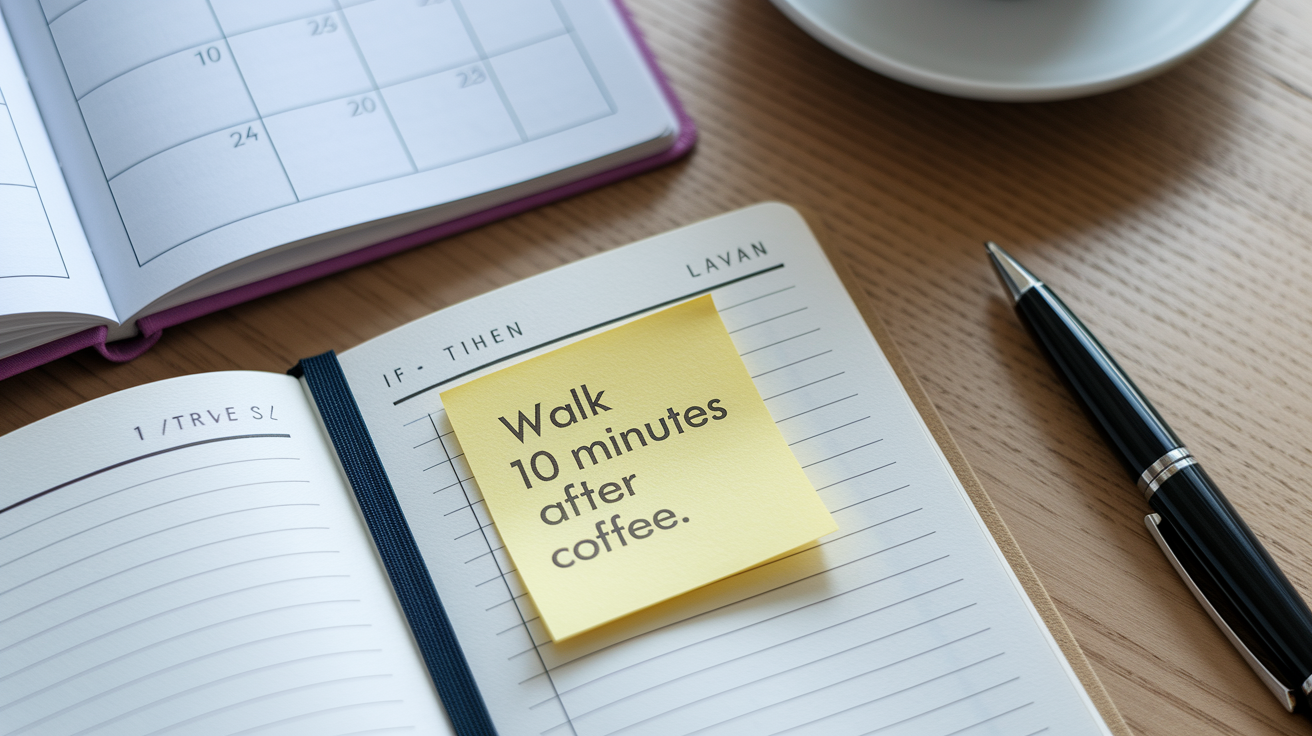
Habit stacking links a new, tiny fat-loss behavior to something you already do every day without thinking. The pattern’s dead simple: “After [existing habit], I will [new tiny behavior].” Your morning coffee becomes the trigger for a 10-minute walk. Brushing your teeth at night means you pack tomorrow’s lunch. The existing habit anchors everything. The new behavior just rides along.
This works because your brain’s already running the anchor on autopilot. You don’t debate whether to brush your teeth or pour coffee. You just do it. Attaching a new behavior to that automatic trigger skips the whole willpower conversation. The cue fires, the routine follows, you get a small win, and repetition locks it in. After 2–4 weeks, the new behavior starts feeling automatic too. Around 66 days, it’s wired deep. You’re not grinding through discipline. You’re borrowing momentum from habits that already exist.
Two stacks you can start today:
After I pour my morning coffee, I will walk for 10 minutes. Builds daily movement, burns 50–80 calories, sets an active tone before things get chaotic.
After I brush my teeth at night, I will prepare a protein snack for tomorrow (1 cup Greek yogurt or 1 hard-boiled egg). Removes morning decision fatigue and gives you a high-protein start that supports satiety and protects lean mass during fat loss.
Psychological Science Behind Habit Stacking for Fat Loss Behaviors

Habit stacking works because your brain’s obsessed with efficiency. Every habit follows a three-part loop: cue, routine, reward. The cue triggers the behavior. The routine is the action. The reward reinforces repetition. When you stack a new behavior onto an existing cue, you’re piggybacking on a loop that’s already automatic. Your brain doesn’t build a new trigger from scratch. It just tacks one small step onto a sequence it already runs without thinking.
Implementation intentions make this even stronger. Research shows people who write exact if-then plans are way more likely to follow through. “If I finish my coffee, then I will walk for 10 minutes” beats “I should walk more” every time. The specificity kills ambiguity. Your brain knows exactly when and what to do. Decision fatigue disappears. You don’t waste mental energy debating whether to walk. The cue decides for you.
Five psychological mechanisms that make habit stacking work for fat loss:
Cue-dependent memory: Your brain links specific contexts (coffee mug on the counter, toothbrush in hand) with specific actions, making the new behavior easier to recall and execute.
Reduced decision friction: Automating small behaviors saves willpower for harder choices later, like resisting high-calorie foods when stress hits.
Small wins and dopamine: Completing a tiny habit releases a dopamine hit, which reinforces the behavior and builds momentum for bigger changes.
Identity reinforcement: Repeating “I’m someone who walks after coffee” strengthens your self-image as someone who takes care of their body, which supports long-term consistency.
Automaticity over time: Repetition in consistent contexts shifts the behavior from effortful to automatic, typically within 21–66 days depending on complexity and frequency.
Step-by-Step Method to Build Effective Fat Loss Habit Stacks
Start by listing the daily habits you already do without thinking. These are your anchors. Strong anchors happen every day at predictable times: brushing teeth, morning coffee, starting work, lunch break, cooking dinner, parking your car, turning on the TV. Write down 5–10 anchors that occur daily and rarely get skipped. If an anchor only happens on weekends or depends on your mood, it’s not reliable enough.
Next, pick one micro-behavior to attach to one anchor. Keep it tiny. If the new habit takes longer than 2 minutes or needs serious effort, shrink it. Instead of “work out for 30 minutes,” start with “do 5 squats.” Instead of “eat a perfect breakfast,” start with “prepare 1 hard-boiled egg.” You’re building the loop, not chasing results yet. You can always scale up later.
Write your stack as an exact if-then statement. “After I [anchor], I will [new behavior].” Be specific about time, reps, or quantity. “After I sit at my desk at 9:00 AM, I will fill a 20-oz water bottle and drink one glass.” Track daily completion on a simple checklist or calendar. Mark an X for every day you complete the stack. After 5–7 consecutive days, add an immediate reward like 30 seconds of a favorite song or marking a streak on a visible habit tracker. After 2–4 weeks of consistent daily repetition, consider adding one more stack or bumping the duration by 2–5 minutes.
Match the frequency of your cue to the frequency you want the new habit. If you want to walk daily, anchor it to a daily habit like coffee or brushing teeth. If you want to meal-prep weekly, anchor it to a weekly event like grocery shopping. Mismatched frequency kills stacks fast. A nightly cue won’t build a morning habit.
| Anchor Habit | Ideal Fat-Loss Micro-Behavior | Duration/Quantity |
|---|---|---|
| After pouring morning coffee | Walk outside or on treadmill | 10 minutes (1,000–1,500 steps) |
| After washing hands post-lunch | Add 1 cup non-starchy vegetables to plate | 1 cup (broccoli, salad, bell peppers) |
| After brushing teeth at night | Prepare tomorrow’s breakfast | Portion 1 serving oats or 2 eggs |
| After sitting at desk at 3:00 PM | Drink water and wait before snacking | 8 oz water, 10-minute wait |
| After changing out of work clothes | Complete bodyweight circuit | 10 minutes (2 rounds, 5 exercises) |
Practical Fat Loss Habit Stack Examples for Real-Life Routines

Real habit stacks work because they fit into the rhythm of your actual day, not the idealized schedule you wish you had. These examples anchor to moments that already happen reliably. Pick one or two that match your current routine, write the exact if-then statement, and track daily completion for two weeks before adding more.
Morning and commute stacks help you start the day with momentum. “After I pour my morning coffee, I will walk for 10 minutes” burns 50–80 calories and often sharpens focus before work. “After I park my car at work, I will walk an extra 200 steps by parking in the farthest spot” adds small daily movement that compounds over weeks. “Before I open my email at 9:00 AM, I will drink 8 oz of water” starts hydration early and cuts mid-morning snacking driven by thirst.
Meal-related stacks reduce calorie intake and improve satiety without needing willpower in the moment. “Before I sit down to eat lunch, I will drink 8 oz of water” can drop portion sizes by 20–30% through pre-meal fullness. “After I finish cooking dinner, I will pack leftovers into meal-prep containers immediately” prevents overeating and saves a meal for tomorrow. “After washing my hands post-lunch, I will add 1 cup of non-starchy vegetables to my plate” boosts fiber and volume for 25–50 extra calories while increasing satiety.
Evening and home stacks prevent passive snacking and build consistency when motivation’s lowest. “Before I sit down to watch TV, I will take a 10-minute walk around the block” adds 50–100 calories of movement and often cuts the urge to snack. “After I brush my teeth at night, I will prepare tomorrow’s breakfast by portioning 1 serving of oats or cracking 2 eggs into a bowl” removes morning decision fatigue. “Before I open Instagram, I will take a drink from my water bottle” micro-stacks hydration onto a high-frequency behavior.
Twelve ready-to-use habit stacks you can copy exactly:
After I pour my morning coffee, I will walk for 10 minutes.
After I brush my teeth in the evening, I will prepare a protein snack for tomorrow (1 cup Greek yogurt or 1 hard-boiled egg).
After I sit at my desk at 9:00 AM, I will fill a 20-oz water bottle and drink one glass.
Before I eat lunch, I will drink 8 oz of water.
After washing my hands post-lunch, I will add 1 cup of vegetables to my plate.
After I finish cooking dinner, I will pack leftovers into containers immediately.
Before I watch my favorite TV show, I will take a 10-minute walk.
After I park my car, I will choose the farthest spot and walk 200 extra steps.
After I change out of work clothes, I will do a 10-minute bodyweight circuit (2 rounds of squats, push-ups, lunges, planks, glute bridges).
Before I open social media, I will take a drink from my water bottle.
After grocery shopping, I will spend 15 minutes washing and portioning fruits and vegetables.
Before I go out to eat, I will check the restaurant menu online and plan my order.
How Habit Stacking Supports Portion Control, Meal Planning, and Smarter Nutrition

Portion control’s one of the hardest parts of fat loss to sustain because it demands constant micro-decisions when you’re hungry or distracted. Habit stacking removes those decisions by automating portion-friendly behaviors before you sit down to eat. “Before I serve dinner, I will use a 9-inch plate instead of a 12-inch plate” reduces portion sizes by 20–30% without measuring or tracking. “After I open the fridge, I will pack one portioned snack (150–200 calories) instead of grazing” turns vague hunger into a concrete action with a built-in limit.
Pre-meal rituals work especially well. Drinking 8 oz of water before each meal increases fullness and can cut intake by 75–150 calories per meal. That’s 225–450 fewer calories per day if you apply it to three meals, roughly 0.5 lb of fat loss per week without changing the food itself. “Before I take the first bite of dinner, I will take three deep breaths and eat the first three bites slowly” activates mindful eating, giving satiety signals time to register before you’ve cleared your plate.
Meal-planning stacks eliminate the decision fatigue that leads to high-calorie convenience choices. “After I return from grocery shopping, I will spend 15–30 minutes washing, chopping, and portioning produce” makes vegetables the default option later in the week. “Before I watch my favorite Saturday night show, I will spend 30 minutes planning meals for the week ahead” turns planning into a reward-anchored routine rather than a Sunday-night chore you skip when you’re tired.
Five nutrition-focused habit stacks with exact quantities:
Before each meal, I will drink 8 oz (240 mL) of water. Increases satiety, reduces portion sizes by around 20–30%, saves roughly 75–150 kcal per meal.
After making morning coffee, I will eat 1 piece of fruit or 1 oz (28 g) of nuts. Replaces a sugary snack, adds fiber, keeps calories at around 80–160 kcal.
After washing my hands post-lunch, I will add 1 cup of non-starchy vegetables to my plate. Adds volume and fiber for around 25–50 kcal, increases satiety.
After setting the table for dinner, I will use a 9-inch plate. Reduces portion sizes passively by around 20–30%.
After grocery shopping, I will spend 15–30 minutes preparing fruits and vegetables. Makes healthy options the easiest grab, reduces friction for future meals.
Movement-Based Habit Stacking for Daily Fat Loss and Higher NEAT

Most fat loss happens outside the gym. Non-exercise activity thermogenesis (the calories you burn through daily movement like walking, standing, and light chores) can account for 15–30% of total daily energy expenditure. Habit stacking makes it easy to boost NEAT without adding formal workouts. Small, frequent movement stacks compound over weeks and months.
Walking’s the simplest, highest-return movement stack. A 10-minute brisk walk burns roughly 50–80 calories depending on your weight and pace. Stack it onto coffee, lunch breaks, or post-dinner routines, and you’ve added 150–240 calories of daily movement without scheduling a workout. “After I pour my morning coffee, I will walk for 10 minutes” builds the habit when energy’s highest. “After I finish dinner, I will take a 10–15 minute walk instead of sitting immediately” improves digestion and prevents passive snacking. A 30-minute walk done five times per week burns 750–1,500 calories per week, enough to support 0.2–0.4 lb of fat loss weekly when paired with a modest calorie deficit.
Strength training stacks protect lean muscle during fat loss. You don’t need an hour at the gym. Two 20–40 minute resistance sessions per week are enough to maintain muscle mass in a calorie deficit. “After I change out of work clothes on Tuesday and Thursday, I will do a 10-minute bodyweight circuit” anchors strength work to a reliable daily transition. Start with two rounds of five exercises: squats, push-ups, lunges, planks, and glute bridges. Add reps or a third round as it becomes automatic.
Eight movement stacks you can start this week:
After I pour my morning coffee, I will walk for 10 minutes. Burns around 50–80 kcal, adds 1,000–1,500 steps.
After I finish lunch, I will take a 10-minute walk outside or around the office. Breaks up sedentary time, burns around 50–80 kcal.
After I park my car, I will choose the farthest spot and walk 200 extra steps. Small daily NEAT boost.
While cooking (during simmer or wait times), I will do 2 sets of 10 squats or 1–2 minutes of calf raises. Adds strength stimulus, burns around 10–20 kcal.
After I change out of work clothes on Tuesday and Thursday, I will do a 10-minute bodyweight circuit. Maintains muscle in a calorie deficit, burns around 60–100 kcal per session.
Before I sit down to watch TV, I will walk for 10 minutes around the block. Prevents passive snacking, burns around 50–80 kcal.
After I brush my teeth in the morning, I will do 10 calf raises or 5 squats. Tiny strength stimulus, takes less than 2 minutes.
After I finish dinner, I will take a 10–15 minute walk instead of sitting immediately. Improves digestion, adds around 50–100 kcal burned.
Tracking and Measuring Progress When Using Habit Stacking for Fat Loss

Track behaviors, not just outcomes. Your weight will bounce around daily because of water, sodium, digestion, and hormones. Your habit completion rate won’t. A simple checklist or calendar X for each day you complete a stack gives you real-time feedback on what’s working. If you hit 6 out of 7 days on “walk after coffee” for two weeks straight, you know the stack’s solid. If you only hit 2 out of 7 days, the stack needs adjustment: smaller action, stronger anchor, or better reward.
Weigh yourself once per week under consistent conditions: same day, same time, after using the bathroom, before eating. Log the number, but focus on the 4-week trend, not the weekly change. Take waist measurements and progress photos every 2–4 weeks. These capture fat loss the scale might miss, especially if you’re doing strength work and preserving muscle. A 0.5–1 inch waist reduction over four weeks with stable weight often means you’re losing fat and gaining or maintaining lean mass.
Automaticity’s the real metric. After 2–4 weeks, ask yourself: “Did I complete this stack 5–7 days per week without internal negotiation?” If yes, the habit’s becoming automatic. If no, troubleshoot: Is the cue reliable? Is the action small enough? Is there an immediate reward? Habit strength matters more than perfection. A stack you complete 6 days per week for six months will crush a stack you white-knuckle through for two weeks and then quit.
For fat-loss expectations, aim for 0.5–1 lb (0.25–0.5 kg) per week as a sustainable rate. A 500-calorie daily deficit (through habit stacks that reduce intake and increase movement) typically produces about 1 lb of fat loss per week. Over 12 weeks, that’s 6–12 lb (3–5.5 kg). Stack-driven changes like replacing one 12-oz soda with water saves 150 calories per day, or about 0.3 lb per week. Skipping a 300-calorie evening snack saves 2,100 calories per week, or roughly 0.6 lb. These small, repeatable stacks compound.
Four tracking methods that support habit stacking without obsession:
Daily habit checklist: Write your stacks on a simple sheet or app. Mark an X for each day completed. Aim for 5–7 days per week.
Weekly weigh-ins: Weigh once per week, same conditions. Track the 4-week average to filter out noise.
Waist and photo measurements every 2–4 weeks: Measure at the navel level, take front, side, and back photos in the same clothes and lighting.
Monthly habit audits: Every 4 weeks, review which stacks you completed most consistently, which you skipped, and why. Retire or reshape stacks that fail more than 50% of the time across two weeks.
Common Habit Stacking Mistakes That Sabotage Fat Loss (and How to Fix Them)

The biggest mistake is stacking a new habit onto an unreliable cue. If your anchor habit only happens three times per week, your new habit will fail four times per week by default. Weekend-only routines, mood-dependent activities, or behaviors that vary by schedule won’t work. Choose anchors that happen every single day at predictable times: brushing teeth, morning coffee, commute start, lunch break, or evening shutdown ritual. If a stack fails consistently, the first fix is to swap the anchor, not blame yourself for lacking discipline.
Starting too big is the second most common failure. A 60-minute workout sounds impressive, but if it doesn’t fit into your actual day, you won’t do it. Break it into two 10–15 minute stacks anchored to morning coffee and post-work clothes change. “After I change out of work clothes, I will do a 10-minute bodyweight circuit” is more sustainable than “After work, I will go to the gym for an hour.” Start with a version so small that skipping it feels ridiculous, then scale up once the loop’s automatic.
Six mistakes that sabotage habit stacks:
Choosing unreliable or infrequent cues (weekend-only routines, mood-dependent triggers).
Setting goals that are too large (60-minute workouts, drastic meal overhauls).
Using vague language (“when I have time” instead of “after I pour my morning coffee”).
Relying on willpower instead of environmental design (expecting yourself to resist snacks instead of removing them from sight).
Skipping immediate rewards (no calendar X, no 30-second pleasant ritual after completing the stack).
Stacking too many habits at once (adding 5 new stacks in week one instead of 1–2).
Six fixes to get stacks back on track:
Swap to a stronger, daily anchor: Replace “after my weekend run” with “after I brush my teeth every morning.”
Shrink the action: Turn “30-minute walk” into “10-minute walk” or “5 squats.”
Make cues and actions concrete: “After I sit at my desk at 9:00 AM, I will drink 8 oz of water” instead of “drink more water.”
Change the environment: Place your water bottle on your desk the night before, lay out workout clothes next to your bed.
Add an immediate, non-food reward: Mark a calendar X, play 30 seconds of a favorite song, or text a friend after completing the stack.
Focus on one stack at a time: Master one habit for 2–4 weeks before adding the next.
Long-Term Maintenance: How to Keep Fat-Loss Habit Stacks Working for Months and Years

Habit stacking isn’t a 30-day challenge. It’s a system for building a lifestyle where fat-loss behaviors run on autopilot. After the first 2–4 weeks, when your initial stack feels automatic, you can add one more. Repeat that cycle: establish one stack, wait for consistency, add the next. Over six months, you might build 6–8 solid stacks that collectively create a 300–500 calorie daily deficit and 20–40 extra minutes of movement without relying on motivation.
Monthly habit audits keep the system alive. Every four weeks, review your checklist. Which stacks did you complete 5–7 days per week? Keep those. Which stacks did you complete fewer than 3 days per week? Either shrink the action, change the anchor, or retire the stack entirely. Habits that don’t stick after two full weeks of honest effort usually need reshaping, not more willpower. Replace them with simpler versions or different behaviors that fit your actual routine better.
Chaining stacks into routines creates compound momentum. “After I wake up, I will drink 8 oz of water” leads into “After I drink water, I will walk for 10 minutes,” which leads into “After I walk, I will eat a high-protein breakfast (20–30 g protein).” Three small stacks become a single morning sequence that sets up the rest of your day. You’re not making three separate decisions. You’re running one automated routine.
Preserve lean muscle with two resistance sessions per week, even in a calorie deficit. Muscle burns more calories at rest and keeps your metabolism higher as you lose fat. Stack strength work onto reliable weekly anchors: “After I change clothes on Tuesday and Thursday evenings, I will do a 20-minute bodyweight or dumbbell circuit.” Protein intake of 20–30 g per meal supports muscle retention and satiety during fat loss.
Five long-term strategies to sustain habit stacks:
Add one new stack every 2–4 weeks once the previous stack is consistent (5–7 days per week for two weeks).
Conduct monthly habit audits: retire stacks that fail more than 50% of the time, keep stacks with 70%+ adherence.
Chain related stacks into routines: hydration, walk, protein breakfast becomes one morning sequence.
Use environmental design: prep containers, visible water bottles, laid-out workout clothes reduce friction and support automaticity.
Reassess every 4–12 weeks: check if calorie deficit or activity level needs adjustment, scale up stack duration or intensity by 10–20% if fat loss plateaus.
Final Words
Start stacking today: pick one cue (coffee or brushing teeth) and attach a tiny fat-loss habit you can do in 2 minutes or a simple 10-minute action.
This post gave a quick start, the behavioral science, a step-by-step build, real-life examples for meals and movement, tracking tips, common fixes, and long-term maintenance. Keep actions tiny, track frequency, and tweak one thing at a time.
If you want to know how to use habit stacking for consistent fat loss, begin with one two-minute stack, track it for a few weeks, then add another when it’s automatic. Small wins add up.
FAQ
Q: What is the 3-3-3 rule for fat loss?
A: The 3-3-3 rule for fat loss is a simple framework: pick three tiny daily habits, repeat them for three weeks, and check progress at three regular points to build consistency and momentum.
Q: How to habit stack for weight loss?
A: To habit stack for weight loss, attach a tiny fat-loss action to a reliable cue with an if-then statement, keep it ≤2 minutes (or a short 10-minute task), and track daily adherence.
Q: How did Kelly Clarkson lose weight so quickly?
A: Kelly Clarkson lost weight quickly by changing her eating habits, adding consistent cardio and strength work, and following a structured plan with professional guidance rather than a single fast fix.
Q: What is the 5 2 1 0 rule?
A: The 5 2 1 0 rule is a simple health guideline: 5 servings of fruits/vegetables, 2 hours max screen time, 1 hour active movement daily, and 0 sugary drinks.