

Think tempo runs are only for elite runners?
Think again.
A tempo workout is a steady, “comfortably hard” run that trains your body to process lactate and hold faster paces for longer.
Done right, it raises your sustainable speed and builds the endurance you need late in races.
In this post you’ll learn how to find your tempo pace, simple sessions for every level, and common mistakes to avoid.
Read on to turn one steady effort into real speed and stamina gains.
Core Explanation of Tempo Workouts

A tempo workout is a sustained running effort performed at or near your lactate threshold. That’s the intensity where your body produces lactate faster than it can clear it. Most runners describe tempo pace as “comfortably hard.” Faster than a conversational jog but not an all-out sprint. You should be able to speak in short phrases but not hold a full conversation. Tempo runs sit between your easy mileage and your high-intensity interval sessions. It’s a sweet spot where you build aerobic strength without beating yourself up.
The primary purpose of tempo work is to raise the speed you can maintain aerobically. By training at threshold intensity, you teach your body to process lactate more efficiently, push your sustainable pace faster, and develop mental toughness for holding discomfort. Tempo runs aren’t about chasing a personal record on a single mile. They’re about holding steady effort for a sustained block, usually 20 to 40 minutes, so your body adapts to clearing waste products while working hard.
From a practical standpoint, tempo effort feels controlled but challenging. Your breathing is rhythmic and deliberate. Your legs are working, but you’re not sprinting. You can hold the pace for the planned duration without fading or needing to bail early. It’s an effort you could sustain for roughly 45 to 60 minutes in a race scenario, often close to your current 10K pace or slightly slower for longer tempo sessions.
Common tempo characteristics include:
Duration: typically 20 to 40 minutes of sustained effort, though beginners may start with 10 to 15 minutes
Intensity cues: breathing hard but controlled, limited ability to speak full sentences, effort that feels like a 6 to 8 out of 10
Pace description: often described as “one-hour race pace” or slightly slower than 10K pace
Training placement: scheduled once every 1 to 2 weeks during a planned training cycle, positioned between easy runs and high-intensity interval days
Physiological Basis: Lactate Threshold and Tempo Pace

Your lactate threshold is the exercise intensity where lactate begins to accumulate in your bloodstream faster than your body can clear it. Below this threshold, you’re working aerobically and can sustain effort for a long time. Cross it, and lactate builds up quickly, forcing you to slow down or stop. Tempo pace targets the zone right at or slightly below this threshold, training your body to process lactate more efficiently and push the threshold higher over time.
The adaptations are specific. Your muscles get better at using lactate as fuel, your capillary density increases, and your aerobic enzymes become more active.
Training at threshold pace signals your body to strengthen the systems that sustain speed. Your heart becomes more efficient at pumping oxygenated blood. Your muscles improve their ability to buffer and clear metabolic byproducts. Your nervous system learns to maintain form and rhythm under sustained stress. These adaptations don’t happen overnight. Consistent tempo work over 3 to 4 months produces noticeable improvements in sustainable pace and race performance.
The key is specificity. Running too fast turns the session into an interval workout that targets different energy systems. Running too slow misses the threshold stimulus entirely. Tempo pace lives in a narrow band where the aerobic system is challenged but not overwhelmed.
How to Determine Your Tempo Pace

Finding your tempo pace involves balancing precision with practicality. You want a pace that challenges your aerobic system without exceeding your lactate threshold. Here are five methods to estimate it:
Perceived effort scale: Aim for a 6 to 8 out of 10 effort. You should feel like you’re working hard but not gasping. Speaking should be limited to short phrases. If you can chat comfortably, you’re too slow. If you can’t say anything, you’re too fast.
Heart rate range: Calculate your estimated maximum heart rate (220 minus your age), then target 80 to 90 percent of that number. For a 32 year old runner, max HR is roughly 188 beats per minute, so tempo range is about 150 to 170 bpm. Use a chest strap or reliable wrist monitor for accuracy.
Race pace equivalency: Tempo pace is often close to the pace you could hold for a 60 minute race, typically similar to current 10K pace or slightly slower. If you recently raced a 10K in 50 minutes (about 8:03 per mile), your tempo pace might be around 8:10 to 8:20 per mile.
Lactate threshold testing: Some running labs offer treadmill tests that measure blood lactate at increasing speeds. The test pinpoints your exact threshold pace. It’s the most accurate method but requires access to a lab and costs money.
Time trial proxy: Run a steady 20 to 30 minute time trial at the hardest pace you can sustain for that duration. Your average pace for that effort is a good estimate of your tempo pace. Repeat every 6 to 8 weeks as fitness improves.
All methods have trade-offs. Heart rate can lag behind effort and varies with heat, fatigue, and hydration. Perceived effort is subjective but useful once you’ve learned what threshold feels like. Race equivalency works well if you’ve raced recently. The key is consistency. Pick one method, use it for a training block, then adjust based on how the workouts feel and how your race performances progress.
Tempo Workouts for Different Experience Levels

Beginner Workouts
If you’re new to tempo work, start with short controlled efforts that let you practice threshold intensity without overwhelming your system. Beginners often run their first tempo sessions too fast, turning them into hard interval sessions. Focus on holding steady effort and learning what “comfortably hard” feels like.
A simple beginner tempo session: warm up with 10 minutes of easy jogging, then run 10 to 15 minutes at tempo pace (RPE 6 to 7 out of 10), followed by a 5 to 10 minute easy cooldown. Total session time is about 25 to 35 minutes. You can also break the tempo segment into two blocks (example, 2 × 8 minutes at tempo with 2 minutes of easy jogging between) to build confidence before running one continuous block.
Intermediate Workouts
Once you can comfortably hold 15 minutes at tempo pace, progress to longer continuous runs. Intermediate runners benefit from sustained 20 to 30 minute tempo blocks that challenge aerobic endurance and mental focus.
A typical intermediate session: warm up with 1 to 2 miles easy, then run 20 to 25 minutes at tempo pace (heart rate around 80 to 88 percent of max or RPE 6 to 7), followed by a 1 mile easy cooldown. Total mileage is roughly 6 to 8 miles depending on your pace. Another variation is tempo intervals: warm up 1 mile easy, then run 3 × 1 mile at tempo pace with 90 seconds of easy jogging between repeats, and finish with a 1 mile easy cooldown. The short recoveries keep your aerobic system engaged while giving brief mental breaks.
Advanced Workouts
Advanced runners can extend tempo duration, add surges, or combine tempo running with strength circuits. A long sustained tempo: warm up 2 miles easy, run 40 to 50 minutes at steady tempo pace, then cool down 1 mile easy. This session closely mimics the sustained effort of a half marathon or marathon race pace segment.
For a tempo circuit variation, alternate 8 minutes of tempo running with 2 minutes of bodyweight strength exercises (squats, lunges, push-ups) during recovery, repeated 3 to 4 times. Your heart rate stays elevated throughout, and you add a strength stimulus.
A lactate clearance tempo session: warm up 1 mile easy, run 30 minutes at tempo pace, but every 6 to 8 minutes insert a 45 second surge at 5K pace, then return immediately to tempo. This teaches your body to clear lactate spikes while maintaining threshold effort. Limit lactate clearance sessions to once every 2 to 3 weeks during mid to late training phases.
Key Benefits of Tempo Training
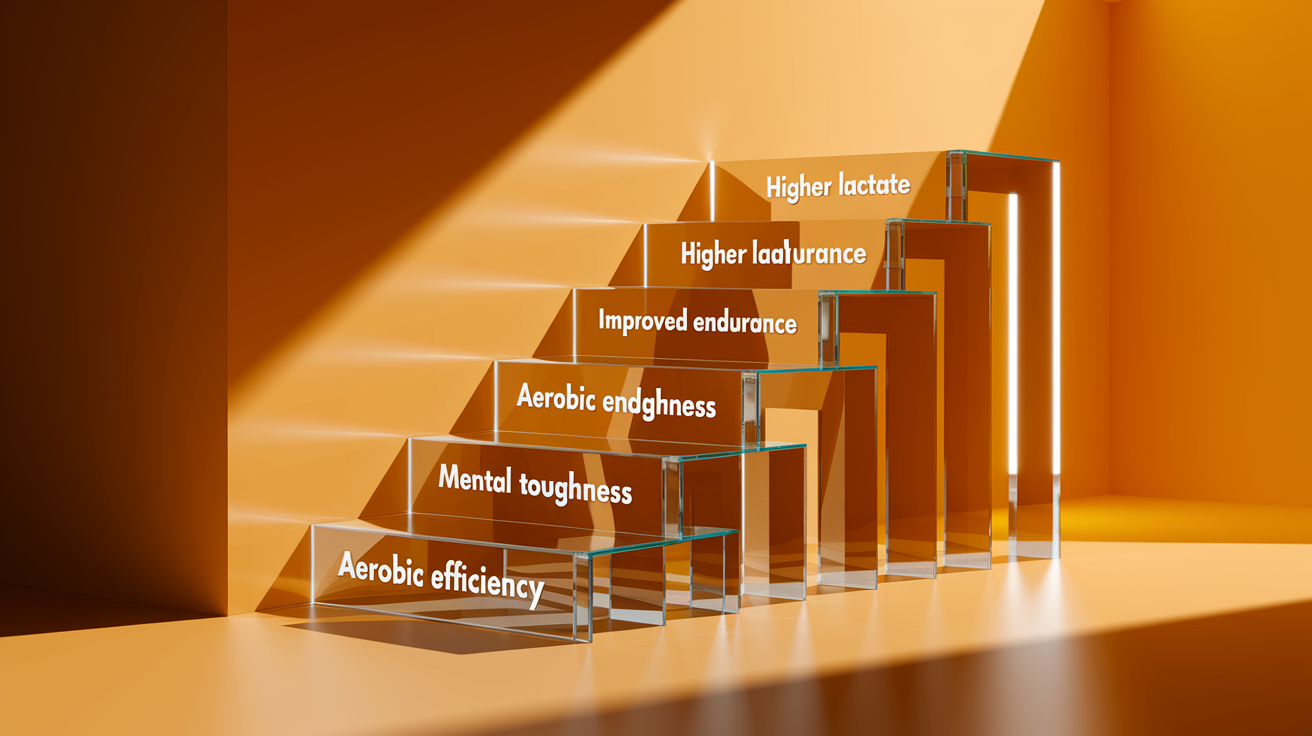
Tempo workouts improve your body’s ability to sustain faster paces by raising your lactate threshold. As your threshold rises, the pace you can hold aerobically increases. You can run faster for longer without accumulating the metabolic byproducts that force you to slow down. This translates directly to better race performances across all distances, from 5K to marathon.
Tempo running also builds mental resilience. Holding discomfort for 20 to 40 minutes teaches you to stay calm and controlled when effort feels hard. It’s a skill that pays off late in races when fatigue sets in.
Beyond performance, tempo sessions strengthen aerobic efficiency. Your heart pumps more blood per beat, your muscles use oxygen more effectively, and your capillary network expands to deliver fuel and remove waste faster. These adaptations support long-term cardiovascular health and make everyday running feel easier over time.
Main performance gains from consistent tempo training:
Higher lactate threshold: Sustainable pace increases as your body clears lactate more efficiently
Improved endurance: Aerobic systems adapt to sustain harder efforts for longer durations
Mental toughness: Repeated exposure to controlled discomfort builds confidence and race readiness
Aerobic efficiency: Heart, lungs, and muscles work together more effectively, reducing effort at any given pace
Common Mistakes When Doing Tempo Workouts

Runners often sabotage tempo sessions by turning them into interval workouts. The most frequent mistakes:
Running too fast: Tempo pace should feel comfortably hard, not all out. If you’re sprinting or gasping for air, you’ve crossed into interval territory and missed the aerobic threshold stimulus. Dial it back.
Inconsistent pacing: Starting too fast and fading defeats the purpose. Tempo runs train steady effort. Use a GPS watch or heart rate monitor to hold consistent pace throughout the session.
Skipping warmups: Jumping straight into tempo pace without 10 to 15 minutes of easy jogging increases injury risk and makes the effort feel harder than it should. Warm muscles respond better to threshold work.
Overusing tempo sessions: More isn’t better. Tempo runs are high quality workouts that require recovery. Scheduling them more than twice a week (or back to back days) leads to fatigue, poor performance, and higher injury risk.
Tempo work is about disciplined pacing, not heroic effort. If you can’t hold the prescribed pace for the planned duration, the pace is too fast. Adjust downward, complete the session as written, and build fitness over weeks. Patience wins.
Progressing Tempo Workouts Safely

Safe progression starts with small increases in duration before adding intensity. Most runners can handle a 10 percent increase in tempo duration every 2 to 3 weeks, as long as overall weekly mileage stays manageable. Begin with 10 to 15 minutes at tempo pace, progress to 20 minutes, then 25, and so on. Once you can comfortably complete 30 to 40 minutes of continuous tempo running, you can experiment with tempo intervals, lactate clearance surges, or slightly faster paces within the threshold range.
Monitor recovery between sessions. If you feel flat or sore on easy run days, hold your current tempo duration for another week before progressing. Adaptation happens during recovery, not during the workout itself. Rushing progression leads to overtraining, poor performance, and setbacks.
| Duration Increase | Intensity Adjustment | Notes |
|---|---|---|
| Start: 10 to 15 min tempo | Hold RPE 6 to 7, around 80 to 85% max HR | Build comfort at threshold effort, focus on steady pacing |
| Weeks 3 to 6: 20 to 25 min tempo | Same intensity range, add 5 min every 2 to 3 weeks | Extend duration before raising pace, monitor recovery on easy days |
| Weeks 7+: 30 to 40 min tempo or intervals | Option to add tempo intervals (3 × 10 min) or hold continuous effort | Advanced progression: add lactate surges or tempo circuits once fitness is solid |
Final Words
This guide walks you through what a tempo workout is, the lactate threshold behind it, and simple ways to find your tempo pace.
You’ve also got beginner, intermediate, and advanced session examples, the main benefits, common mistakes to avoid, and safe progression tips.
Pick one tempo workout to try this week. Start conservatively, focus on steady pacing, and track how it feels. Do it consistently and the gains will come. You’re ready. Keep it steady and enjoy the progress.
FAQ
Q: What is tempo in a workout?
A: The tempo in a workout is a comfortably hard, steady effort near your lactate threshold that boosts sustainable speed and efficiency, usually held for a focused 20–40 minute effort.
Q: What is a good tempo workout?
A: A good tempo workout is a steady, controlled run at threshold pace for 20–40 minutes with a proper warm-up and cool-down, or broken intervals totaling similar time if you need brief rests.
Q: What is the 3-3-3 tempo exercise?
A: The 3-3-3 tempo exercise is three sets of 3 minutes at tempo effort with 3 minutes easy recovery between each, a beginner-friendly way to build sustained threshold pacing.
Q: What is an example of a tempo exercise?
A: An example of a tempo exercise is: 10-minute warm-up, 20 minutes at tempo pace (comfortably hard), then 10-minute cool-down, a steady effort you could sustain for about 45–60 minutes.