

Think short workouts can’t stop muscle loss while you cut? Think again.
When you eat less, your body looks for fuel and muscle is an easy target.
Training each major muscle at least twice weekly, with roughly 10 working sets per muscle, tells your body to keep that tissue.
That means spreading volume across multiple shorter sessions instead of one brutal, once-a-week day.
This post lays out simple weekly splits, like a 4-day upper/lower plus 3- and 6-day options, and clear rules to help you lose fat while preserving muscle.
The Most Effective Weekly Split Structure for Fat Loss and Muscle Preservation
When you’re eating fewer calories to lose fat, your body hunts for fuel anywhere it can. Muscle’s expensive to keep around. Stop giving it a reason to stay and it’ll disappear right alongside the fat you’re trying to drop.
You need to train each major muscle group at least twice per week. That frequency tells your body the muscle still matters.
Research points to at least 10 working sets per muscle group weekly just to maintain size when you’re in a deficit. Train a muscle once a week and you’re stuck cramming all that volume into one brutal session. Quality tanks after 20 or 30 sets. Split that same volume across two or three shorter workouts and you can actually push harder, recover better, and protect what you’ve built while the fat comes off.
That’s why upper/lower and full body splits beat traditional bro splits during fat loss.
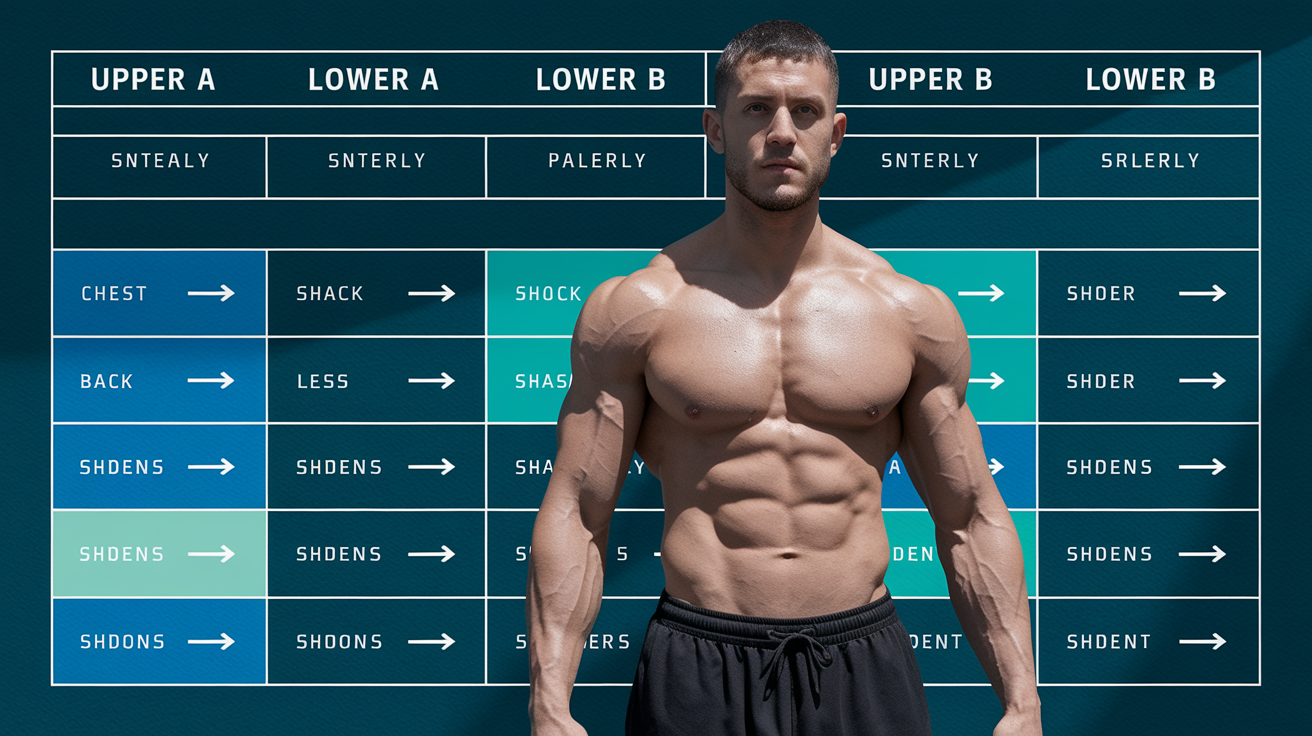
Here’s a simple 4-day upper/lower schedule hitting everything twice:
- Monday – Upper A (chest, back, shoulders, arms)
- Tuesday – Lower A (quads, hamstrings, glutes, calves)
- Wednesday – Rest or light cardio
- Thursday – Upper B (same muscles, different exercises or rep ranges)
- Friday – Lower B (same muscles, different exercises or rep ranges)
- Saturday – Rest or active recovery
- Sunday – Rest or active recovery
Got only 3 days? Full body works. Got 5 or 6? Add a third upper or lower session to hit weak spots. The key is consistent frequency without overwhelming any single session.
This gives each muscle 48 to 72 hours between sessions, which matters even more when you’re underfed. Two quality exposures weekly instead of one massive day that wrecks you for a week. Consistency protects muscle and keeps your metabolism higher while you’re losing weight.
Strength Training Principles that Support a Weekly Split for Fat Loss and Muscle Preservation

Muscle sticks around when it experiences mechanical tension regularly. Progressive overload (a bit more weight, another rep, an extra set over time) tells your body that muscle tissue is still necessary. Without that signal, your body treats muscle as optional during a calorie deficit and burns it for energy.
Rep ranges between 8 and 15 work well for fat loss phases. Lower reps (1 to 5) build strength but don’t always create enough metabolic stress or time under tension. Higher reps (20+) have their place for some isolation work. But most of your effort should land in that 8 to 15 window where you build tension, manage fatigue, and rack up enough volume without destroying recovery.
Weekly set totals matter more than single-session heroics. Shoot for 10 to 20 sets per muscle group spread across the week. Going beyond 20 sets for one muscle can work if you’re advanced with years of training and solid recovery habits. Most people in a caloric deficit will see better results staying in the 10 to 15 range per muscle. Quality beats quantity when energy’s limited.
The best exercises for fat loss and muscle retention are multi-joint movements recruiting large amounts of muscle:
- Back squat or front squat
- Deadlift or Romanian deadlift
- Barbell or dumbbell bench press
- Barbell or dumbbell row
- Overhead press
These lifts burn more calories per set, challenge multiple muscle groups at once, and give you the most bang for your limited energy. Add isolation moves like curls, tricep extensions, or calf raises after the big lifts to round things out. But don’t skip the compounds.
Comparing Weekly Strength Training Splits for Fat Loss and Lean Muscle Maintenance
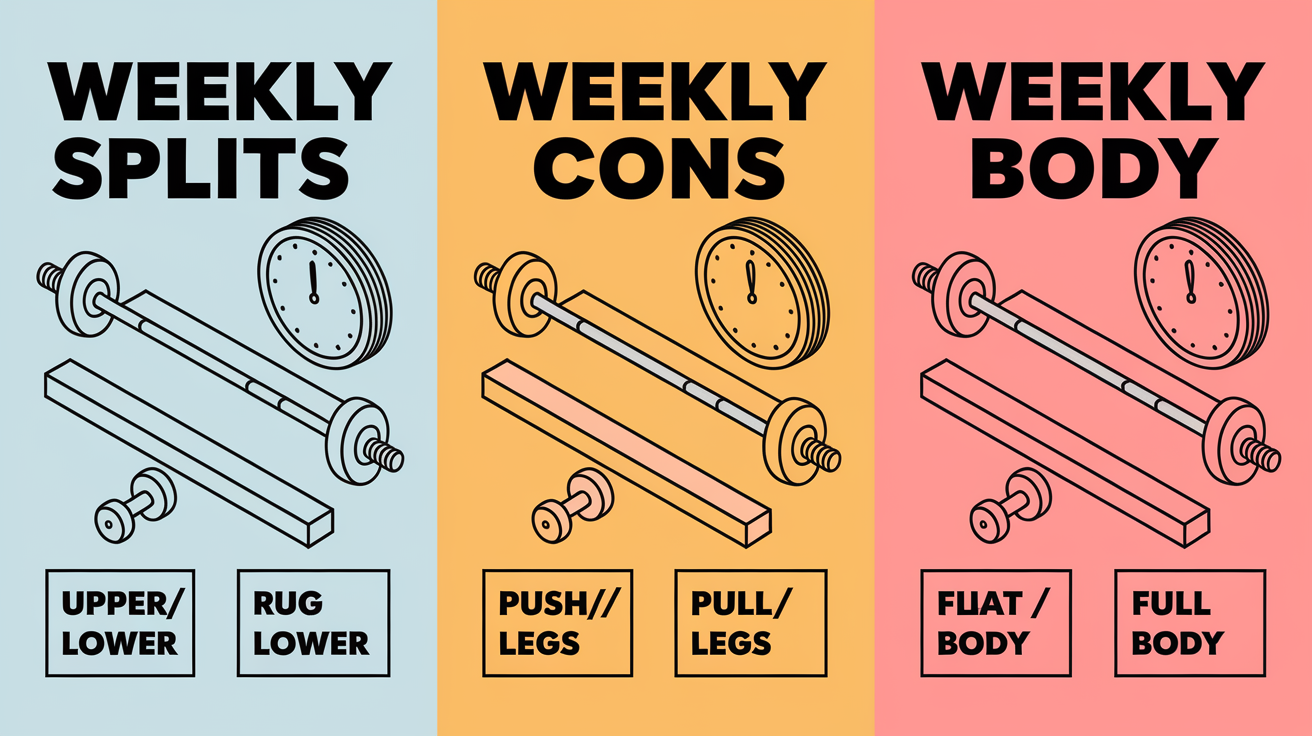
Different splits organize your training week in different ways. Some work better than others when your goal is losing fat without losing muscle. The right choice depends on how many days you can train, how long you’ve been lifting, and how well you recover when calories are lower.
Upper/Lower Split
This split separates your week into upper body days (chest, back, shoulders, arms) and lower body days (quads, hamstrings, glutes, calves). You alternate between them throughout the week.
Pros: Trains each muscle group 2 to 3 times per week, fits 4 to 6 training days, allows 48 to 72 hours recovery between hitting the same muscle group.
Cons: Lower body sessions can be demanding when you’re underfed. Requires good exercise variety to avoid boredom.
Best weekly frequency: 4 to 6 days (most common is 4 days).
Push/Pull/Legs Split
Push day trains quads, chest, shoulders, triceps, and calves. Pull day trains glutes, back, hamstrings, biceps, and traps. Legs day can be folded into push and pull, or stand alone if you run a true 3-day cycle.
Pros: Movement-based grouping feels natural, high training frequency when run 6 days per week, excellent for intermediate to advanced lifters.
Cons: Requires 6 days weekly to hit each muscle twice. Can be too much volume during aggressive fat loss for some people.
Best weekly frequency: 6 days (or 4 to 5 days with modified rotation).
Full Body Training Split
Every session trains your entire body with 5 to 7 exercises. You pick one movement per major pattern (squat, hinge, push, pull, carry or core).
Pros: Perfect for 3 training days per week, high frequency per muscle, time efficient, great for beginners or people with unpredictable schedules.
Cons: Hard to accumulate very high volume per muscle in one session without the workout becoming too long.
Best weekly frequency: 3 to 4 days.
Bro splits (chest Monday, back Tuesday, shoulders Wednesday, legs Thursday, arms Friday) and Arnold splits (chest/back, shoulders/arms, legs, repeat) train most muscles only once per week. That low frequency makes them less effective for muscle retention during fat loss. You’d need to pack 15+ hard sets into one session, and by set 12 your performance is already dropping. Twice-weekly frequency with moderate session volume beats once-weekly with high volume every time when you’re trying to hold onto muscle in a deficit.
A Weekly Upper/Lower Split for Fat Loss and Muscle Preservation (4-, 5-, and 6-Day Templates)

The upper/lower split is the best all-around choice for most people. It’s flexible, recovery-friendly, and easy to progress. It fits into 4, 5, or 6 training days without requiring perfect weekly scheduling, and it lets you train each muscle 2 to 3 times with manageable session lengths.
Here are three versions of the same split:
4-day option: Upper A (Monday), Lower A (Tuesday), rest Wednesday, Upper B (Thursday), Lower B (Friday), rest weekend.
5-day option: Add a third upper day (Saturday) if your upper body lags, or a third lower day if legs are a weak point.
6-day option: Upper A (Monday), Lower A (Tuesday), Upper B (Wednesday), Lower B (Thursday), Upper C (Friday), Lower C (Saturday), rest Sunday.
| Day | Muscle Group | Rep Range Target |
|---|---|---|
| Monday | Upper A (chest, back, shoulders, arms) | 8–10 reps |
| Tuesday | Lower A (quads, hamstrings, glutes, calves) | 8–10 reps |
| Thursday | Upper B (chest, back, shoulders, arms) | 12–15 reps |
| Friday | Lower B (quads, hamstrings, glutes, calves) | 12–15 reps |
Recovery demands go up when calories drop. You’ve got less fuel for training, less fuel for rebuilding tissue, and daily stress still piles on. Giving each muscle group 2 to 3 full days between exposures keeps you fresh enough to train hard without digging a hole you can’t climb out of. If you start feeling run down or your performance drops week after week, pull back to 4 days and take a hard look at your calorie intake and sleep quality.
Exercise Selection for a Weekly Strength Training Split Targeting Fat Loss and Muscle Retention

Compound exercises should make up the bulk of your training volume during fat loss. These multi-joint movements recruit the most muscle, burn the most calories, and create the strongest signal for your body to keep that muscle tissue. Isolation exercises still have a place, but they come second.
Start each session with one or two big lifts that let you move heavy loads through a full range of motion. For upper days, that’s bench press variations, rows, or overhead presses. For lower days, squats, deadlifts, lunges, or leg press. These movements give you the most return per set and protect the muscle groups that matter most for your metabolism and appearance.
After your main lifts, add 2 to 4 assistance exercises. Isolation work like dumbbell curls, tricep pushdowns, lateral raises, hamstring curls, and calf raises fills gaps and adds volume without piling on huge fatigue. Think of these as fine-tuning, not the foundation.
Here are the movements that should show up in most weekly splits:
- Back squat, front squat, or hack squat
- Romanian deadlift, conventional deadlift, or trap bar deadlift
- Barbell bench press or dumbbell bench press (flat or incline)
- Barbell row, dumbbell row, or cable row
- Overhead press (barbell or dumbbell)
- Lat pulldown or pull-up
- Leg press or lunge variations
- Hamstring curl (lying or seated)
Alternate your rep ranges between sessions to manage fatigue and stimulate muscle in different ways. Use 8 to 10 reps on your first upper and lower days (Monday and Tuesday in the example), then switch to 12 to 15 reps on your second sessions (Thursday and Friday). Heavier days build strength, lighter days add volume and let you recover a bit while still training hard.
Weekly Recovery Structure to Support a Strength Training Split During Fat Loss

Recovery is where your body rebuilds muscle, refills energy stores, and adapts to training. When you’re in a calorie deficit, all of those processes slow down because you’re giving your body less fuel to work with. That makes structured rest days even more important than they are during a bulk or maintenance phase.
Your central nervous system (CNS) manages every hard contraction you produce in the gym. Training frequently without enough rest between sessions drains your CNS faster than your muscles can repair. You’ll notice it as sluggish performance, trouble concentrating, poor motivation, or feeling weaker even though you haven’t changed your program. Scheduling 2 to 3 full rest days per week (or at least 1 full rest day plus 1 active recovery day) keeps your CNS fresh and your muscles ready to work hard.
Follow these recovery guidelines every week:
Take at least one full rest day with no structured exercise (walking is fine). Include one active recovery day with 20 to 30 minutes of low-intensity movement like walking, stretching, or foam rolling. Sleep 7 to 9 hours per night. Muscle repair happens mostly during deep sleep. If soreness lasts more than 48 hours or you can’t match last week’s performance, add another rest day before your next session.
Nutrition Elements That Support a Weekly Strength Training Split for Fat Loss and Muscle Preservation

Training sends the signal to keep muscle. Nutrition provides the raw materials to actually do it. You can design the perfect split, but if your protein’s too low or your deficit’s too aggressive, you’ll still lose muscle alongside fat.
Protein intake should sit between 0.7 and 1 gram per pound of body weight daily during fat loss. That range supports muscle protein synthesis even when total calories are down. Spread that protein across 3 to 5 meals instead of loading it all into one or two. Your body can only use so much protein per meal for muscle repair, and steady intake throughout the day keeps muscle protein synthesis elevated.
Carbohydrates fuel your training sessions and help you recover afterward. Timing most of your carbs around your workouts (1 to 2 hours before and within 2 hours after) gives you better performance and faster glycogen refill without needing huge carb totals for the day. Fats support hormone production and overall health, so don’t cut them too low. Aim for 20 to 30 percent of total calories from fat as a baseline.
Here’s what to focus on each week:
Protein amount: 0.7 to 1 gram per pound of body weight daily, every day, no exceptions.
Carb timing: Place 40 to 60 grams of carbs in the meal before your workout and another 40 to 60 grams in the meal after.
Hydration: Drink at least half your body weight in ounces of water daily. More if you sweat heavily or train in heat.
Recovery nutrition: Eat a meal with 20 to 40 grams of protein and 30 to 50 grams of carbs within 2 hours post-workout to kickstart repair and refill energy.
Final Words
In the action, you learned a clear weekly roadmap: why twice-weekly muscle hits protect mass, how full-body and upper/lower splits fit different schedules, and example 3–6 day templates you can use this week.
We covered sets and rep ranges, key compound lifts, recovery signs, and the nutrition basics that help preserve muscle while losing fat.
Pick a plan, aim for 10+ sets per muscle weekly, and stay consistent with the weekly strength training split for fat loss and muscle preservation. You’ve got this.
FAQ
Q: What is the 3-3-3 rule for fat loss? / What is the 3-3-3 rule gym?
A: The 3-3-3 rule for fat loss in the gym usually means three compound exercises, three sets each, done three times per week—simple strength work that helps preserve muscle and raise calorie burn.
Q: What is the best workout split to build muscle and lose fat?
A: The best workout split to build muscle and lose fat is a full-body (3 days) or upper/lower (4 days) plan that hits each muscle twice weekly, giving about 10+ sets per muscle and solid recovery.
Q: Can you build muscle and lose fat and stay the same weight?
A: You can build muscle and lose fat while weight stays the same; body composition shifts. Prioritize protein, resistance training, modest calorie change or maintenance, and track measurements and strength.