

Can four minutes of exercise actually beat an hour at the gym?
Tabata is a four-minute, high-intensity protocol: 20 seconds all-out, 10 seconds rest, repeated eight times.
It pushes your heart and muscles into near-max effort so you get a big training effect in a tiny time slot.
In this post I’ll break down the exact structure, the science behind it, real benefits, safe setup, and easy exercises you can start now.
If your week is busy, Tabata gives a practical, time-efficient way to train without guesswork.
Clear Breakdown of the Tabata Workout Structure

Tabata is a four-minute protocol built on 20 seconds of all-out work followed by 10 seconds of rest, repeated eight times. The method expects near-maximal intensity during every work interval. By round three or four, you should feel breathless and unable to talk. That short rest is intentional. It’s not enough time to recover fully, so your heart rate stays high and your muscles keep working under fatigue.
A single Tabata set lasts exactly four minutes. You can use those four minutes when you’re short on time, or stack multiple sets with breaks in between for a longer session. A typical full workout includes a warm-up of five to ten minutes, one to six Tabata sets, and a cool-down of five to ten minutes, bringing total time to around 15 to 30 minutes.
Your heart rate will climb into zone four or five during the work intervals. That means you’ll hit 80 to 100 percent of your max heart rate. The work-to-rest ratio is locked at two-to-one. That rigid structure separates Tabata from other interval formats and defines its intensity signature.
The core rules:
- Each work interval is 20 seconds at near-maximal effort.
- Each rest interval is 10 seconds with no movement or very slow active recovery.
- You complete eight consecutive rounds without pause beyond the 10-second rests.
- The entire set takes four minutes from start to finish.
Origins and Scientific Basis of the Tabata Workout Method

The protocol comes from a 1996 study conducted by Dr. Izumi Tabata and a team of researchers working with Japanese speed skaters. The original goal was to compare high-intensity interval training with steady-state moderate exercise to see which method improved both aerobic and anaerobic systems more effectively. What they found changed how coaches and athletes thought about short, intense training blocks.
Over six weeks, one group trained at moderate intensity for one hour, five times per week, totaling 1,800 minutes of training. The Tabata group trained for four minutes per session, four times per week, totaling just 120 minutes. Both groups improved aerobic capacity, but the Tabata group saw a 15 percent increase in VO2 max and a 28 percent increase in anaerobic capacity. The moderate-intensity group showed no anaerobic improvement.
| Group | Training Volume (6 weeks) | VO2 Max Change | Anaerobic Capacity Change |
|---|---|---|---|
| Tabata (HIIT) | 120 minutes | +15% | +28% |
| Moderate Intensity | 1,800 minutes | Increased | No change |
That study established the protocol’s credibility. It showed that maximal-intensity intervals with minimal rest can produce dual-system training effects in a fraction of the time required by traditional endurance work.
Benefits of Tabata Workouts for Health and Fitness

Tabata training delivers measurable improvements in both aerobic and anaerobic systems, often in less time than traditional cardio. The repeated bursts of near-maximal effort followed by short rests create a metabolic demand that continues even after the session ends. That post-exercise oxygen consumption effect, known as EPOC, means your body keeps burning calories at a higher rate for hours after you finish.
Because the rest intervals are so brief, your muscles don’t fully recover between rounds. That incomplete recovery forces your cardiovascular system to work harder and builds muscular endurance by repeatedly taxing the same muscle groups under fatigue. The result is improved lactate tolerance, faster recovery between high-intensity efforts, and greater power output over time.
Key benefits:
- Increases VO2 max, which measures your body’s ability to use oxygen during intense exercise.
- Boosts anaerobic capacity, improving performance in short, explosive activities.
- Burns a high number of calories in a short period due to maximal effort and elevated heart rate.
- Elevates post-exercise oxygen consumption, extending calorie burn after the workout.
- Builds muscular endurance by forcing repeated high-intensity contractions with limited rest.
- Provides time-efficient training, with meaningful stimulus delivered in as little as four minutes.
Even a single four-minute Tabata can stimulate training adaptations when performed at true maximal intensity. That makes it practical for days when your schedule is packed but you still want a structured, effective workout.
How to Perform a Tabata Workout Safely and Effectively

Start every Tabata session with a five- to ten-minute warm-up that includes dynamic movement and raises your heart rate gradually. Jumping jacks, leg swings, arm circles, and light jogging all prepare your muscles and cardiovascular system for the sudden spike in intensity. Skipping the warm-up increases injury risk and reduces your ability to hit true maximal effort during the work intervals.
The four-minute Tabata block itself should be performed with full commitment. That means going as hard as you can sustain for the full 20 seconds, not holding back to pace yourself across all eight rounds. Yes, you’ll slow down as fatigue builds. That’s expected. But each interval should still feel like an all-out push. Use the 10-second rest to breathe deeply and reset your position, but don’t sit down or stop moving entirely unless you’re dizzy or unsafe.
After completing one or more Tabata sets, cool down for five to ten minutes with slow walking, light stretching, or foam rolling. Your heart rate will still be elevated, and your muscles will be flooded with metabolic byproducts. A proper cool-down helps clear lactate, reduces muscle soreness, and brings your heart rate back to baseline safely. Don’t skip this step, even when you’re short on time.
Technique-focused rules for effective execution:
- Warm up for at least five minutes with dynamic movement before starting your first interval.
- Commit to near-maximal effort during each 20-second work interval, even as fatigue builds.
- Use the 10-second rest to catch your breath and reset form, not to walk away or sit down.
- Maintain proper exercise form throughout every round to reduce injury risk under fatigue.
- Cool down for five to ten minutes after your last Tabata set to support recovery and lower heart rate safely.
Intensity Targets and Monitoring
You want to reach 80 to 95 percent of your maximum heart rate during the work intervals. You can estimate your max heart rate using 220 minus your age, though individual variation exists. If you don’t have a heart-rate monitor, use rate of perceived exertion. On a scale of one to ten, your effort during the 20-second bursts should feel like an eight or nine. You shouldn’t be able to hold a conversation, and breathing should be heavy and fast.
Comparing Tabata Workouts with Traditional HIIT
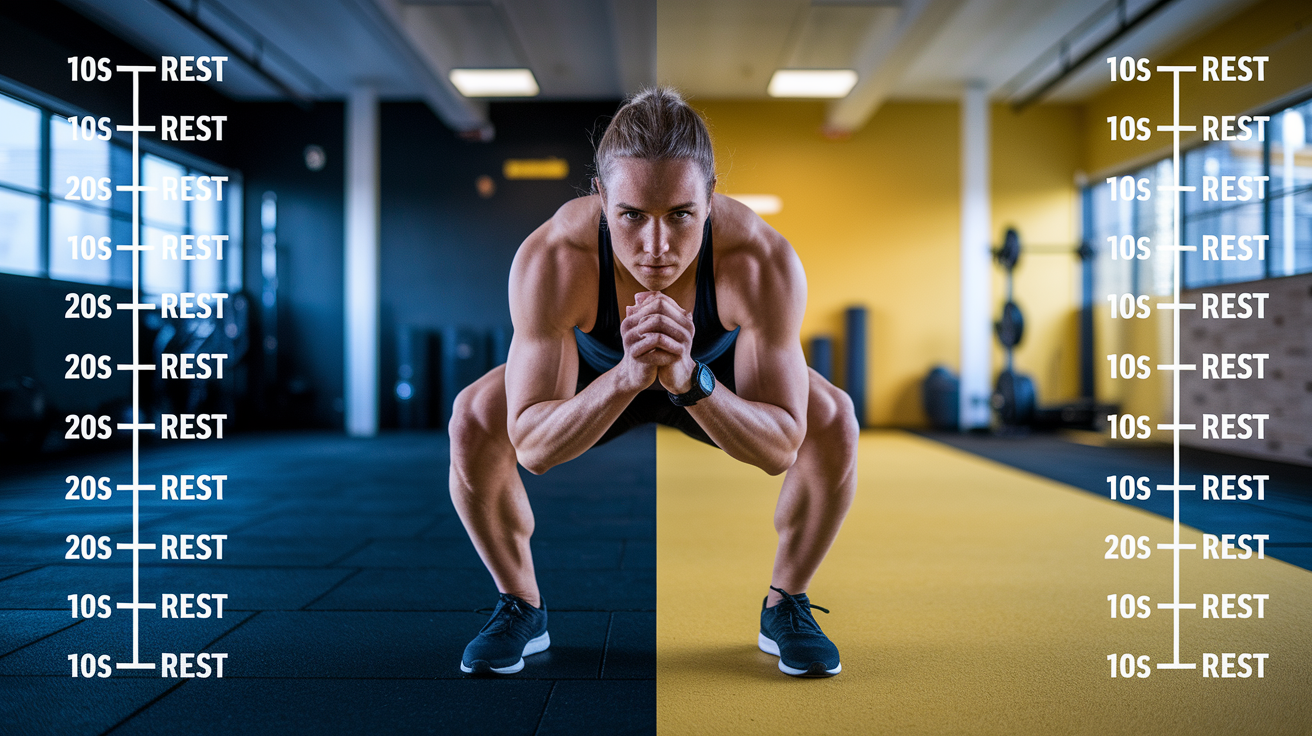
Tabata is a specific type of high-intensity interval training, not a synonym for HIIT in general. The defining feature of Tabata is its rigid 20-second work, 10-second rest structure repeated eight times. Other HIIT protocols vary widely. You might see 30 seconds on and 30 seconds off, 40 seconds on and 20 seconds off, or even one-minute intervals with two-minute rests. Those are all HIIT, but they’re not Tabata.
The intensity demand also differs. Tabata requires near-maximal effort in every round, which is why the rest is so short and the total duration is just four minutes. Many HIIT workouts use high but submaximal effort with longer work intervals and more generous rest periods. That makes them sustainable for 20 to 40 minutes of total work time. Tabata, by contrast, is short and brutal by design.
Key differences between Tabata and other training methods:
- Tabata uses a fixed 20/10 structure, general HIIT allows flexible interval lengths and ratios.
- Tabata demands near-max intensity every round, other HIIT formats may use high but sustainable pacing.
- Steady-state cardio maintains moderate effort continuously and doesn’t spike heart rate or challenge anaerobic systems the way Tabata does.
- Tabata sessions are shorter overall but require higher peak output and mental commitment per minute of work.
Exercises that Work Best in Tabata Workouts

The best Tabata exercises allow you to move explosively and safely for the full 20 seconds without complicated setup or high technical demand. Bodyweight moves like burpees, jump squats, mountain climbers, and push-ups work well because you can perform them anywhere and transition quickly between rounds. Plyometric exercises such as tuck jumps, box jumps, and alternating jump lunges fit the protocol’s intensity, but only if your joints and coordination can handle the impact under fatigue.
Exercise categories:
Bodyweight: burpees, push-ups, squat jumps, mountain climbers, high knees, plank jacks
Plyometrics: box jumps, tuck jumps, lateral bounds, froggers, alternating jump lunges
Cardio machines: sprints on treadmill, all-out rowing intervals, cycling at maximum resistance or speed
Kettlebell: kettlebell swings, goblet squat pulses, single-arm snatches (use lighter weight for speed)
Dumbbell: dumbbell thrusters, renegade rows, overhead presses, walking lunges with weights
Core-focused: bicycle crunches, Russian twists, plank with leg raises, hollow holds, side plank with hip dips
Upper/lower split: combine push-ups and tricep dips for upper body, pair squat jumps and reverse lunges for lower body
If you’re using weights, go lighter than your usual strength-training load. The goal is to maintain explosive speed and full range of motion for 20 seconds, not to grind through heavy reps. Proper form under fatigue matters more than the number you move.
Sample Tabata Workout Plans for Different Fitness Levels
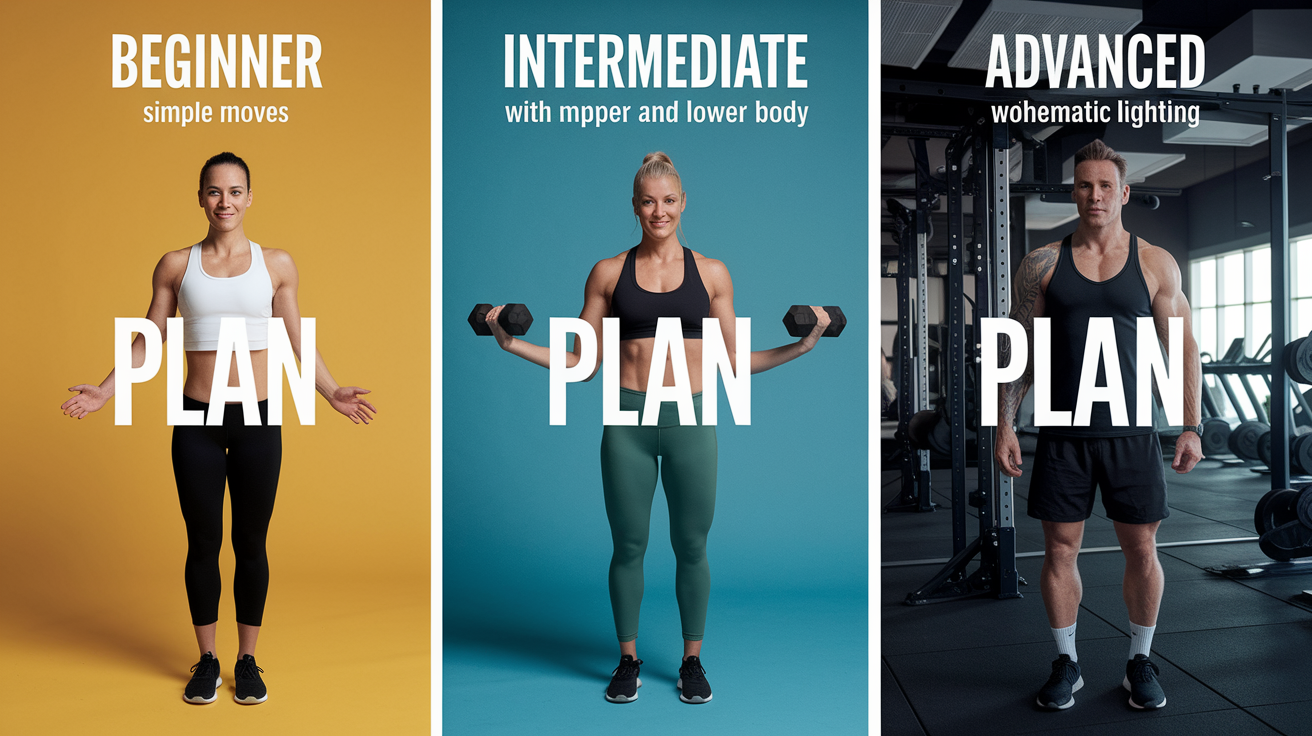
Beginner Workout
Start with one or two Tabata sets using simple, low-impact movements. Focus on learning the timing and building your ability to sustain effort without stopping mid-interval. You can rest for two to three minutes between sets while you build conditioning. If 10 seconds of rest feels too short, extend it to 15 or 20 seconds for the first few weeks, then gradually work down to the standard protocol.
Sample beginner exercises (choose one per set):
- Bodyweight squats (no jump)
- Modified push-ups (on knees or against a wall)
- Step-back lunges (alternating legs, no jump)
- Plank hold (drop to knees if needed)
Intermediate Full-Body Workout
Use two to four Tabata sets with one to two minutes of rest between sets. Mix upper-body, lower-body, and cardio moves to spread fatigue across muscle groups. You should be able to complete all eight rounds of each set, though your speed and power will drop as you progress through the intervals.
Sample intermediate exercises (rotate across sets):
- Burpees (full or step-back version)
- Jump squats
- Mountain climbers
- Push-ups (full range)
Advanced Equipment Workout
Incorporate cardio machines or weighted implements for three to six Tabata sets. Allow one to three minutes of rest between sets depending on the movement. Machines like rowers, bikes, and treadmills let you measure power output or speed, which helps you track whether you’re truly hitting maximal effort each round.
Sample advanced exercises:
- Treadmill: 20-second sprint at near-max speed, 10-second recovery walk or stand on rails
- Rowing machine: 20-second all-out row, 10-second rest with light grip on handle
- Kettlebell swings: explosive hip drive with moderate weight
- Dumbbell thrusters: squat to overhead press, light to moderate weight
How to Program Tabata in a Weekly Training Schedule

Tabata sessions are high-stress by design, so they shouldn’t be your only form of training or happen every day. Most people do well with one to three Tabata workouts per week, spaced at least 24 hours apart to allow full recovery. On non-Tabata days, you can train strength, practice skills, do low-intensity steady cardio, or work on mobility and flexibility.
If you’re combining Tabata with strength training, schedule them on separate days or place the Tabata session after your strength work. Doing a maximal-intensity interval session before heavy lifting will compromise your power output and increase injury risk under the bar. When Tabata is your only workout that day, keep the total session under 30 minutes including warm-up and cool-down.
| Day | Focus | Notes |
|---|---|---|
| Monday | Strength training (upper body) | Full session, moderate volume |
| Tuesday | Tabata (lower-body focus) | 2–3 sets, 1–2 min rest between |
| Wednesday | Active recovery or rest | Walk, yoga, or full rest day |
| Thursday | Strength training (lower body) | Full session, moderate volume |
| Friday | Tabata (full-body or cardio) | 2–4 sets, machine-based if available |
| Saturday | Low-intensity cardio or mobility | 30–45 min walk, stretching, or swim |
| Sunday | Rest | Full recovery |
Watch for signs of overtraining if you’re doing Tabata frequently. Elevated resting heart rate, persistent muscle soreness, trouble sleeping, irritability, and declining performance in your intervals all suggest you need more recovery time. If those symptoms show up, drop one Tabata session that week or replace it with a low-intensity alternative.
Safety, Modifications, and Who Tabata Is (and Isn’t) For

Tabata is built for people who already have a solid cardiovascular base and can handle high-impact, high-intensity movement safely. If you’re new to exercise, haven’t worked out consistently in months, or have uncontrolled cardiovascular conditions like hypertension or arrhythmia, Tabata is not the place to start. Build your aerobic fitness with moderate-intensity cardio first, then progress to shorter, less intense intervals before attempting true Tabata protocols.
People with joint pain, previous injuries, or movement limitations can still use the Tabata structure, but they need to swap high-impact exercises for lower-impact alternatives. For example, replace jump squats with bodyweight squats or step-back lunges. Swap burpees for mountain climbers or plank shoulder taps. The 20-second work, 10-second rest timing stays the same. You’re just choosing movements that let you push hard without aggravating old injuries or creating new ones.
Pregnant or postpartum individuals should avoid maximal-effort intervals and high-impact plyometrics unless cleared by a healthcare provider. The hormonal and structural changes during and after pregnancy increase joint laxity and shift your center of gravity, which raises injury risk during explosive movements. Lower-impact variations with extended rest periods are safer options if you want to keep training.
Population-specific modifications:
Seniors: use low-impact moves like marching in place, seated punches, or resistance-band pulls, extend rest to 15–20 seconds.
Joint pain or arthritis: choose non-impact exercises like cycling, rowing, or resistance-band work, avoid jumps and hard landings.
Pregnancy: skip plyometrics and supine exercises after the first trimester, focus on controlled squats, modified planks, and upper-body movements.
Postpartum recovery: wait until cleared for exercise, start with pelvic-floor-safe moves and avoid high-impact or maximal-effort intervals early on.
Rehab clients: consult a physical therapist, use Tabata timing with therapeutic exercises at submaximal intensity to rebuild conditioning safely.
Absolute beginners: build a cardio base with 20–30 minutes of moderate walking or cycling three times per week before attempting Tabata intervals.
When to Avoid Tabata
Do not perform Tabata if you have uncontrolled high blood pressure, a recent cardiac event, unstable angina, or any condition where sudden spikes in heart rate pose a health risk. If you’re unsure whether high-intensity intervals are safe for you, get medical clearance before starting. Also skip Tabata on days when you’re dealing with acute illness, severe muscle soreness, or any symptom that suggests your body needs rest instead of maximal effort.
Final Words
You learned the Tabata formula: 20 seconds on, 10 seconds off, eight rounds for a four-minute block. We covered the origin, the science, the benefits, session structure, exercises, programming, and safety tips.
Use it safely: warm up, watch form, monitor intensity, and keep Tabata to 1–3 sessions per week. Pick moves that let you go hard without risking injury.
If you still wonder what is tabata workout, it’s a quick, effective high-intensity block you can slot into a 15–30 minute session. Try one 4-minute set this week and see how it fits your routine.
FAQ
Q: Is Tabata good for weight loss?
A: Tabata is good for weight loss because it delivers high calorie burn and raises post‑exercise metabolism in short sessions. Pair it with a calorie‑aware diet and proper recovery; don’t do it every day.
Q: What is the difference between HIIT and Tabata?
A: The difference between HIIT and Tabata is that Tabata is a fixed 20‑second work / 10‑second rest ×8 protocol requiring near‑max effort, while HIIT is a broader category with varied intervals and intensities.
Q: What are the disadvantages of Tabata?
A: The disadvantages of Tabata are its very high intensity, increased injury risk if form slips, poor fit for beginners or those with cardiac issues, and limited strength gains without added resistance.
Q: What is the 3-3-3 rule for workout?
A: The 3-3-3 rule for workout is a simple progression guideline: do three sessions per week, three rounds or sets per session, for three weeks to build consistency before increasing intensity or volume.