

Tired of starting strong and fading by week two?
A simple weekly habit checklist fixes that.
It shows exactly what you planned, what you did, and where things fell apart.
Takes two minutes to review your week and less than 30 seconds to check a session.
Use it to set realistic sessions, rate intensity, and pick one small change for next week.
This template makes planning and adjusting automatic so exercise becomes something you do most weeks, not something you debate every day.
Weekly Exercise Checklist Template (Immediately Usable)

A simple checklist gets rid of the guesswork. You’ll see exactly what you planned, what you did, and where things fell apart. Takes maybe two minutes to review your whole week. Less than 30 seconds to check off a session. Use this to stay consistent without second-guessing every workout.
| Day | Planned Activity | Duration (min) | Intensity (1-10) | Completed? |
|---|---|---|---|---|
| Monday | ||||
| Tuesday | ||||
| Wednesday | ||||
| Thursday | ||||
| Friday | ||||
| Saturday | ||||
| Sunday |
How to actually use it:
Start of the week, fill in what you’re planning. Write the type (strength, walk, yoga) and how long you’re aiming for.
Before bed, mark if you did it. If you swapped something in, write what you actually did instead.
Rate your intensity on a 1 to 10 scale. A 5 feels moderate. An 8 feels hard but doable.
Sunday night or Monday morning, review the week. Count how many you finished.
Adjust next week based on what worked and what didn’t. If you only hit two sessions, shoot for three next week instead of jumping to five.
How to Use the Weekly Checklist for Sustainable Progress

Look at your checklist each morning or the night before. Seeing what’s planned removes that “what should I do today” spiral. When you finish the session, check the box right away. That tiny action builds the habit loop and gives you proof you’re moving forward.
End of the week, add up your completed sessions and total minutes. Compare that to your target. If you planned four and hit three, that’s not failure. That’s useful information about what your real schedule can handle right now.
Steps for your weekly review:
Count completed sessions and total minutes. Jot those numbers at the bottom.
Look for patterns. Same day always skipped? Evening workouts never happen?
Pick one small thing to change. Move a session to a different day, or cut the target from 40 minutes to 25.
Set next week’s plan based on what actually happened, not what you hoped would happen. Realistic beats optimistic when you’re building a habit.
Building Sustainable Exercise Habits

Habits form when a cue triggers a routine that gives you a reward. Your cue can be a time (7 a.m.), a spot (your home gym corner), or something you already do (right after coffee). The routine is your workout. The reward is checking the box, feeling energized, or just keeping your word to yourself. String these loops together over weeks and it starts to feel automatic. Eventually it’s less of a decision and more just what you do on Tuesday mornings.
Motivation gets you started. Consistency keeps you going.
Motivation is unreliable. It shows up and disappears with stress, sleep quality, and your mood on any given day. Consistency doesn’t wait around for motivation. It shows up because the plan says so. A checklist makes the expectation visible and trackable. When you see a blank checkbox, doing a short session feels easier than breaking a streak.
Set up your environment so the routine is easier. Lay out your workout clothes the night before. Keep your resistance band next to the coffee maker. Planning to walk after dinner? Put your shoes by the door. Every bit of friction you remove makes follow-through more likely. Your environment either works for you or against you. Make the default path the one that moves you forward.
Weekly Planning Strategies for a Balanced Routine
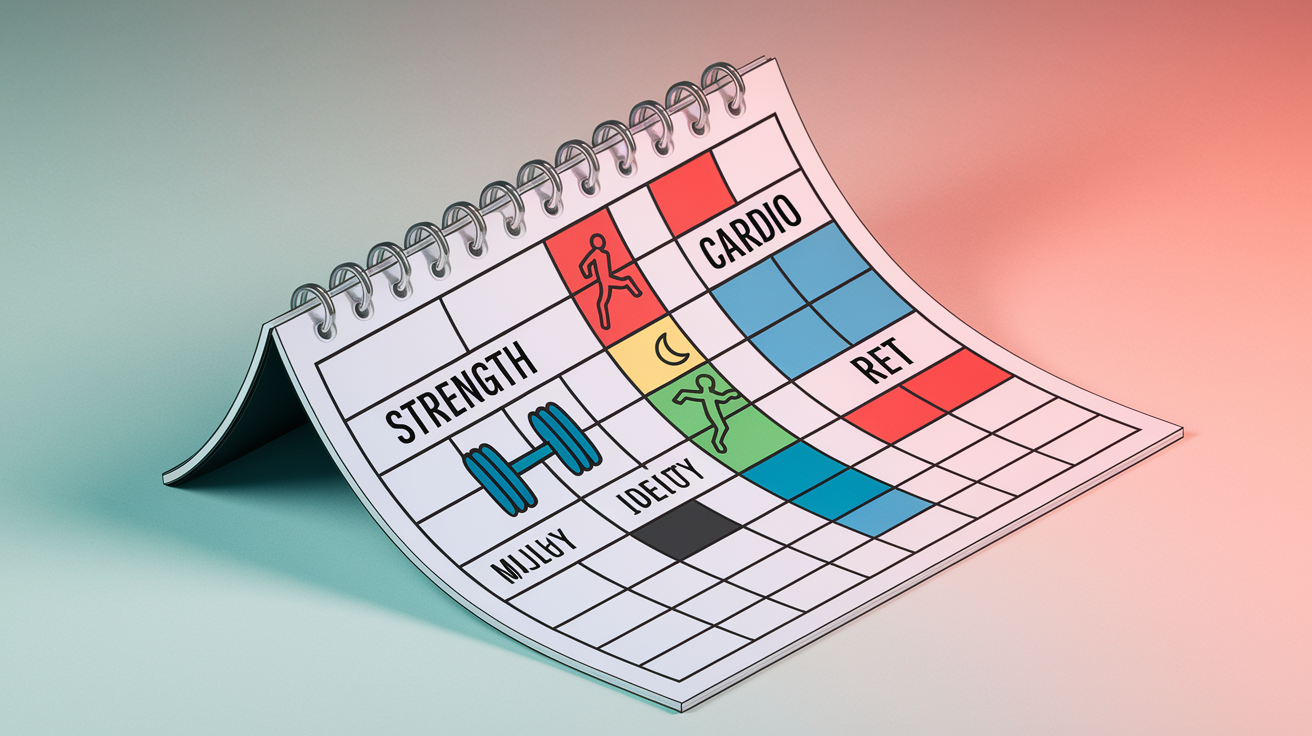
A balanced week covers multiple movement types without overloading anything. Planning ahead lets you spot if you’re skipping strength three weeks straight or stacking hard sessions with zero recovery. A basic structure might be two or three strength days, a couple cardio sessions, some mobility blocks, and at least one full rest day.
What a balanced week looks like:
Strength training two to four days, spaced out so muscles recover between sessions.
Cardio two to three times per week. Mix steady efforts with some interval work when you can.
Mobility or flexibility three to seven days, even if it’s just five to ten minutes.
At least one full rest day with nothing structured. Maybe add an optional active recovery day like a light walk or easy stretching.
Variety in intensity. Not every session should feel maximal. Mix moderate days with one or two harder pushes per week.
A weekly total around 150 minutes of moderate activity or 75 minutes of vigorous work if general health is your goal. Adjust based on where you’re starting from.
Customize this to fit your schedule and energy. If you’ve got three reliable windows each week, use them. If you can only commit to two, start there. Add 5 to 10 percent every few weeks. Balanced doesn’t mean identical every week. It means hitting the major categories over time without burning out or skipping recovery.
Common Obstacles and Fixes for Weekly Exercise Habits
Most consistency issues come from the same handful of problems. Spotting the pattern lets you fix the root cause instead of blaming willpower. Small fixes applied week after week solve more than big changes that last two weeks.
| Problem | Cause | Quick Fix |
|---|---|---|
| Skipping sessions repeatedly | Unrealistic schedule or session length | Cut target duration by 30 to 50% and move to a more protected time slot |
| Low energy during workouts | Poor sleep, under-eating, or overtraining | Add one extra rest day, check daily protein intake, aim for 7+ hours sleep |
| Losing motivation after two weeks | No clear short-term goal or visible progress | Set a 4 week micro-goal, track one simple metric weekly, use the checklist to see streaks |
| Inconsistent workout times | No set routine or cue | Pick one consistent time and link the session to an existing habit like morning coffee or lunch break |
| Frequent soreness or minor injuries | Skipping warm-ups, poor form, or insufficient recovery | Add 5 minute dynamic warm-ups, drop load by 10 to 20%, schedule at least one full rest day per week |
When the same obstacle shows up three weeks in a row, treat it as data. Your plan doesn’t match your real life. Adjust the plan, not your expectations of superhuman discipline.
Final Words
Use the checklist this week. The template gives a ready seven-day plan, the how-to section shows simple daily and weekly reviews, habit-building explains cues and environment, planning tips balance strength, cardio and mobility, and the obstacle fixes offer quick solutions.
Start small—fill the table, pick one target, and review it each evening. Adjust the plan on Sunday for the week ahead.
Make a weekly habit checklist for maintaining a sustainable exercise routine by tracking wins and small fixes. Small steps repeat into progress. You’ve got this.
FAQ
Q: What is a weekly exercise checklist and why should I use one?
A: A weekly exercise checklist is a simple plan listing planned activity, duration, intensity, and completion to cut decision fatigue and boost consistency by making choices clear and tracking progress each week.
Q: How do I use the weekly checklist day-to-day?
A: You use the weekly checklist day-to-day by noting planned activity, ticking completed boxes, recording actual duration and intensity, and doing a quick end-of-day review to stay on track and adjust.
Q: What should I track on the checklist?
A: You should track the planned activity, actual duration, intensity, and a completed yes/no; add short notes for energy or soreness to guide tweaks next week.
Q: How often and how should I review and adjust my checklist?
A: You should review briefly each day and do a fuller weekly review, checking what worked, shifting sessions as needed, and choosing one clear tweak for the next week.
Q: How many strength, cardio, and mobility sessions should I plan each week?
A: You should plan strength training 2–4 times, cardio 2–3 times, and mobility most days or at least 3 times weekly, mixing intensity and alternating muscle groups.
Q: How do I build sustainable exercise habits with this checklist?
A: You build sustainable habits by linking workouts to simple cues, starting small, prioritizing consistency over intensity, and shaping your environment so workouts become easier to start.
Q: What can I do if I have limited time or low energy?
A: If time or energy is low, shorten sessions to 10–20 minutes, choose lower intensity or mobility work, and log the session so small wins still count toward your week.
Q: How do I balance workouts to avoid overtraining?
A: You balance workouts by alternating muscle groups, spacing intense sessions with easy or recovery days, and tracking rest and sleep alongside training load.
Q: How do I customize the checklist for my goals and schedule?
A: You customize the checklist by matching session types and frequency to your goal, fitting workouts into realistic time blocks, and scaling duration or intensity to your energy levels.
Q: How does tracking consistency improve long-term progress?
A: Tracking consistency turns vague intentions into measurable habits, reveals patterns to fix, and lets small weekly adjustments compound into meaningful fitness gains.