
Think adding big jumps in weight every week is the fastest way to get stronger?
It feels smart, but that approach stacks fatigue faster than your muscles can adapt and lands you in stalled lifts, nagging aches, and low motivation.
This post shows a simple plan to progress weights without burning out: tiny load increases, smarter options like more reps or slower tempo, tracking recovery, and using deloads and autoregulation to steer your training.
Follow these steps and you’ll build strength more consistently while keeping injuries and overtraining at bay.
Applying Progressive Overload Safely and Effectively

Progressive overload is adding small bits of training stress over time so your muscles get stronger. Your body responds to steady challenges, not wild jumps. When you throw too much weight or volume at yourself in one week, you blow past what your system can adapt to and land straight in fatigue buildup. That’s when injuries show up, your lifts stall, and you stop wanting to train. You want to stress things just enough to spark growth, then back off and let your body do the repair work.
Small bumps work because they give your connective tissue, nervous system, and muscle fibers time to catch up. Tendons and ligaments adapt way slower than muscle does. If you get aggressive with weight jumps, your muscles might survive a session or two, but your joints and recovery systems can’t keep pace. Fatigue stacks up faster than you can clear it. That gap is how overtraining sneaks in. Watching your performance and how you feel between workouts tells you if your body’s keeping up or getting buried.
Staying away from excessive fatigue means matching your progression to what your recovery can handle right now. If sleep’s been rough, stress is high, or soreness won’t clear after 72 hours, your system isn’t ready for another increase. Progress doesn’t move in a straight line week to week. Some weeks you add load, some weeks you stay put, and some weeks you pull back. That rhythm keeps you moving without digging yourself into a hole.
Practical weekly progress guidelines:
- Bump load by 2 to 5% per week on upper body and assistance lifts when recovery feels solid
- Add 5 to 10% per week on lower body compound movements if form stays tight and soreness clears normally
- Add 1 to 2 reps per set each session until you hit your target rep range, then increase weight by 2.5 to 10%
- Toss in one extra set to a lift when volume feels manageable and performance isn’t dropping session to session
- Keep weight the same and clean up form if resting heart rate’s elevated or you’ve been short on sleep for several nights
Methods for Increasing Training Stress Without Overreaching
Adding weight isn’t your only option for pushing progress. When fatigue’s creeping in or your joints feel beat up, switching to a different progression variable keeps training moving without overloading one area.
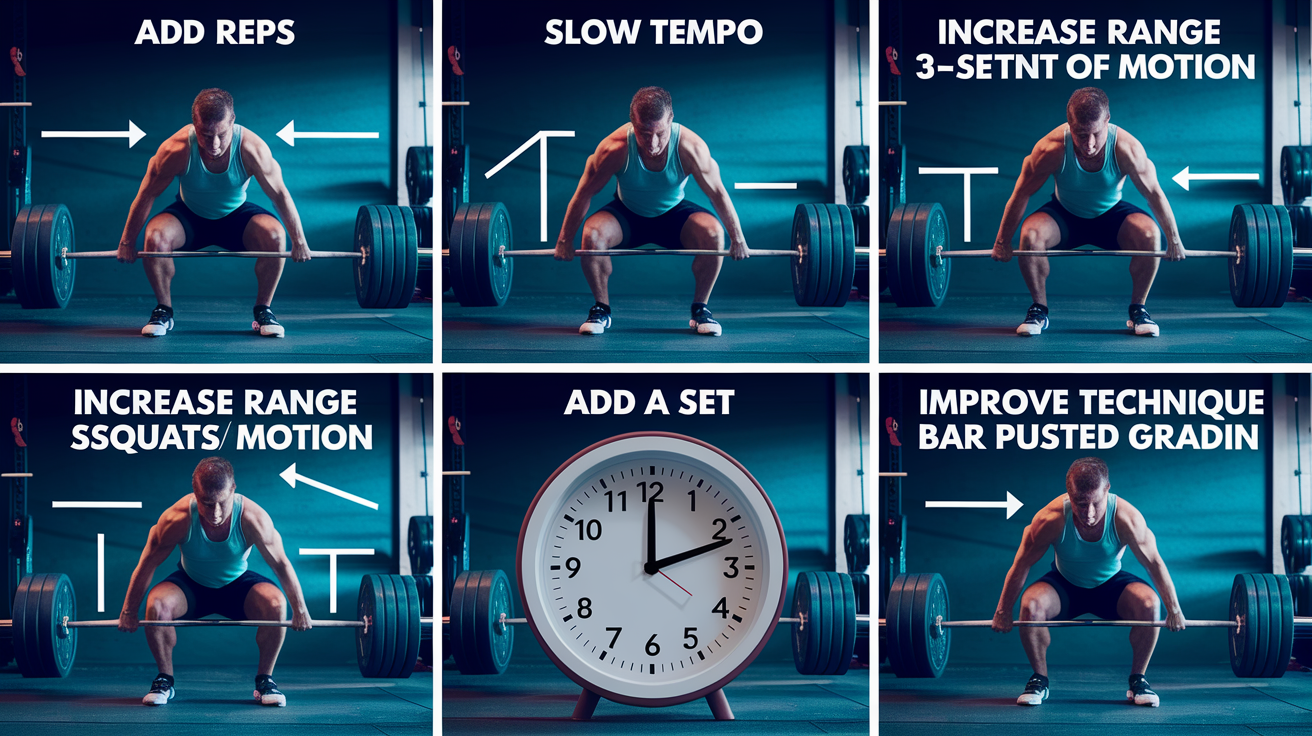
Six progression methods:
- Add reps. Work up from 6 reps to 10 reps at the same weight before you increase load.
- Slow the tempo. Use a 3 second eccentric (the lowering part) to increase time under tension without touching the weight.
- Increase range of motion. Move from partial squats to full depth squats or add deficit work on deadlifts.
- Add a set. Go from 3 sets to 4 sets at the same weight and reps when recovery allows.
- Shorten rest intervals. Drop rest from 3 minutes to 2 minutes between sets to raise metabolic demand.
- Improve technique. Clean up bar path, stabilize your core harder, or control the eccentric better to get more from the same load.
Picking the right variable depends on how you feel that day and that week. If you’re fresh and joints feel solid, adding weight or reps makes sense. If you’re carrying fatigue from a hard block or dealing with minor aches, tempo work or technique refinement keeps you training without digging deeper into your recovery debt. Rotating variables also breaks up monotony and hits different parts of strength and muscle growth. Some weeks you chase heavier loads, some weeks you chase volume or control. Both build capacity when you time them right.
Managing Recovery to Support Sustainable Progress

Recovery isn’t just rest days. It’s tracking the signals your body sends between sessions so you know whether to push or ease off. Sleep quality, resting heart rate, session difficulty, mood shifts, soreness patterns, and how your lifts feel all feed into that picture. When you log these markers, trends show up. A single rough night or sore muscle doesn’t mean much. Three nights of broken sleep, elevated morning heart rate, and workouts that feel way harder than they should? That’s accumulated fatigue talking.
Resting heart rate’s simple to track. Take it first thing in the morning before you get out of bed. If it’s 5 to 10 beats higher than your normal baseline for a few days straight, your nervous system’s under strain. Session RPE (rate of perceived exertion) tells you how hard a workout felt overall, usually on a scale of 1 to 10. If an RPE 7 session suddenly feels like a 9 with no change in load or volume, your recovery tank’s low. Soreness that lingers past 72 hours or keeps coming back in the same spot is another warning sign. Your body repairs muscle damage in about 48 to 72 hours under normal conditions. When soreness hangs around longer, you’re either hitting the same area too often or not giving it enough fuel and rest to heal.
Mood changes and motivation dips are less obvious but just as important. Irritability, low energy, or losing interest in training you normally enjoy can signal central nervous system fatigue. Your brain and nervous system need recovery too. When multiple markers trend the wrong way at once, it’s time to adjust. That might mean skipping a planned progression, taking an extra rest day, or swapping a heavy session for something lighter.
Key daily and weekly recovery metrics:
- Morning resting heart rate compared to baseline (track for trends, not single day spikes)
- Sleep duration and quality (shoot for 7 to 9 hours, note nights below 6 hours)
- Soreness duration and location (recovery should clear most soreness in 48 to 72 hours)
- Session RPE or overall training feel (sudden jumps in perceived difficulty without load changes signal fatigue)
Periodization Models for Long Term Weight Progress

Periodization is how you organize training stress over weeks and months so progress stays steady without burning out. Instead of pushing hard every week until you crash, you plan cycles of harder work, moderate work, and recovery. Different models arrange intensity and volume in different patterns, but they all try to control fatigue while building strength and size.
Linear Periodization
Linear periodization gradually increases intensity while dropping volume over a training block. You might start with higher reps and moderate weight, then shift to lower reps and heavier weight as the weeks roll on. A typical block runs 8 to 12 weeks. Week one might be 3 sets of 12 reps at 65% of your one rep max, and by week eight you’re doing 5 sets of 3 reps at 85%. Volume drops as weight climbs, so fatigue builds slower than if you kept both high. This model works well for beginners because it’s simple to follow and progress is predictable. Fatigue builds gradually, and you deload or reset after the block ends.
Undulating Periodization
Undulating periodization varies intensity and volume within the same week or even session to session. Monday might be heavy triples at 85%, Wednesday could be moderate sets of 8 at 70%, and Friday might be speed work or lighter volume. This variation prevents monotony and spreads fatigue across different systems. Your nervous system gets a break on lighter days while your muscles still get work. It’s a good fit for intermediate lifters who need more variety to keep adapting. Fatigue doesn’t climb in a straight line. Instead, hard days spike it and lighter days let it dip, so you avoid the constant grind of pushing maximum effort every session.
Block Periodization
Block periodization separates training into distinct phases, each with a specific goal. A hypertrophy block might run 4 to 6 weeks with higher volume and moderate intensity to build muscle. Then you shift into a strength block with lower reps and heavier loads for another 4 weeks. A peaking block at the end drops volume further and pushes intensity near your max to express the strength you built. Each block stresses different qualities, and fatigue from one block doesn’t carry into the next if you time recovery right. This model suits advanced lifters or anyone preparing for a competition or testing day. Fatigue peaks at the end of each block, then you deload before starting the next phase.
Deloading and Autoregulation Strategies

Deload weeks give your body a break from accumulated training stress without stopping completely. You cut volume or intensity by 30 to 50% for about a week. That might mean cutting sets in half, dropping weight by 20%, or doing lighter skill work instead of max effort lifts. Deloads let connective tissue recover, clear lingering soreness, and reset your nervous system. Most people deload every 3 to 4 weeks, but the timing depends on how fast fatigue builds. If you’re running a high volume program or training six days a week, you might need a deload every three weeks. If your program’s moderate and you take regular rest days, every four to six weeks works.
Autoregulation adjusts your training load based on how you feel that day. RPE (rate of perceived exertion) and RIR (reps in reserve) are the most common tools. RPE rates how hard a set felt on a scale of 1 to 10. RIR counts how many more reps you could have done before failure. If your program calls for sets at RPE 8 (about 2 reps shy of failure) but today those sets feel like RPE 9 or 10, you back off the weight or cut a set. Autoregulation stops you from grinding through a session when your body isn’t ready. Some days you’re strong and add a rep or a little weight. Other days you’re flat and you hold steady or drop load slightly. Over time, this approach keeps you progressing without pushing into overtraining territory.
Common autoregulation approaches:
- Use daily opener sets at a moderate load to check readiness, then adjust the working weight based on how that set moved
- Set RPE targets for main lifts (example: RPE 7 to 8 on heavy days, RPE 5 to 6 on light days) and match load to feel, not just the written number
- Track RIR for top sets and reduce load by 10 to 20% if RIR drops below 1 on a set where you planned for 2 to 3 reps in reserve
Practical Training Examples for Sustainable Weight Progression

Sample programs show how progression, periodization, and recovery fit together in real weekly plans. These examples aren’t one size fits all, but they show how to layer small load increases, manage fatigue, and adjust when needed.
A beginner running a three day per week full body program might start with squats at 135 pounds for 3 sets of 8 reps. Week one feels manageable at RPE 7. Week two, if recovery looks good (sleep solid, soreness cleared, resting heart rate normal), the lifter adds 5 pounds and hits 140 for 3 sets of 8. Week three, another 5 pounds to 145. By week four, fatigue’s creeping up. Morning heart rate’s a few beats high, and the session RPE jumped to 8.5 even though the load only went up 5 pounds. Instead of adding weight in week four, the lifter holds at 145 and focuses on clean reps and controlled tempo. Week five is a planned deload. Drop to 115 pounds, keep it at 3 sets of 8, move well, and let the body catch up. Week six, start the cycle again at 145 or 150, depending on how the deload felt. This pattern builds strength steadily without grinding into the ground.
An intermediate lifter using undulating periodization across four sessions per week might structure it like this. Monday is heavy squats, 5 sets of 3 at 85% with full rest between sets. Tuesday is moderate bench press, 4 sets of 8 at 70%, lighter and faster. Thursday is a volume deadlift day, 4 sets of 6 at 75%, and Friday is accessory work with higher reps and shorter rest. Load progression happens every two weeks on the heavy day if performance holds. If Monday’s triples at 85% move cleanly with RPE 8, week three bumps to 87%. If sleep was short that week or soreness lingered, the lifter repeats 85% and tries the jump the following cycle. Moderate and volume days don’t push as hard, so fatigue stays distributed. Every fourth week is a deload. Heavy day drops to 3 sets of 3 at 75%, moderate day becomes 3 sets of 8 at 60%, and volume day cuts to 3 sets of 5 at 65%. This structure balances hard work with built in recovery, and autoregulation keeps daily load matched to readiness.
Final Words
Start with the actions: apply progressive overload safely, pick different progression methods, watch recovery markers, plan periodized blocks, and use deloads plus autoregulation.
Make tiny weekly changes—small load jumps, extra reps, or an added set—while tracking sleep, mood, session RPE, and performance. Back off when fatigue rises.
Do this for a few weeks and adjust based on readiness. That’s how to progress weights sustainably without overtraining. Keep it steady and patient—you’ll keep making real, lasting gains.
FAQ
Q: What is the 3 3 3 rule in weightlifting?
A: The 3 3 3 rule in weightlifting is a simple strength scheme of three sets of three reps, usually on heavy compound lifts; use full rests, strict form, and small weight increases when you hit all sets.
Q: What is the 5-3-1 rule in gym?
A: The 5-3-1 rule in the gym is a monthly strength cycle using sets of five, three, then one rep at rising intensities, with percentage-based loads and gradual progression to build steady strength.
Q: Do 90% of people quit the gym after 3 months?
A: The claim that 90% quit the gym after 3 months is exaggerated; dropout rates vary, but many stop without clear goals, simple habits, or manageable progress tracking.
Q: How to avoid overtraining weightlifting?
A: To avoid overtraining weightlifting, monitor sleep and performance, use small weekly load increases, schedule deloads, alternate intensity, track session RPE, and prioritize rest and adequate protein.