

What if “no time” isn’t the real reason you skip workouts?
When your week is chaotic and stress is high, decision fatigue and picking the wrong session beat the clock every time.
This piece gives a simple decision framework, a short menu of options you can choose based on how much time and energy you actually have.
It removes mental load, protects your recovery, and keeps you moving even when life is messy.
You’ll learn how to match 5 to 30-minute workouts to your stress and schedule so you show up more often.
Core Framework for Staying Fit with Limited Time and High Stress

When your week’s all over the place, the best workout is the one you’ll actually do. A simple decision framework cuts out hesitation and makes it easier to move on days when planning feels impossible. Instead of asking “What should I do today?” you pick from a short menu based on how much time you’ve got and how stressed you feel. That removes mental load and builds a habit of showing up even when things are chaotic.
Time and stress both affect how your body responds to exercise. If you’re running on four hours of sleep and high cortisol, a 45-minute high-intensity session might tank your energy instead of improving it. On the flip side, ten minutes of walking or gentle movement can lower stress hormones and improve mood without adding physical demand. The goal is matching the session to your current state, not pushing through a rigid plan that ignores real life.
Here’s a quick selector you can use every day:
10-minute option: Three rounds of 10 goblet squats, 8 push-ups, and 30-second plank. Rest as needed.
20-minute option: 12-minute EMOM (minute 1: 12 kettlebell swings, minute 2: 10 push-ups, minute 3: 8 air squats, repeat four times), then 8 minutes of mobility.
High-stress, low-energy option: 15-minute slow walk outside, followed by 5 minutes of 4-4-6 breathing (inhale 4 seconds, hold 4 seconds, exhale 6 seconds).
High-stress, high-energy option: Four rounds of 40 seconds work, 20 seconds rest. Jump rope or march in place, mountain climbers, bodyweight squats, plank hold.
No-equipment emergency option: Five minutes of air squats, lunges, and push-ups from the couch or a countertop. Repeat twice if you can.
Apply this system as a morning check-in. Before you leave the house or log into work, ask yourself how much time and energy you have, then pick the matching option. You can write it on a sticky note or set a phone reminder. The point is making the decision automatic so you don’t lose the day to overthinking.
Modular Workout Templates for Unpredictable Schedules
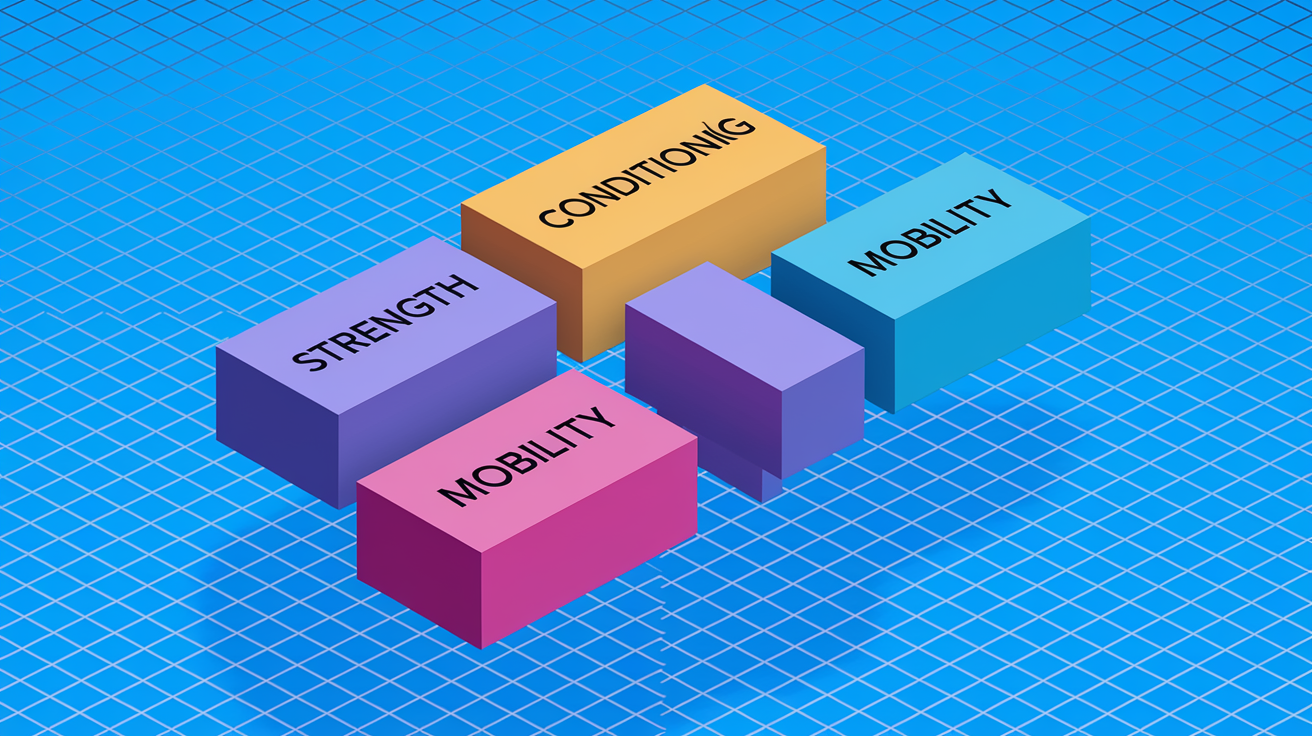
Modular workouts let you assemble a session like building blocks. You keep a few short templates ready, and when you have ten minutes, you pull one. When you have twenty, you stack two together. This removes the friction of planning from scratch every time and helps you stay consistent even when your calendar shifts hour by hour.
Here are three core modules you can mix and match:
Strength module (5–15 minutes): Pick one compound lift. Deadlift, goblet squat, or single-arm row. Do 3 sets of 5–8 reps at RPE 7–8 (heavy enough that you could maybe do one or two more reps). Rest 90–120 seconds between sets. If you only have five minutes, do one set to near failure, rest two minutes, then one more heavy set.
Conditioning module (3–12 minutes): Run a 10-minute AMRAP (as many rounds as possible) of 10 air squats, 8 push-ups, and 6 burpees. Or do a four-minute Tabata. 20 seconds of kettlebell swings, 10 seconds rest, repeat eight times. Both formats spike your heart rate and improve cardiovascular fitness in a short window.
Mobility module (3–10 minutes): Flow through 6–8 positions. Cat-cow, downward dog, low lunge, child’s pose. Hold each for 30–90 seconds. Add 5 minutes of foam rolling or 3 minutes of box breathing (inhale 4 seconds, hold 4 seconds, exhale 4 seconds, hold 4 seconds) if you have extra time.
If you wake up with 20 minutes, you might do the strength module (10 minutes), then the mobility module (10 minutes). If your afternoon clears for 15 minutes, run the conditioning AMRAP and skip the rest. On a day when you’re mentally exhausted but physically okay, just do the mobility module and call it done. The templates stay the same. You adjust how many you use based on what your day allows.
Stress-Reducing Training Options

Stress-reducing movement isn’t about burning calories or setting PRs. It’s about lowering cortisol, calming your nervous system, and keeping your body ready to handle the next wave of chaos. When work is relentless and sleep is short, these sessions protect your health without adding to your physical or mental load.
Walking is one of the simplest options. A 15-minute brisk walk at RPE 3–5 (you can talk easily) lowers anxiety and improves mood. If you can’t leave the house, try a gentle mobility flow for 10–20 minutes. Six to eight stretches held for 30–90 seconds, focusing on deep breathing in each position. Another option is a breath-paced bodyweight circuit: 5 rounds of 30 seconds of slow air squats, 30 seconds of plank hold, and 30 seconds of rest, matching your breath to each rep. The pace stays easy, and the focus is on control instead of intensity.
These sessions support hormonal balance by reducing sympathetic nervous system activation. They also improve recovery between harder workouts and give you a low-cognitive-demand activity when decision fatigue is high. If you’re not sure whether to train hard or rest, pick one of these. They count as movement, and they won’t dig you deeper into a stress hole.
Minimum Effective Dose Fitness Strategies
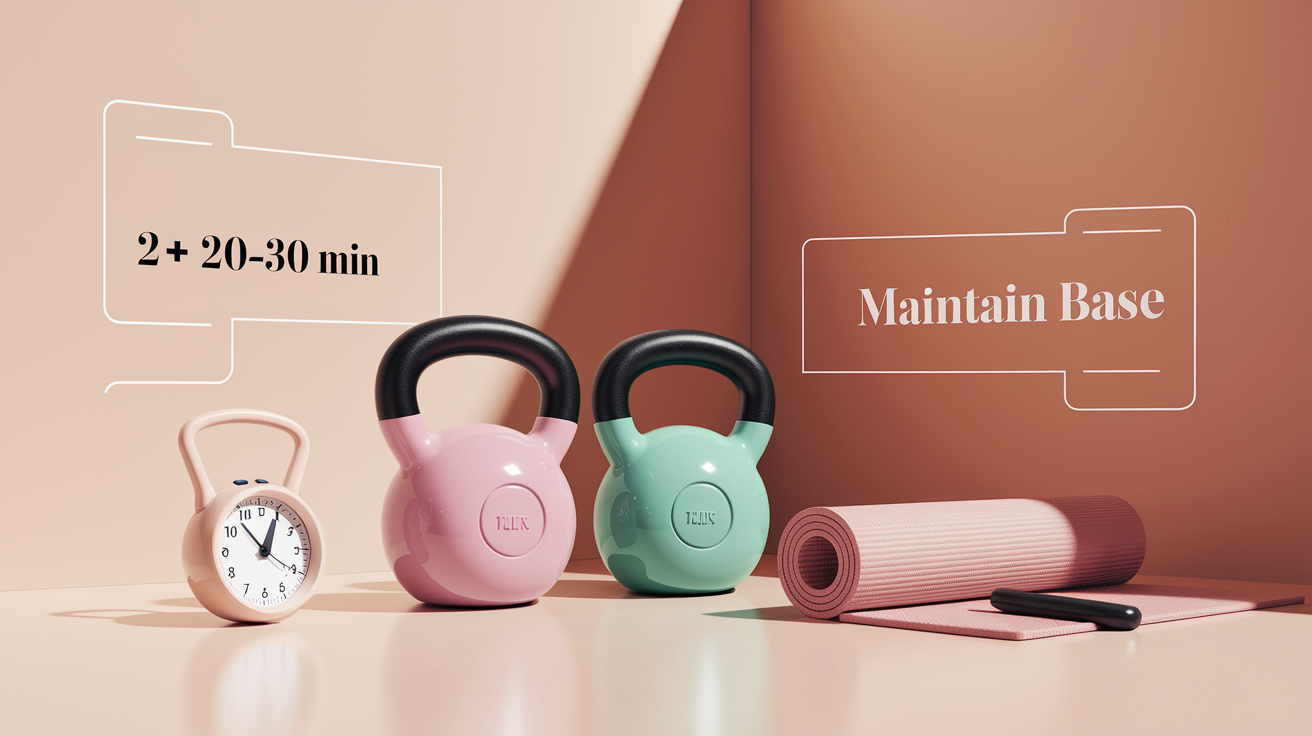
Minimum effective dose means the smallest amount of training that keeps you from losing strength, cardio fitness, or mobility. It’s not about making progress. It’s about holding the line when life is demanding and you can’t give fitness your usual attention. The goal is staying active enough that you don’t have to start over when things calm down.
For strength, two 20–30 minute sessions per week with compound lifts can maintain your current level. Do 3 sets of 5–8 reps at heavy load (RPE 7–8) for movements like deadlifts, squats, or rows. For cardio, two 10–20 minute high-intensity interval sessions per week or three 15–20 minute moderate walks will preserve your aerobic base. Mobility can be maintained with 5–10 minute sessions two to five times per week. Simple stretches, hip circles, and shoulder openers.
Minimum effective dose is useful during a busy block at work, travel weeks, or when you’re dealing with illness or family demands. It prevents regression without requiring the recovery cost of a full program. You show up, do the work, and move on without guilt.
| Method | Time Needed | Expected Benefit |
|---|---|---|
| 2× strength sessions/week (compound lifts, 3 sets × 5–8 reps) | 20–30 minutes each | Maintains current strength levels |
| 2× HIIT sessions/week (10–20 min AMRAP or EMOM) | 10–20 minutes each | Preserves cardiovascular fitness |
| 3× moderate walks/week | 15–20 minutes each | Supports aerobic base and stress reduction |
| 2–5× mobility sessions/week | 5–10 minutes each | Maintains range of motion and joint health |
Scheduling Methods for Irregular Weeks

Micro-planning and chaos-proof scheduling mean you adapt your training day by day instead of committing to a rigid weekly structure. When your calendar shifts constantly, you need tactics that let you grab movement whenever a window opens. The system stays flexible, but you still hit your minimum targets over the course of a week.
Four methods work well together:
Snapshot-planning: Each morning, look at your day and mark one 10–20 minute block where you’ll move. Write it down or set a timer reminder. If the window closes, pick a new one immediately instead of waiting until tomorrow.
Energy-based scheduling: Match your workout intensity to how you feel, not what your old plan said. If you’re mentally sharp but physically tired, do a short strength session. If you’re physically fine but cognitively drained, go for a walk or a simple mobility flow.
Anchor-habits: Attach a 5–10 minute movement routine to something you do every day. After your morning coffee, during your lunch break, or right before dinner. The habit cue triggers the session automatically.
Micro-sessions: Split a 30-minute workout into two 15-minute blocks or three 10-minute blocks spread across the day. One strength set in the morning, a conditioning circuit at lunch, and a mobility session before bed still adds up to a full training day.
Combine these by snapshot-planning your anchor time each morning, then filling gaps with micro-sessions when energy allows. You’re not locked into “Monday is leg day.” You’re asking “What can I do in the next hour?” and adjusting as you go. The goal is consistency over the week, not perfection on any single day.
Mindset Approaches for Consistent Training Under Stress

Identity-based fitness habits mean you see yourself as someone who moves regularly, not someone who’s trying to stick to a program. Instead of “I need to do four workouts this week,” the frame is “I’m a person who finds time to move, even when it’s messy.” That shift makes it easier to show up for a 10-minute session instead of skipping because you can’t do the full hour. You’re reinforcing the identity, not chasing a specific outcome.
All-or-nothing thinking is the main consistency killer during high-stress periods. If you miss a planned session, the temptation is to write off the whole week or quit until things calm down. Instead, treat every window as a fresh start. A single 5-minute session after a skipped day still counts as movement. It keeps the habit alive and reduces the psychological gap between “on track” and “off track.”
Self-permission and flexibility reduce long-term burnout. Give yourself permission to scale back without guilt when stress is high. A 10-minute walk is enough. A single set of squats is enough. A breathing session counts. You’re not failing by doing less. You’re adapting intelligently to real life. That mindset protects the habit so you can return to higher volume when capacity improves, instead of burning out and quitting entirely.
Final Words
Pick a simple choice and move. Use the decision framework to match a quick 10–20 minute plan to your current stress and schedule.
Modular templates let you combine strength, conditioning, and mobility without overthinking. When energy is low, choose a stress‑reducing session or the minimum effective dose to keep progress.
This is how to adapt workouts for intermittent time constraints and stress. Small, consistent steps win — try one option today and build from there.
FAQ
Q: What is the 3-3-3 rule for workout and lifting?
A: The 3-3-3 rule for workouts and lifting usually means a simple template: pick three exercises and do three sets each, or use the strength-focused 3×3 (three sets of three heavy reps) for power.
Q: What is the 5 5 5 30 rule?
A: The 5 5 5 30 rule usually describes a short circuit: five reps, five sets, with about 30 seconds rest—an efficient strength-endurance template that fits a 10–20 minute session.
Q: What is the best exercise for stress and anxiety?
A: The best exercise for stress and anxiety is often brisk walking because it pairs steady movement, easy intensity, and breath rhythm to lower tension and lift mood quickly.