

What if your workouts are working but you can’t prove it?
Without a simple tracking system, progress stays a feeling, not facts.
This post shows the exact metrics beginners should log: reps for each exercise, rounds completed, weight or resistance, rest between stations, total workout time, and a quick RPE or heart-rate note.
You’ll get easy, no-gear methods to record these each session, plus weekly and monthly check-ins so you can see real gains and know what to change.
How to Track Your Circuit Training Progress as a Beginner

Tracking turns vague feelings into hard facts. When you write down how many reps you finished or how long the circuit took, you’re building a performance snapshot. Stack enough of those snapshots together and you’ll see whether you’re moving forward, stuck, or sliding backward.
Progress isn’t just about heavier weights or faster rounds. Sometimes it’s shorter rest. Smoother transitions. Better form at the same load.
Beginners should log five simple things: reps completed per exercise, total rounds finished, weight or resistance used, rest time between stations or rounds, and total workout duration. That’s it. If you’re writing “Goblet squat: 12 reps with 25 lb, 30 seconds rest” each session, you’ll spot when 12 turns into 14. Or when 30 seconds shrinks to 20.
You don’t need expensive gear. A paper notebook works. Print a one-page template with columns for date, exercise, reps, weight, rest, and notes. Fill it in right after your circuit. Phone apps like Strong, JEFIT, or FitNotes let you log on the spot and auto-graph your progress. Pick whichever method you’ll actually use every single session.
Six-step beginner tracking method after each workout:
-
Record the date and circuit name or type so you can compare identical workouts across weeks.
-
List every exercise you performed in order, noting the equipment (bodyweight, dumbbells, kettlebell).
-
Write down reps completed for each exercise in each round. If you did three rounds of push-ups, write “12 / 12 / 14” to show rep counts per round.
-
Note the weight or resistance for every weighted exercise using pounds or kilograms so you know exactly what you lifted.
-
Log rest intervals in seconds between stations and between full rounds. Shorter rest at the same volume is clear progress.
-
Add total workout time and an RPE score (1 to 10) so you can track efficiency and perceived difficulty over time.
Signs Your Circuit Training Is Improving

The most reliable early indicators don’t come from the scale. They show up in how you move and recover.
You finish the same circuit faster. You complete an extra round without gasping for air. Transitions between exercises become smoother. Rest periods feel less desperate.
These performance signs appear before visible body changes, often within two to four weeks of consistent sessions.
Physical recovery rates improve, too. You might stop feeling sore after every workout. Your heart rate drops back to baseline faster after each circuit. Energy during the session holds steadier. You’re less likely to hit a wall midway through your third round.
When stamina, control, and recovery all trend upward together, your training is working even if nothing else has changed yet.
Using Time-Based Metrics to Track Progress

Time metrics are simple and powerful.
Total circuit time tells you how long it took to finish your planned rounds. Time per round shows whether you’re slowing down or staying consistent across the workout. When you log these numbers every session, you’ll see patterns.
A 25-minute circuit might drop to 22 minutes in three weeks without changing reps or weight. That’s endurance improvement in action.
Beginners often cut 10 to 20 percent off their circuit time within the first month. That doesn’t mean rushing through reps with bad form. It means you’re moving more efficiently, resting less, and handling transitions faster.
Track the clock, but always pair it with technique notes to make sure speed gains aren’t technique losses.
Four time-based metrics to log every session:
- Total workout duration from first rep to final cooldown (minutes and seconds).
- Average time per round if you’re doing fixed circuits (divide total time by rounds completed).
- Rest time between stations and between full rounds (capture both in seconds).
- Time to complete a specific exercise or station within the circuit (useful for identifying weak points).
Tracking Strength Gains in Circuit Training

Strength progress in circuits doesn’t always look like gym PRs.
Instead, it shows up as more reps at the same weight. Or the same reps with slightly heavier load. If you logged 10 goblet squats with a 20-pound dumbbell last week and this week you hit 12, that’s a measurable gain. If you moved from 20 pounds to 25 pounds and still finished 10 solid reps, same result.
Both paths count.
Technique-based improvement is just as real. When you can hold a plank with a flat back for the full 45 seconds instead of sagging at 30, you’ve gotten stronger. When your push-up depth increases or your row pulls tighter to your ribs, those are strength markers too.
Write a quick note in your log when form improves. It keeps you honest and shows progress that numbers alone might miss.
Safe progression for beginners follows small, regular steps. Add one to three reps per exercise every week or two. For upper-body moves, increase load by 2.5 to 5 pounds. For lower-body exercises, jump by 5 to 10 pounds.
If you can’t complete your target reps with good form at the new weight, drop back and add another week at the lighter load. Patience here prevents injury and builds a stronger base than chasing numbers too fast.
Monitoring Heart Rate and Perceived Exertion

Heart rate data and perceived exertion scores give you insight into your cardiovascular response and internal effort.
A chest strap or wrist monitor captures average and peak heart rate during your circuit. Over weeks, you’ll notice that the same workout produces a lower average heart rate. Maybe 138 beats per minute instead of 148. That drop signals improved conditioning. Your heart is pumping more efficiently, delivering oxygen with less stress.
Rate of perceived exertion, or RPE, is a 1-to-10 scale you assign at the end of each session. A 10 means maximal all-out effort. A 6 or 7 feels challenging but sustainable.
When a circuit that used to feel like an 8 starts feeling like a 6, you’re fitter even if the numbers on paper stayed the same. Pairing RPE with objective metrics like reps and time gives you a complete picture of effort versus output.
Understanding Basic Heart Rate Zones
Beginners don’t need complex zone calculations. A simple framework helps.
Zone 1 and 2 cover easy, conversational effort, roughly 50 to 70 percent of your estimated max heart rate (a rough estimate is 220 minus your age). Zone 3 sits around 70 to 80 percent, moderately hard but sustainable for several minutes. Zones 4 and 5 push into hard and maximal efforts above 80 percent.
Most beginner circuits live in Zone 3, dipping into Zone 4 during high-intensity stations.
Track your average and peak heart rate each session. When your average heart rate for the same circuit trends downward by 5 to 10 beats per minute over four to eight weeks, your aerobic base is improving.
If peak heart rate stays similar but recovery heart rate (one minute post-workout) drops faster, that’s another win.
Weekly and Monthly Check-In Methods

Weekly logs help you catch short-term trends before they turn into problems or plateaus.
At the end of each week, scan your last three or four sessions. Did reps hold steady or increase? Did rest times stay consistent or drop? Did total workout time trend down while rounds stayed the same or went up?
A quick five-minute review tells you whether to keep the plan or adjust one variable.
Monthly comparisons offer the long view. Pull your first session of the month and compare it to your last. Look at rounds completed, average reps per exercise, total weight moved, and average heart rate.
Body measurements taken every two to four weeks (waist, hips, chest, arms) add another layer. Monthly data smooths out daily noise like bad sleep or a stressful week and shows real progress or stalls that need program changes.
| Metric | Weekly Check-In | Monthly Check-In |
|---|---|---|
| Reps per exercise | Compare session to session; look for +1 to +3 reps on key moves | Calculate average reps across all sessions; aim for +10 to +20% increase |
| Total circuit time | Check if time dropped by 1 to 3 minutes for identical workouts | Review trend over 4 weeks; target 10 to 15% time reduction at same volume |
| Endurance (rounds completed) | Note if you added a partial or full round within the week | Compare total rounds across month; expect +1 round or sustained volume with less rest |
| Strength (load used) | Track any 2.5 to 10 lb increases on weighted exercises | Sum total weight moved per session; look for cumulative volume increase of 15 to 25% |
Avoiding Common Tracking Mistakes
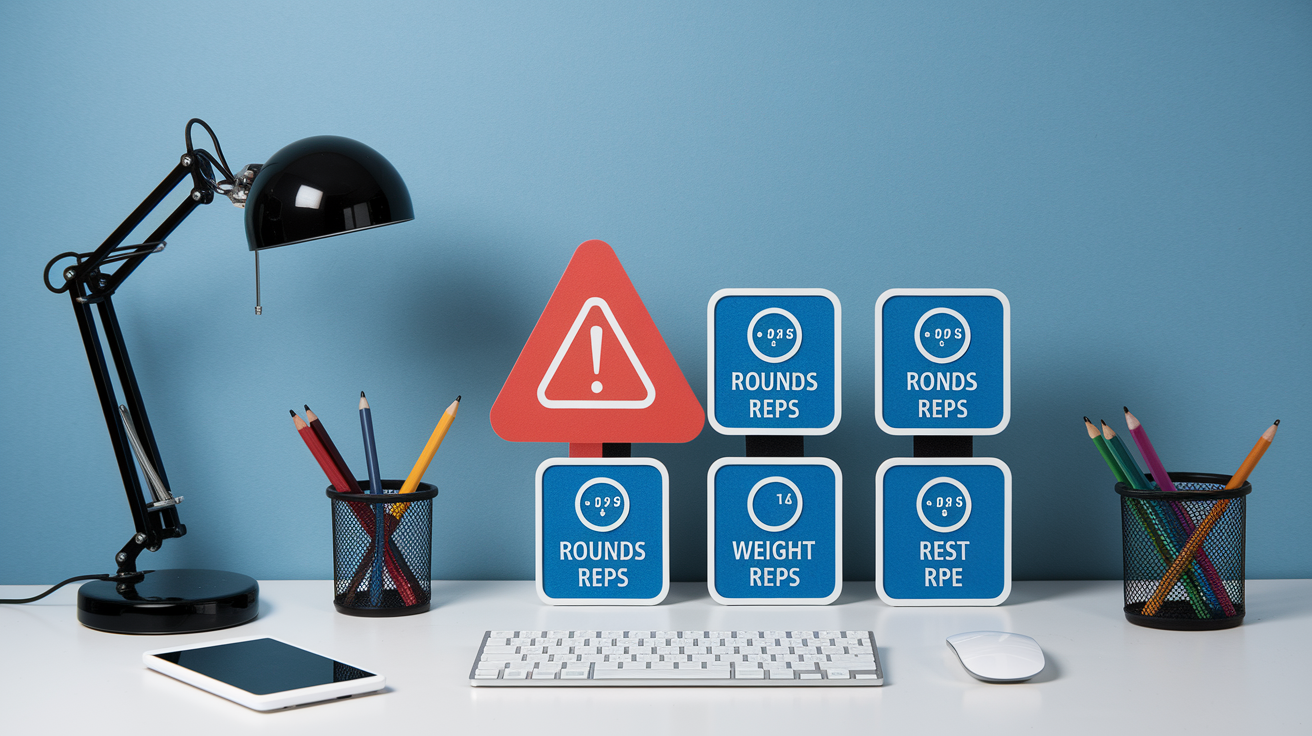
Beginners often try to log everything at once. Date, exercises, reps, sets, weights, rest, heart rate, RPE, calories, mood, sleep quality, hydration.
That list gets overwhelming fast. You skip a session because filling out the log feels like homework.
Start with six core fields: date, rounds completed, reps per key exercise, weight used, rest time, and RPE. Add more later if those six become automatic. Simplicity keeps you consistent, and consistency gives you useful data.
Changing workouts too frequently wrecks your ability to measure progress. If you swap exercises or interval formats every session, you can’t compare anything. Stick with one circuit structure for at least four weeks. Log it every time. Only then will you see whether reps increased, rest decreased, or time improved.
Natural performance swings happen. One bad night of sleep or a stressful day at work can drop your reps by two or three. Don’t panic and change your whole program. Look at the two-week and four-week trend instead of single-session dips.
Patterns matter more than outliers.
Final Words
Track reps, rounds, rest, load, and total circuit time from day one. Those numbers show real progress faster than feelings alone.
Use a simple log, an app, or a printable sheet to record each workout. Check weekly for small wins and monthly for trends. Watch for more reps, shorter rests, and smoother movement.
If you want a clear next step, pick one metric to log this week and stick with it. This is how to track progress in beginner circuit training, and you’ll be surprised what a few weeks of consistency brings.
FAQ
Q: What is the 3-3-3 rule at the gym?
A: The 3-3-3 rule at the gym is a simple beginner template: pick three compound exercises, do three sets per exercise, and train those movements about three times per week to build consistency and skill.
Q: How long does it take to see results from circuit training?
A: The time to see results from circuit training is often 2–4 weeks for stamina and performance improvements; visible changes in body composition usually take 4–8+ weeks with consistent sessions and reasonable eating.
Q: What is the 5-3-1 rule?
A: The 5-3-1 rule is a strength method using heavy sets of five, three, then one rep, often organized across weekly cycles, with planned weight increases each phase to drive steady strength gains.
Q: What is the easiest way to track workout progress?
A: The easiest way to track workout progress is a simple log recording date, exercises, sets, reps, weight, rest, and one focus metric like time or rounds. Use a phone app or small notebook each session.