

Think strength training will slow your running? Think again.
Short, targeted strength work makes you faster, more efficient, and tougher against the aches that sideline runners.
This isn’t about heavy lifting or long gym sessions.
It’s about simple, twice-weekly moves that build power, stabilize your hips and knees, and cut the odds of common overuse injuries.
Read on for practical exercises, progressions, and a weekly plan you can actually stick to.
How Strength Training Directly Improves Running Performance

Strength training increases the force your muscles can produce, which means a stronger push off with every stride. When you strengthen your legs and glutes, you need less oxygen to maintain your pace. This is called improved running economy. Think of it like tuning an engine to run more efficiently. A stronger runner can hold marathon pace using less energy, delaying fatigue and improving finish times.
Strong muscles also protect your joints, tendons, and bones from the repetitive impact of running. Every foot strike sends force up through your ankle, knee, and hip. If the muscles around those joints are weak, soft tissue absorbs extra stress. That’s how you get common overuse injuries like runner’s knee, shin splints, and Achilles tendinitis. Strength work fortifies the entire system, distributing load more evenly and reducing injury risk.
If you’re new to strength training, start with a simple routine twice a week. You don’t need a gym. Focus on movement quality first, then build from there.
Beginner Strength Workout for Runners
Bodyweight squats: 2 sets × 10 reps. Keep your chest up, sit back into your heels, and stand tall.
Glute bridge: 2 sets × 15 reps. Lie on your back, feet flat, push through your heels and squeeze your glutes at the top.
Calf raises: 2 sets × 15 reps. Stand tall, rise onto your toes, lower with control.
Dead bug: 2 sets × 8 reps each side. Lie flat, extend opposite arm and leg while keeping your lower back pressed to the floor.
Front plank: 2 sets × 30 seconds. Hold a straight line from head to heels, brace your core, don’t let your hips sag.
Key Lower‑Body Exercises for Stronger, More Efficient Strides
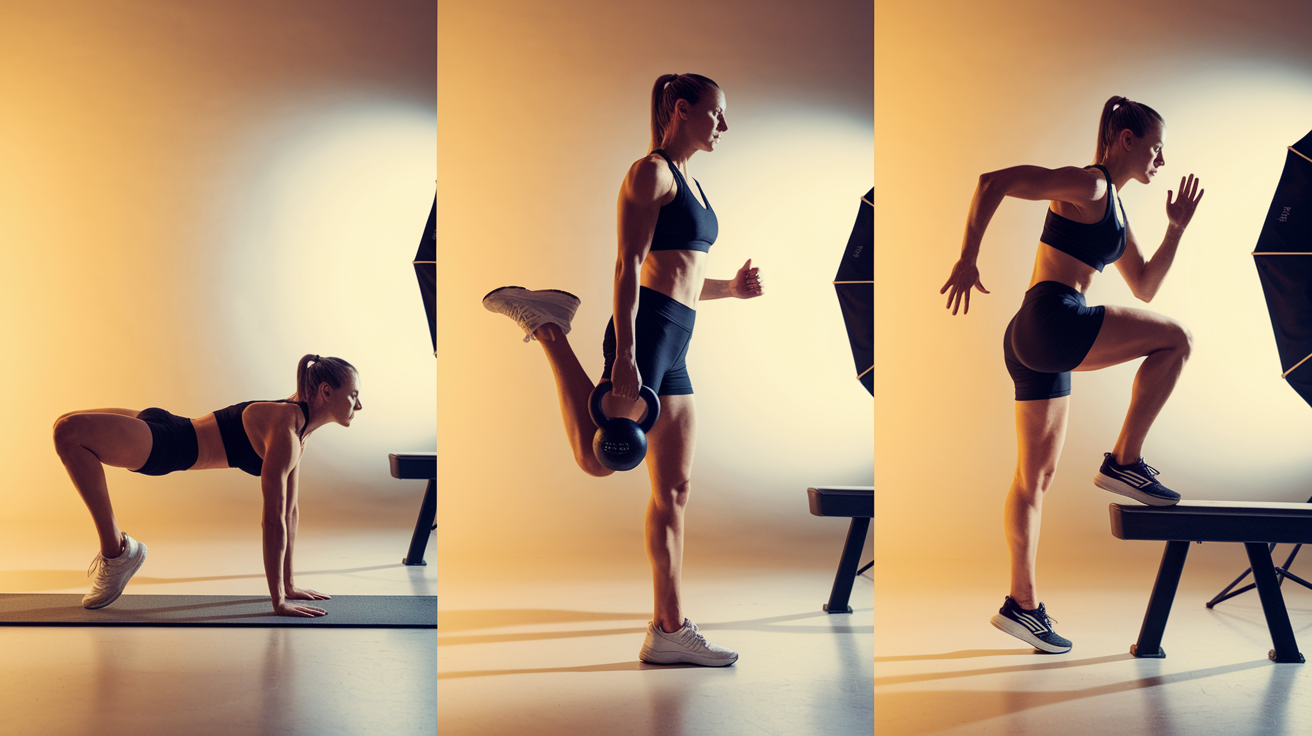
Glute exercises like glute bridges, single leg Romanian deadlifts, and step ups build the power you need for hill running and late race surges. Your glutes are the engine behind every stride. When they fire properly, you get more drive with less wasted motion. Weak glutes force your quads and calves to overcompensate, increasing fatigue and injury risk. Focus on exercises that isolate and activate your glutes under control, then add load as you adapt.
Quad and hamstring strength supports knee stability and helps absorb shock, especially on downhill sections. Exercises like squats, reverse lunges, and split squats build the balanced leg strength runners need to maintain form when tired. Hamstrings work hardest during the braking phase of each stride, so strengthening them with Romanian deadlifts or Nordic curls reduces strain on your knees and lower back. Keep the tempo controlled. No bouncing. Focus on a full range of motion to build resilient, functional strength.
Single leg movements improve balance, correct side to side imbalances, and mimic the demands of running more closely than bilateral exercises. Try single leg squats, lateral split squats, and single leg glute bridges. These moves force each leg to stabilize independently, exposing weaknesses you might miss during regular squats. Start with bodyweight, nail the form, then add light dumbbells or a resistance band. Running is a single leg sport. Your strength training should reflect that.
Core Training to Improve Posture and Late‑Run Stability

A strong core prevents form breakdown when you’re tired. As your legs fatigue, weak core muscles allow your torso to rotate excessively or your hips to drop, wasting energy and slowing you down. Core stability keeps your spine neutral and your pelvis level, so power transfers efficiently from your legs to the ground. This matters most in the final miles of a long run or race, when small inefficiencies add up. Building a stable trunk delays that collapse and helps you finish strong.
Core work for runners isn’t about endless crunches. You need exercises that train your muscles to resist movement and brace under load. These moves teach your body to stay stable while your limbs move dynamically, exactly what happens when you run.
Four Essential Core Exercises
Front plank: Hold 30 to 45 seconds, keep a straight line, brace hard.
Side plank: 30 seconds each side, don’t let your hips sag.
Bird dog: 8 reps each side, extend opposite arm and leg, stay tight through your core.
Dead bug: 8 reps each side, press your lower back into the floor the entire time.
Plyometric Movements to Increase Speed and Stride Power

Plyometrics train your muscles and tendons to store and release energy quickly, improving your reactive strength and reducing ground contact time. When you land and push off faster, you cover more ground with less effort. Exercises like single leg hops, box step offs, and split jumps teach your nervous system to coordinate explosive movements, which translates directly into faster running and better hill climbing power. Plyometric work also strengthens tendons, making them more resilient to the repetitive loading of high mileage.
Start plyometrics only after you’ve built a solid strength base. If you can’t perform 10 controlled single leg squats or hold a 60 second plank, you’re not ready for high impact jumps. Begin with low height, low volume drills. Six reps per leg of single leg hops for height, focusing on soft landings and “sticking” each landing for 2 seconds. Progress slowly by adding reps, height, or complexity. One plyometric session per week is enough for most runners. Schedule it on a day when you’re fresh, and avoid placing it before a hard interval session or long run.
How to Fit Strength Training Into a Weekly Running Schedule

Most runners benefit from two to three strength sessions per week, spaced so they don’t compromise key running workouts. Start with two sessions if you’re new to strength work, then add a third once the habit sticks. Place strength sessions on easy run days or rest days, and aim for at least 48 hours between sessions targeting the same muscle groups. This gives your body time to recover and adapt without interfering with hard running efforts.
Pairing a short strength session with an easy run works well if your schedule is tight. Run in the morning, then do 15 minutes of bodyweight or dumbbell work later that evening. Avoid heavy lower body lifting the day before speed intervals, tempo runs, or races. Fatigued legs won’t let you hit your paces. If you must double up, keep the strength session light and focused on core or upper body. Save your hardest strength work for days when running volume is low.
A sample weekly layout might look like this: Monday easy run plus 20 minutes of lower body strength, Tuesday speed intervals (no strength), Wednesday easy run, Thursday core and upper body strength, Friday rest or easy shakeout, Saturday long run, Sunday full rest or 15 minutes of mobility and light core work. Adjust the structure to fit your training cycle, but protect your hard running days by scheduling strength intelligently around them.
Progressions, Load Increases, and When to Advance Exercises
Gradual progression builds strength and protects you from injury. Start with bodyweight movements until you can complete all prescribed reps with good form and control. Once an exercise feels easy (you’re not breathing hard, form stays crisp, and you could do a few more reps), it’s time to add challenge. Small, consistent increases over weeks and months produce lasting gains without overwhelming your system or disrupting your running.
Progressing safely means choosing one variable to change at a time. Add one or two reps per set, increase weight by the smallest available increment (often 2.5 kg or 5 lb dumbbells), slow down your tempo to 3 seconds on the lowering phase, or switch to a single leg variation. For example, if you’ve been doing 3 sets of 10 bodyweight squats comfortably for two weeks, try goblet squats holding a light dumbbell. A few weeks later, add a second dumbbell or increase the load. Listen to your body. If form breaks down or you feel sharp pain, dial it back.
Simple Progression Guide
Start with 2 sets of 8 to 10 reps for any new exercise. When you can complete 3 sets of 10 reps with control, add external load. A resistance band, light dumbbells, or a weighted vest. Once you’re comfortable with moderate weight, progress to heavier dumbbells, a barbell, or a hex bar deadlift. You can also increase difficulty by slowing the eccentric (lowering) phase to 3 to 4 seconds, which builds strength and teaches better motor control. Single leg variations (like progressing from a regular squat to a single leg squat) challenge stability and expose imbalances. Advance one step at a time, give each progression at least two to three weeks to settle, and focus on quality over numbers.
Minimal, Home, and Gym Equipment Options for Runners
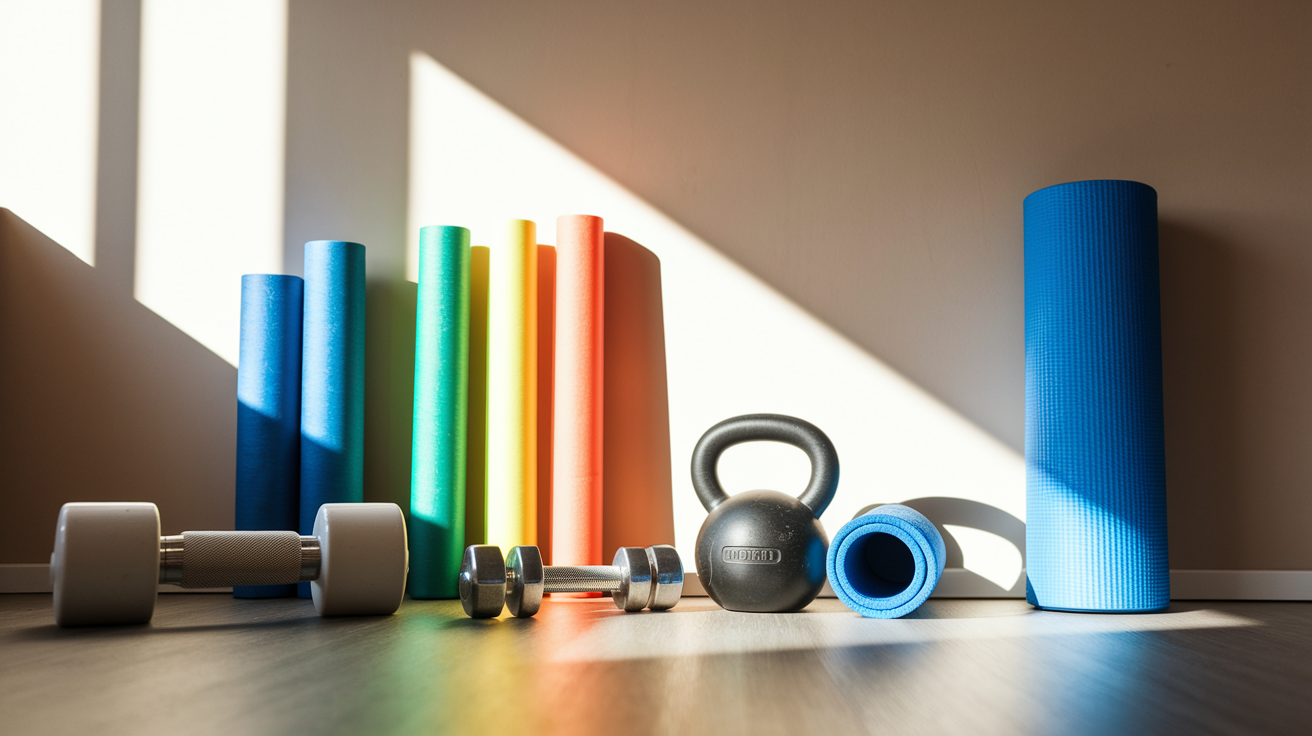
You don’t need a gym membership to build runner specific strength. A resistance band and a set of light dumbbells cover most essential exercises. Bands are portable, cheap, and perfect for glute activation, lateral leg raises, and banded squats. Dumbbells let you load goblet squats, single leg Romanian deadlifts, overhead presses, and rows. Start with 5 to 10 kg dumbbells (or 10 to 20 lb) and progress from there. If space and budget allow, add a kettlebell for swings and goblet variations. Everything else (planks, lunges, glute bridges, calf raises) works fine with just your bodyweight.
If you have access to a gym, barbells and cable machines open up heavier, more progressive strength work. Barbell back squats, hex bar deadlifts, and weighted step ups let you load movements with enough resistance to build maximal strength, which improves power and running economy. Cable machines are useful for anti rotation core exercises like cable chops and for adjustable resistance on rows and pull downs. Kettlebells offer a middle ground. They’re versatile, relatively affordable, and effective for swings, single arm rows, and loaded carries. Choose equipment based on your access and consistency. A simple home setup you use twice a week beats a fancy gym routine you skip.
Final Words
Start by adding two short strength sessions to your week, basic moves like squats, glute bridges, calf raises, dead bugs, and planks. They boost running economy, stride power, and joint stability right away.
Build from there. Add glute and single-leg work, a bit of core, and simple plyometrics. Place sessions away from hard runs and increase load slowly with reps, tempo, or single-leg versions. Use bands at home or dumbbells at the gym.
Strength training for runners pays off fast. Stick with it, stay consistent, and you’ll run stronger and with less pain.
FAQ
Q: Why should runners do strength training?
A: Runners should do strength training because it improves running economy, raises stride power, boosts muscular endurance, and strengthens joints and stabilizers, which helps you run faster and cut injury risk.
Q: What is a simple beginner strength workout for runners?
A: A simple beginner strength workout for runners is 3×8–12 squats, 3×10 glute bridges, 3×12 calf raises, 2×8–12 dead bugs per side, and 2×30–60 second planks, done twice weekly.
Q: Which lower-body exercises should runners prioritize and why?
A: Runners should prioritize squats, lunges, deadlifts, and step-ups because glute moves power propulsion, quads and hamstrings add stability and downhill strength, and single-leg work fixes balance and stride asymmetry.
Q: How does core training help running?
A: Core training helps running by keeping your torso stable, reducing excess rotation, delaying fatigue, and preventing form breakdown so you stay efficient and steady late in long runs.
Q: What core exercises should runners do?
A: Runners should do plank, side plank, bird dog, and dead bug for core strength, aiming for multiple short holds and controlled reps to build stability without fatiguing running muscles.
Q: Are plyometrics useful for runners and are they safe?
A: Plyometrics are useful for runners because they boost reactive strength, elastic power, and reduce ground contact time; start with low-volume hops or jump lunges, focus on safe landings, and progress slowly.
Q: How often should runners strength train each week and how should they schedule it?
A: Runners should strength train two to three times weekly, placing sessions away from hard speed or long runs; pair strength with easy run days and avoid heavy lifts before key workouts.
Q: How should runners progress strength training safely?
A: Runners should progress strength training by increasing weight, reps, tempo, or moving to single-leg versions in small steps, watching form and soreness to avoid overload and stabilizer injuries.
Q: What home equipment do runners need versus gym options?
A: Runners can train at home with resistance bands and light dumbbells for most exercises; use gym tools like kettlebells, barbells, and cable machines when you need heavier or more precise progression.
Q: When will strength training start helping my running?
A: Runners usually see strength benefits in four to eight weeks, with improved economy and joint resilience building sooner if you train consistently and keep sessions twice weekly or more.