

Think you need endless cardio to lose fat and get more toned?
Think again.
This beginner strength circuit for fat loss and muscle tone mixes compound lifts with short cardio bursts so you burn calories and build lean muscle in one 20 to 30 minute session.
It’s made for total beginners, uses simple equipment or just bodyweight, and keeps rest short so your heart and muscles work together.
Follow two to three rounds with good form, and you’ll get results without long, complicated workouts.
Complete Beginner-Friendly Strength Circuit to Start Burning Fat and Building Muscle Tone

This circuit mixes compound strength moves with quick cardio bursts. You’ll burn fat and build lean muscle in one session, no separate cardio needed. Six to eight exercises back to back, minimal rest. Upper-body push, pull, lower-body work, core stability, and conditioning all in 20 to 30 minutes. Works at home or in the gym when you’re short on time.
Each exercise hits multiple muscle groups at once. Squats and rows demand more energy than isolation moves, so your heart rate stays up while you build strength. Start with two rounds of the full circuit. Rest 60 to 90 seconds between rounds. Once the first few weeks feel manageable, add a third or fourth round.
Equipment? Keep it simple. One pair of dumbbells, a kettlebell, or just bodyweight. Got a resistance band? Great, you can swap in band rows and presses. Strength moves get 8 to 12 reps. Timed exercises like planks or mountain climbers run for 30 to 45 seconds. Rest 15 to 60 seconds between exercises based on how much you need.
Complete Circuit Sequence:
- Goblet squat, 8 to 12 reps (one dumbbell or kettlebell at chest, or bodyweight only)
- Incline or knee push-up, 8 to 12 reps
- Bent-over one-arm dumbbell row or band row, 8 to 12 reps each side
- Romanian deadlift, 8 to 12 reps (single-leg or two-leg, dumbbell or bodyweight)
- Standing overhead press, 8 to 12 reps (dumbbells or band)
- Glute bridge or hip thrust, 12 to 15 reps
- Plank, 30 to 45 seconds
- Mountain climbers or jumping jacks, 30 to 45 seconds
Warm-Up Essentials to Prepare for a Beginner Strength Circuit

A proper warm-up gets your joints and muscles ready for loaded movement. Five to seven minutes of light activity raises your core temperature and boosts synovial fluid around your knees, hips, and shoulders. Every squat, press, and row feels smoother. Fewer strains or tweaks during working sets.
Start with two minutes of easy cardio. March in place, slow jumping jacks, or jog around the room. Then move into dynamic mobility drills that rehearse the patterns you’re about to load. Don’t overthink it.
Dynamic Warm-Up Sequence:
• Leg swings, 10 each side, front to back and side to side
• Arm circles, 10 forward and 10 backward in each direction
• Hip openers, 10 each side (step one knee up and rotate it out)
• Torso twists, 10 gentle rotations each direction
• Bodyweight squats, 8 to 10 reps with a slow descent and pause at the bottom
How Circuit Principles Help Beginners Burn Fat and Build Muscle Tone

Circuit training keeps you moving from one exercise category to the next without long breaks. Finish a set of squats? Your legs need recovery but your upper body is fresh. Switch immediately to a push-up or row. You keep workout momentum while different muscle groups recover. That alternating demand lets you sustain effort across the entire session instead of standing around between traditional strength sets.
Continuous pacing also pushes your heart rate beyond what steady lifting alone would produce. Your cardiovascular system works harder to deliver oxygen to multiple muscle groups in quick succession. Higher energy output during and after the workout. That supports fat loss when paired with appropriate nutrition over weeks and months.
The push, pull, legs, core, and conditioning balance built into the circuit means no single area becomes a limiting factor. Shoulders fatigued from overhead presses? The next movement might be a glute bridge or plank that gives your upper body a functional rest. You get both strength development and metabolic conditioning without needing separate cardio sessions on the same day.
Form and Technique Breakdown for Key Strength Circuit Exercises
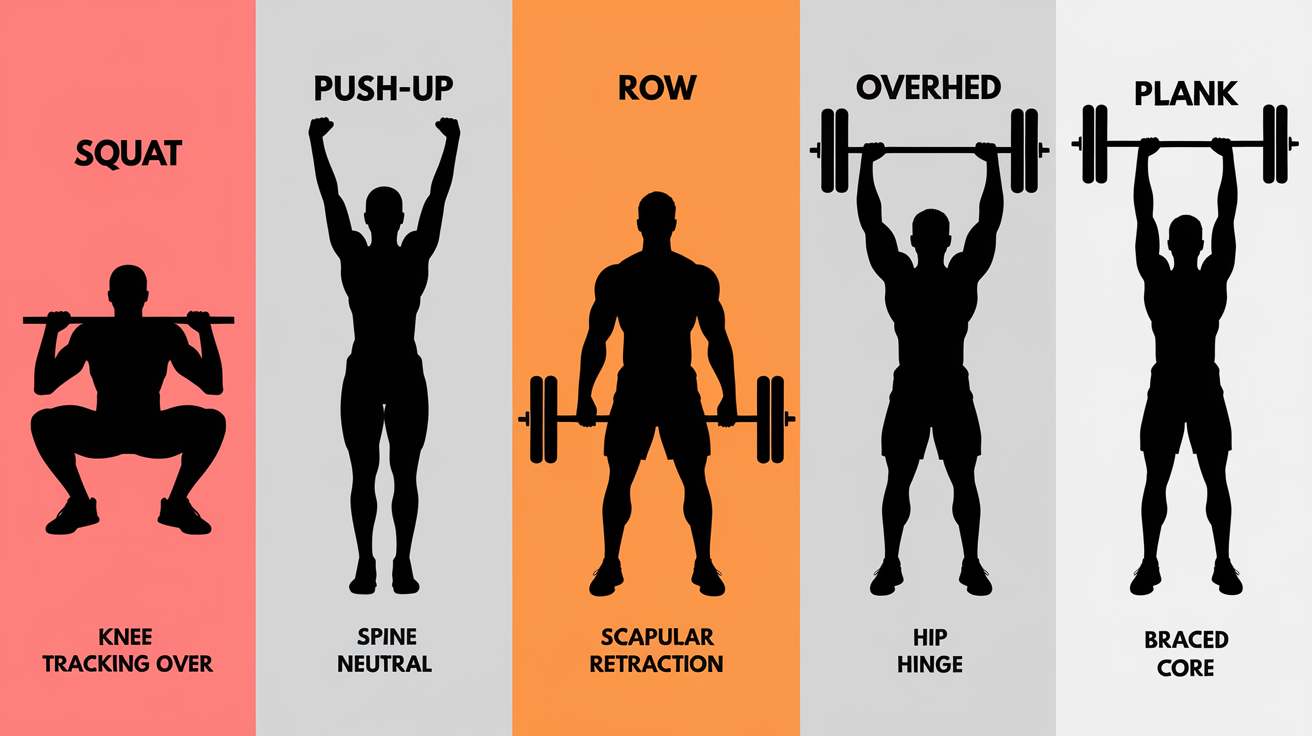
Squat
Send your hips back first, like you’re reaching for a chair behind you, before bending your knees. Chest stays tall. Weight centered over mid-foot. Your knees track in the same direction as your toes without collapsing inward. Holding a dumbbell or kettlebell at chest height for a goblet squat? Use that weight to help you sit deeper. Stand up by driving through your whole foot, not just your toes.
Push-Up Variation
Hands slightly wider than shoulder width. Body in a straight line from head to heels. Lower yourself by bending your elbows until your chest hovers an inch or two above the floor. Full push-up too hard? Elevate your hands on a bench or box, or drop to your knees. Either option lets you maintain a controlled descent and full range of motion. Don’t let your hips sag or your elbows flare past 45 degrees.
Row Variation
Dumbbell, kettlebell, or resistance band, it doesn’t matter. Keep your spine neutral and hinge forward at the hips. Pull the weight or band toward your ribcage by driving your elbow back and squeezing your shoulder blade toward your spine. Your torso shouldn’t rotate during the pull. Doing a one-arm row with a dumbbell? Brace your opposite hand on a bench or your thigh for stability. Lower the weight with control instead of letting it drop.
Romanian Deadlift
Feet hip-width apart. Hold a dumbbell in each hand, or one weight with both hands. Hinge at your hips by pushing them backward while keeping a slight bend in your knees. Back stays flat, not rounded. Weights slide down the front of your thighs. You should feel a stretch in your hamstrings. Once the weights reach mid-shin or you feel your lower back start to round, reverse the movement. Squeeze your glutes and drive your hips forward.
Overhead Press
Stand with feet shoulder-width apart. Hold dumbbells or a band at shoulder height, palms facing forward. Press the weights straight overhead without arching your lower back or locking out your elbows at the top. Core stays tight to protect your spine. Lower the weights back to shoulder level with control. Lower back wants to arch aggressively? Reduce the weight or switch to a band that offers less resistance at the top.
Plank
Start on your forearms and toes. Body forms a straight line. Elbows sit directly under your shoulders. Squeeze your glutes and brace your core like someone’s about to poke your stomach. Don’t let your hips sag toward the floor or pike up toward the ceiling. Hold for 30 to 45 seconds while breathing steadily. Full planks too challenging? Drop to your knees but keep the same straight-line tension from knees to shoulders.
Progression Strategies to Build Strength and Muscle Tone Over Time

Progression means adding a small challenge once your current workload feels manageable. When you can complete the top end of a rep range for all rounds with good form, adjust one variable. Increasing weight by 5 to 10 percent is the most common method for strength-focused moves. Adding one extra set or round boosts total training volume without heavier loads.
For timed exercises like planks or mountain climbers, extend the duration by 5 to 10 seconds once your current target feels steady. Shortening rest between exercises or rounds raises intensity and cardiovascular demand. Pick one progression method every one to two weeks. Don’t change multiple variables at once. You’ll see initial improvements in endurance and coordination within two to four weeks. Visible changes in muscle definition and fat loss typically show up around six to twelve weeks when training and nutrition align.
| Method | How to Apply | Frequency |
|---|---|---|
| Add weight | Increase dumbbell or kettlebell load by 5 to 10% when you exceed rep range by 2 reps | Every 1 to 2 weeks |
| Add a set or round | Move from 2 rounds to 3, or from 3 to 4 | Every 2 to 3 weeks |
| Extend timed holds | Add 5 to 10 seconds to planks or conditioning moves | Every 1 to 2 weeks |
| Shorten rest | Reduce exercise-to-exercise rest by 5 to 10 seconds | Every 2 to 3 weeks |
Weekly Training Plan for a Beginner Strength Circuit Routine

Three non-consecutive circuit sessions per week give your muscles time to recover and adapt between workouts. Monday, Wednesday, and Friday works. So does Tuesday, Thursday, and Saturday. At least one full rest day between sessions. On your off days, light activity like walking, easy cycling, or mobility work supports recovery without interfering with muscle repair.
One or two low-intensity cardio sessions per week can fill active-recovery slots if you want additional movement. A 20 to 30 minute walk or a gentle bike ride keeps blood flowing without taxing the same muscle groups you worked during your circuits. The sample plan below balances training stimulus with adequate rest for someone just starting out.
Sample Weekly Schedule:
• Monday, Circuit A, 25 minutes, 3 rounds
• Tuesday, Low-intensity cardio 20 to 30 minutes or mobility work
• Wednesday, Circuit B, 25 minutes, 3 rounds (swap 2 to 3 exercises from Circuit A)
• Thursday, Rest or gentle walking
• Friday, Circuit A, 20 to 30 minutes, 2 to 3 rounds
• Saturday, Active recovery or complete rest
• Sunday, Complete rest
Beginner Modifications and Exercise Alternatives for Any Fitness Level

If any movement feels too hard or causes discomfort, swap it for a simpler version that lets you complete the prescribed reps with control. Incline push-ups on a bench or wall reduce the percentage of your bodyweight you’re pressing. Easier than floor push-ups. Band rows offer adjustable resistance by changing your grip width or stepping closer to the anchor point. They’re gentler on grip strength than heavy dumbbells.
Glute bridges can replace Romanian deadlifts if hinging at the hips feels awkward or if you want to focus more on glute activation without loading your hamstrings as heavily. For conditioning finishers, marching in place or step-touches work if mountain climbers or jumping jacks feel too intense on your joints. Every exercise in the circuit has a bodyweight-only alternative. You can start without buying any equipment and add external load only when you’re ready to progress.
Nutrition Basics to Support Fat Loss and Muscle Tone from Circuit Training
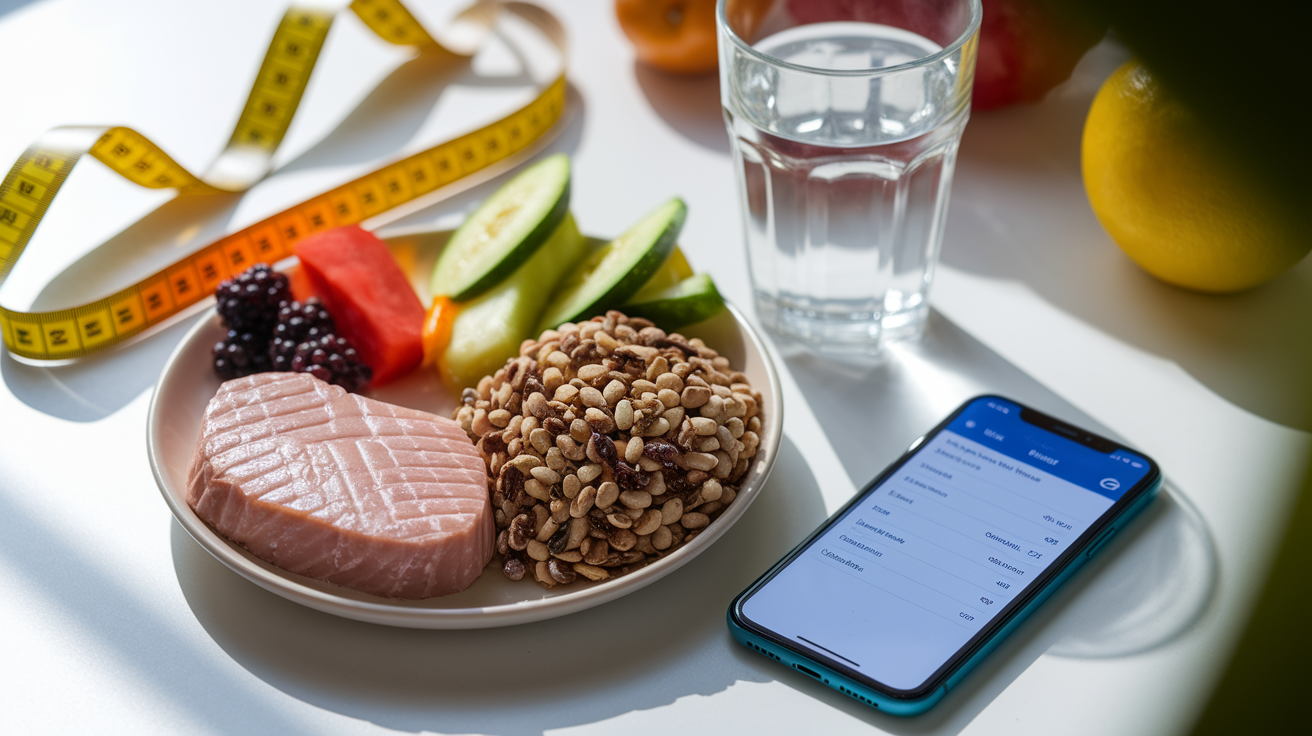
Training drives the muscle-building and cardiovascular adaptations. But nutrition determines whether you lose fat, maintain muscle, or both. A daily calorie deficit of 300 to 500 calories below your maintenance intake creates the energy gap needed for fat loss. Protein intake around 1.6 to 2.2 grams per kilogram of bodyweight, or roughly 0.7 to 1.0 gram per pound, helps preserve lean tissue while you’re in a deficit. That usually translates to a palm-sized portion of protein at each meal if you eat three to five times per day.
Carbohydrates and fats fill the remaining calories and support workout performance and overall health. Prioritize whole foods like vegetables, fruits, whole grains, lean meats, fish, eggs, nuts, and seeds. Hydration matters too. Aim for 2 to 3 liters of water daily. Adjust upward if you’re larger, training in heat, or sweating heavily. Visible results in body composition typically show up within six to twelve weeks when consistent training pairs with appropriate nutrition.
Practical Starter Tips:
• Eat a palm-sized portion of protein at each meal
• Fill half your plate with vegetables or fruit
• Drink a glass of water before and after each workout
• Plan one or two grab-and-go protein sources like Greek yogurt or hard-boiled eggs for busy days
Safety Guidelines for a Beginner Strength Circuit

Start with two rounds and lighter weights if you’re new to strength training or returning after a long break. Consult a healthcare provider before beginning if you’re over 45, have preexisting joint issues, cardiovascular concerns, or any condition that might be affected by moderate-intensity exercise. Neutral spine alignment protects your lower back during squats, deadlifts, and rows. Keep your knees tracking over your toes instead of caving inward. Avoid locking out your elbows or knees at the end range of any press or extension.
Stop immediately if you feel sharp pain, dizziness, or unusual joint discomfort. Muscle fatigue and mild soreness? Normal. Pain that feels localized to a specific spot in a joint? That’s a warning sign. The warm-up and cool-down reduce injury risk by preparing tissues before work and encouraging recovery afterward. If any exercise consistently bothers a joint even with proper form and light weight, swap it for an alternative that feels more comfortable.
Final Words
Jump right into the 20–30 minute full‑body circuit: 6–10 moves, 2–4 rounds, strength sets or short conditioning bursts, and brief rests. Warm up for 5–7 minutes, focus on form cues, and pick regressions or progressions that fit your gear and energy.
Follow the weekly plan, track small progression steps, and pair the work with simple nutrition and recovery habits. Keep at the beginner strength circuit for fat loss and muscle tone, and expect steady, visible progress if you stay consistent. You’ve got this.
FAQ
What is a beginner strength circuit for fat loss and muscle tone?
A beginner strength circuit for fat loss and muscle tone is a 20 to 30 minute workout combining 6 to 10 exercises performed in rounds with minimal rest between movements. This format keeps your heart rate elevated while building strength and burning calories efficiently.
How often should beginners do circuit training each week?
Beginners should do circuit training 3 times per week on non-consecutive days, allowing 48 hours between sessions for recovery. Adding 1 to 2 low-intensity cardio days and rest days creates a balanced weekly schedule that supports consistent progress.
How many sets and reps should beginners use in a strength circuit?
Beginners should perform 8 to 12 repetitions for strength exercises and 30 to 45 seconds for conditioning movements, completing 2 to 4 rounds total. Rest 15 to 60 seconds between exercises and 60 to 90 seconds between full rounds.
What equipment do I need for a beginner strength circuit at home?
A beginner strength circuit needs minimal equipment, often just your bodyweight. Optional items like dumbbells, resistance bands, or household objects like water bottles add resistance as you progress, making home workouts just as effective as gym sessions.
How long does it take to see results from circuit training?
Circuit training delivers visible results in 6 to 12 weeks when combined with proper nutrition and consistency. You’ll notice strength improvements and better endurance within 2 to 4 weeks before physical changes become obvious.
What warm-up should I do before a strength circuit?
A proper warm-up includes 2 minutes of light cardio followed by 3 to 5 minutes of mobility drills like arm circles, hip openers, and leg swings. This 5 to 7 minute routine prepares your joints and reduces injury risk before starting the circuit.
Can circuit training help with both fat loss and muscle building?
Circuit training supports both fat loss and muscle building by combining strength exercises with elevated heart rate throughout the session. The continuous format burns calories while resistance movements stimulate muscle development, improving overall body composition when paired with appropriate nutrition.
What should I eat to support fat loss during circuit training?
Supporting fat loss during circuit training requires a 300 to 500 calorie deficit, protein intake of 1.6 to 2.2 grams per kilogram bodyweight, and 2 to 3 liters of water daily. Focus on whole foods spread across 3 to 5 meals throughout the day.
How do I progress a beginner strength circuit over time?
Progressing a beginner strength circuit involves adding 1 set, increasing weight by 5 to 10 percent, extending timed exercises by 5 to 10 seconds, or shortening rest periods. Apply one progression method every 2 to 4 weeks to continue building strength safely.
What are good exercise alternatives for beginners with limited mobility?
Beginners with limited mobility can use incline push-ups instead of regular push-ups, band rows instead of heavy rows, and glute bridges instead of Romanian deadlifts. These modifications maintain workout effectiveness while matching your current fitness level and available equipment.
Should I do cardio on the same days as circuit training?
You should not do intense cardio on the same days as circuit training since the circuit already elevates your heart rate. Schedule 1 to 2 low-intensity cardio sessions on separate days to support recovery while maintaining cardiovascular fitness throughout the week.
How do I know if I’m using proper form during circuit exercises?
Proper form during circuit exercises means maintaining neutral spine alignment, keeping knees tracking over toes during squats, and avoiding sharp joint pain. Start with bodyweight versions, move slowly through each rep, and prioritize quality over speed or added weight.