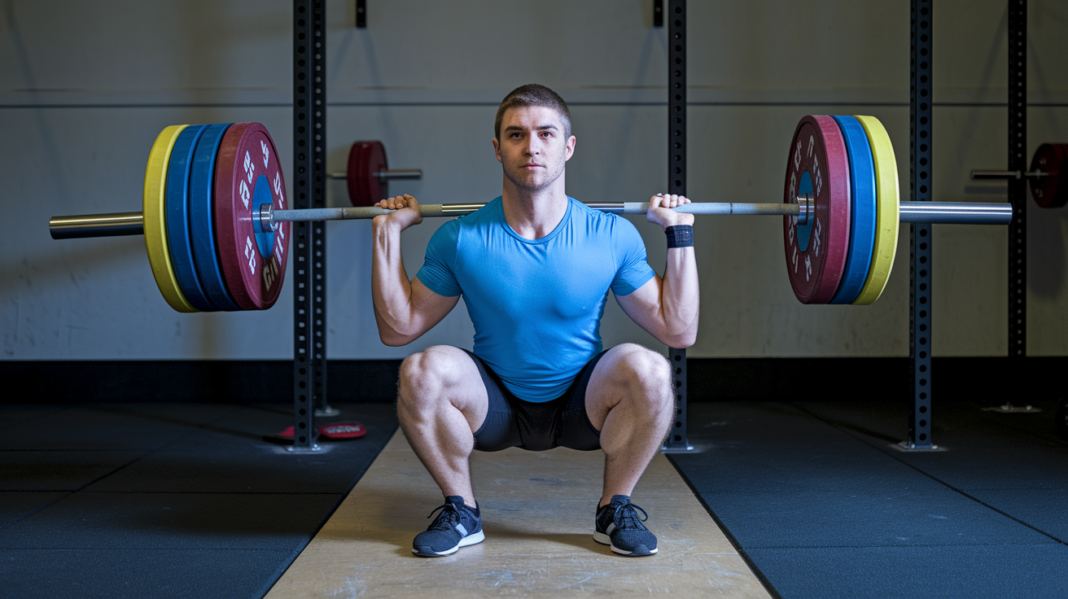

Think strength training is just lifting weights?
Most beginners skip mobility, then wonder why squats stay shallow and presses feel unstable.
Do the extra 5 to 10 minutes of targeted mobility before or between sets and you’ll move better, lift safer, and learn patterns faster.
This short primer shows simple drills to pair with common beginner circuits so your form improves, aches drop, and progress actually sticks.
If you want stronger workouts with less fuss, start here.
Key Mobility Work to Support Beginner Strength Circuits

Mobility drills get your joints ready to handle the full range every strength exercise asks for. Toss in 5 to 10 minutes of targeted work before or during your beginner circuits and you’re cutting down injury risk while cleaning up your form. Squats drop deeper. Presses feel solid. Your body actually learns the patterns you’re teaching it.
When you do this matters. Run through 3 to 6 drills for 30 to 60 seconds each before your first real working set, or drop a single drill between sets while you recover. Both get the job done. Pre-lift mobility opens things up when you need it most. Between-set work keeps your nervous system fired up without gassing the muscles you’re about to use again. Go with whatever fits your time and energy that day.
Every big strength movement gets better with one or two mobility drills aimed at the joints taking the load. Six pairings you can use this week:
- Goblet squat or bodyweight squat – Ankle knee-to-wall work (2 sets of 10 reps each side) or deep squat hold (30 seconds) for better ankle flex and hip depth.
- Romanian deadlift or conventional deadlift – Dynamic hamstring sweep (8 to 10 reps per leg) or glute bridge (3 sets of 12) to wake up the posterior chain.
- Hip hinge or kettlebell swing – Hip CARs (3 slow reps per side, 5 to 10 seconds each) for better hip socket control.
- Overhead press or strict press – Wall slides or banded shoulder dislocations (2 sets of 8 to 12 reps) to open shoulder flexion and scapular rotation.
- Bent-over row or seated row – Band pull-aparts (2 sets of 12 to 20) to fire up your scapular retractors and fix upper-back posture.
- Forward lunge or reverse lunge – World’s Greatest Stretch (2 sets of 6 to 8 per side) for hips, ankles, and thoracic spine all at once.
Dynamic Warm-Up Mobility to Use Before Strength Circuits

Five minutes of dynamic warm-up gets tissue temperature up, joints moving, and switches your nervous system from sitting around to actually lifting. You’re not stretching to make muscles longer here. You’re teaching your body the ranges it’s about to use for the next 30 to 45 minutes. This quick sequence works before any beginner circuit and doesn’t need a single piece of equipment.
Start with movements that hit multiple joints at once. Go from smaller to bigger ranges as you warm. If something feels tight on rep one, it usually loosens by rep ten. That’s the warm-up doing what it should.
- Arm circles – 1 minute total. Small forward circles for 15 seconds, then make them bigger. Switch directions at 30 seconds. Let your shoulder blades move naturally.
- Leg swings – 1 minute per leg, 2 minutes total. Face a wall for balance. Swing one leg forward and back for 30 seconds, then side to side for another 30. Repeat on the other leg.
- Torso twists – 1 minute. Stand with feet hip-width, arms relaxed. Rotate your torso left and right, letting your arms swing. Keep your hips mostly still.
- Neck circles – 1 minute total. Roll your head slowly clockwise for 30 seconds, then counterclockwise. Stay in a pain-free range.
Lower-Body Mobility to Pair with Squat, Lunge, and Hinge Patterns
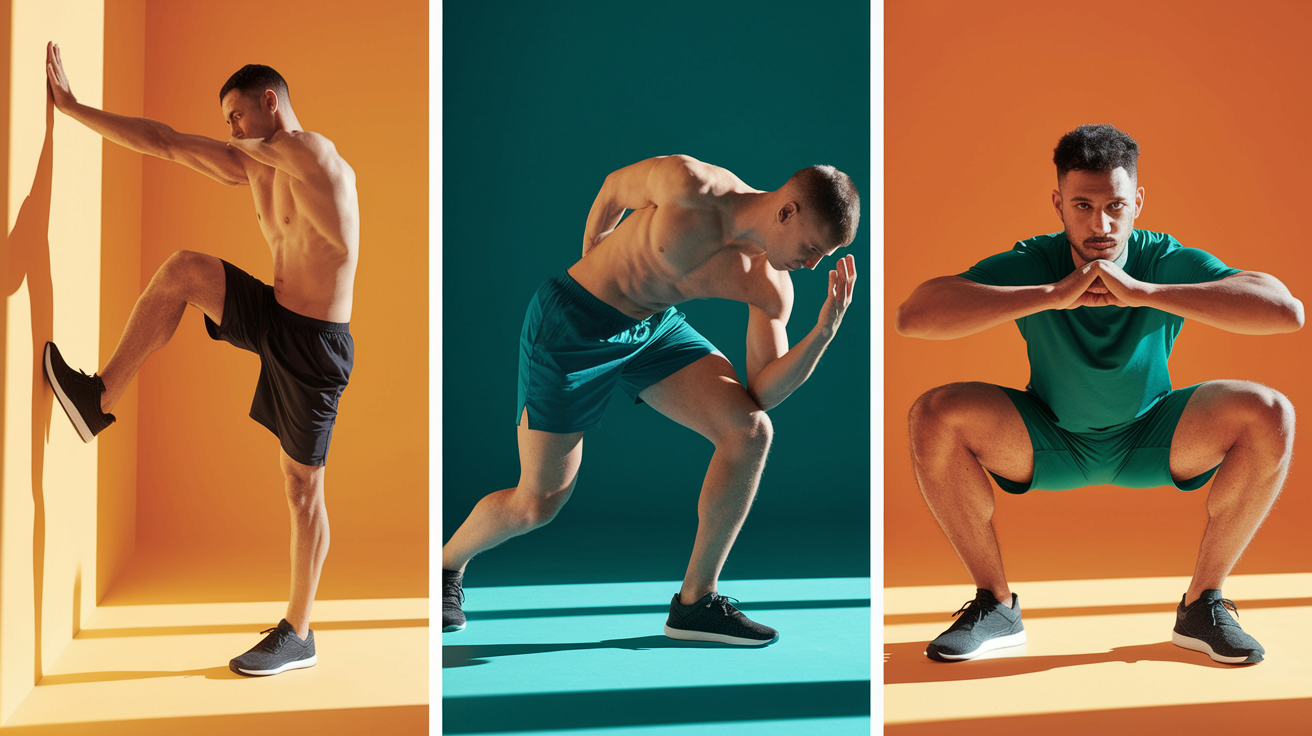
Lower-body mobility drills target your ankle, hip, and posterior chain. These three systems control squat depth, lunge stability, and hinge mechanics. Beginners often lose form not from weak legs, but because tight ankles stop the knee from tracking forward or stiff hips force the lower back to round. Three to 5 minutes on these drills before squatting or hinging makes a real difference in how the weight actually moves.
Run these as a mini-circuit before your first working set, or pick one or two and slot them between warm-up sets. Move slowly. Breathe. Mobility isn’t a race.
Hip Mobility Drills for Squats and Lunges
Your hip mobility decides how deep you can squat and how stable you feel in a lunge. Two drills cover most of what beginners need.
90/90 hip switches – Sit on the floor with one leg bent 90 degrees in front and the other bent 90 degrees behind. Lift your hips slightly, rotate, and switch leg positions so the back leg comes forward and the front leg goes back. Do 2 sets of 8 to 12 reps per side. This opens internal and external hip rotation at the same time.
Hip CARs (controlled articular rotations) – Stand on one leg and lift the other knee to hip height. Slowly rotate the lifted leg outward in the biggest circle your hip allows, then reverse direction. Three reps per side, taking 5 to 10 seconds per rotation. Control every inch. If your hip clicks or you lose balance, shrink the range and slow down.
Ankle Mobility for Squat Depth
Limited ankle dorsiflexion caps squat depth and makes your heels lift. Most beginners can improve this in 4 to 6 weeks with consistent practice.
Knee-to-wall ankle mobilization – Face a wall and place one foot flat about 10 centimeters from the baseboard. Drive your knee forward toward the wall without letting your heel lift. You’ll feel a stretch in your calf and the front of your ankle. Two sets of 10 reps per side, holding each push for 1 to 2 seconds. Track how far from the wall you can stand while still touching your knee to it. Aim to add 2 to 4 centimeters over 4 weeks.
Deep squat hold – Stand with feet shoulder-width and drop into the deepest squat you can hold with your torso upright and heels down. Hold for 20 to 30 seconds. If your heels won’t stay down, grab a pole or door frame for support. Three sets before squatting. Your goal is to go from 20 seconds to 45 seconds within 3 to 6 weeks.
Hamstring and Posterior Chain Prep for Hinges and RDLs
Hamstring mobility and posterior-chain activation directly improve deadlift and RDL form. Tight hamstrings pull the pelvis into a posterior tilt, rounding your lower back under load.
Dynamic hamstring sweep – Stand on one leg. Hinge forward at the hip and reach your opposite hand toward the ground, letting the free leg float behind you. Eight to 10 slow reps per leg. This combines hamstring length with single-leg balance and hip-hinge patterning.
Glute bridge activation – Lie face-up with knees bent and feet flat. Press through your heels and lift your hips until your body forms a straight line from shoulders to knees. Squeeze your glutes hard at the top for 1 second, then lower. Three sets of 8 to 12 reps before deadlifts or RDLs. This wakes up the muscles that protect your spine during hinge movements.
Common mistakes beginners make in lower-body mobility:
- Forcing range instead of moving slowly and breathing through resistance.
- Letting the lower back round during hamstring or hip drills. Keep a neutral spine.
- Skipping ankle work because it feels boring, then wondering why squats stay shallow.
- Holding the breath during holds or stretches, which cranks up tension instead of dropping it.
Upper-Body Mobility Supporting Pressing and Pulling Movements
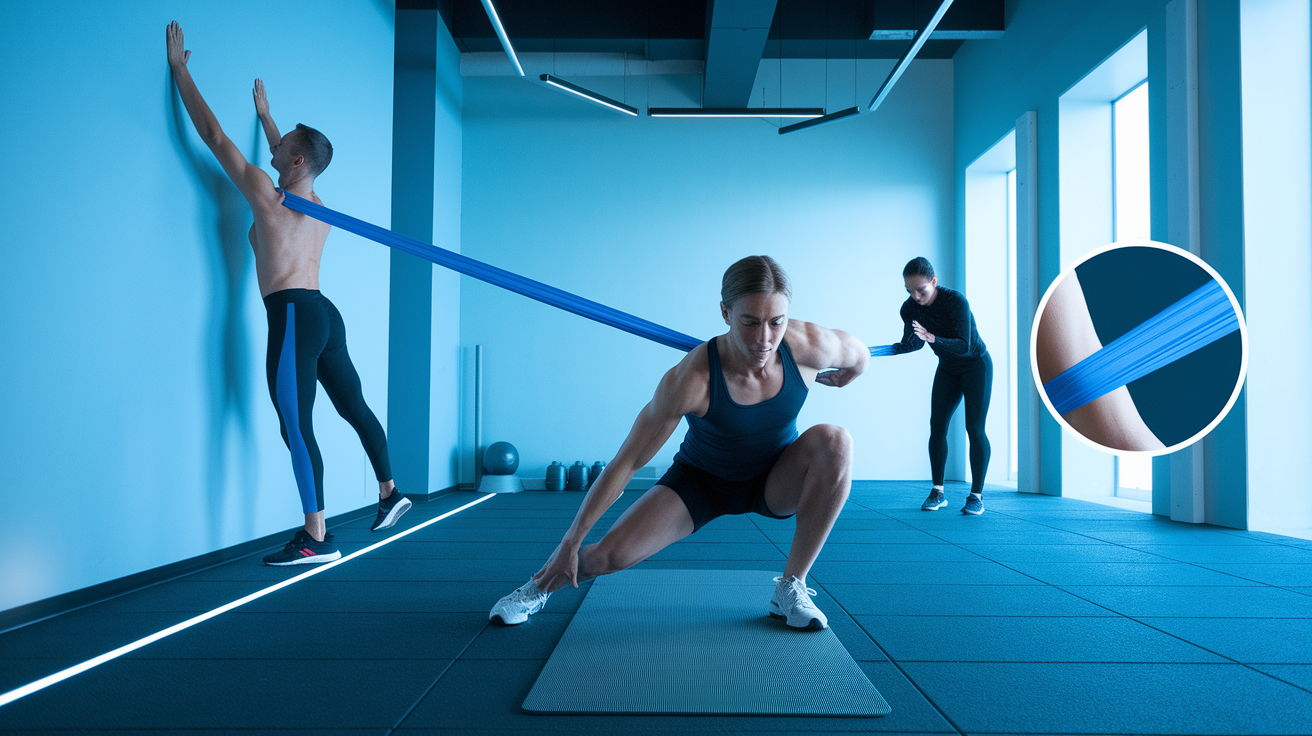
Upper-body mobility for beginners centers on the thoracic spine, shoulders, and scapulae. Stiffness in any of these three spots limits overhead range, reduces pressing power, and makes rows feel awkward. Most desk workers start training with forward-rounded shoulders and a stiff mid-back. Mobility work here improves posture, cuts down shoulder impingement risk, and makes pressing and pulling movements feel more natural.
Thoracic Mobility for Overhead Press Stability
A stiff thoracic spine forces your lower back to hyperextend when you press overhead. That compensation pattern increases injury risk and reduces how much weight you can safely move.
Thoracic spine rotations – Kneel on all fours or lie on your side with knees bent. Place one hand behind your head. Slowly rotate your torso, bringing the elbow toward the ceiling, then return to the starting position. Two sets of 8 to 12 reps per side. Move only through the mid-back. Your hips and lower back should stay still. If you feel this in your lower back, shrink the range and slow down.
This pairs best with any overhead pressing variation. Do it between warm-up sets or right before your first working set.
Shoulder Mobility for Pressing Mechanics
Shoulder flexion requires coordination between the shoulder joint and the scapula. Most beginners lack full overhead range because their scapulae don’t upwardly rotate smoothly.
Wall slides – Stand with your back against a wall, feet a few inches forward. Press your lower back, upper back, and the back of your head against the wall. Raise your arms into a “goal post” position with elbows bent 90 degrees and forearms against the wall. Slowly slide your arms overhead, keeping contact with the wall. Lower back down. Two sets of 8 to 12 reps. If your lower back arches away from the wall, reduce the range.
Banded shoulder dislocations – Hold a resistance band or broomstick with a wide grip in front of your hips. Keeping your elbows straight, raise the band overhead and keep rotating your shoulders until the band is behind your hips. Reverse the movement. Two sets of 8 to 12 reps. Start with a grip wider than shoulder-width. As your range improves over weeks, narrow the grip slightly.
Scapular Control for Rows and Pulling Movements
Rowing movements need scapular retraction. Weak or poorly controlled scapular muscles turn rows into arm exercises instead of back exercises.
Band pull-aparts – Hold a light resistance band at chest height with arms extended. Pull the band apart by squeezing your shoulder blades together. Hold for 1 second, then return to the start. Two sets of 12 to 20 reps. You should feel this between your shoulder blades, not in your arms. If you feel it in your biceps, lighten the band and focus on leading the movement with your shoulder blades.
| Mobility Drill | Strength Movement Supported | Recommended Duration/Reps |
|---|---|---|
| Thoracic spine rotations | Overhead press, push press, strict press | 2 sets of 8 to 12 reps per side |
| Wall slides or banded shoulder dislocations | Overhead press, handstand push-up progression | 2 sets of 8 to 12 reps |
| Band pull-aparts | Bent-over row, seated row, inverted row | 2 sets of 12 to 20 reps |
How to Integrate Mobility into Your Beginner Strength Circuit
You’ve got three practical ways to add mobility work to a beginner strength circuit without pushing your total session past 45 minutes. First method drops 3 to 6 mobility drills before your first working set as a targeted warm-up. Second method slots one mobility drill between sets of a strength exercise as active recovery. Third method saves static stretching and longer holds for a 5-minute cool-down after your last set. All three work. Pick the one that matches your schedule and energy.
Pre-circuit mobility takes 5 to 7 minutes and directly prepares the joints you’re about to load. If your circuit includes goblet squats and Romanian deadlifts, spend 1 minute on ankle knee-to-wall drills, 1 minute on hip 90/90 switches, 1 minute on deep squat holds, and 2 minutes on glute bridges and dynamic hamstring sweeps. Your first working set will feel smoother and safer. Between-set mobility saves time by filling rest periods with movement instead of standing still. After a set of overhead presses, do 30 to 45 seconds of band pull-aparts or thoracic rotations while your pressing muscles recover. This keeps your nervous system engaged and reinforces the mobility you need without adding fatigue.
- Do 2 to 3 minutes of light cardio like walking, bike, or jumping jacks, then add 3 to 5 minutes of targeted mobility before your circuit.
- Use 30 to 60 seconds of mobility work between sets when rest periods are 90 to 120 seconds.
- Pair opposing movements. If you just pressed, do a pulling mobility drill like band pull-aparts during rest.
- Save static stretches and longer holds of 30 to 60 seconds for post-circuit cool-down when your muscles are warm.
- Track which mobility drills you used for at least 3 sessions straight before changing your routine so you can actually measure progress.
Sample Beginner Strength Circuits with Paired Mobility

These three circuits show exactly how to combine beginner-friendly strength exercises with mobility drills. Each circuit includes exercise order, rep ranges, rest times, and specific mobility pairings.
Circuit A – Lower Body Focus
This circuit targets squat and hinge patterns with supporting ankle and hip mobility.
- Goblet squat – 3 sets of 8 reps, holding a light kettlebell or dumbbell at chest height. Rest 60 to 90 seconds between sets.
- Deep squat hold – Do this right after each set of goblet squats. Hold the bottom of a bodyweight squat for 20 to 30 seconds, keeping heels down and torso upright.
- Ankle knee-to-wall mobilization – 2 sets of 10 reps per side before starting goblet squats or during the rest period after the second set.
- 90/90 hip switches – 2 sets of 10 reps per side, done between the first and second round of the circuit or as part of the warm-up.
- Glute bridge – 3 sets of 12 reps as a finisher or activation drill before goblet squats, squeezing glutes at the top for 1 second per rep.
Circuit B – Posterior Chain and Hip Hinge
This circuit emphasizes deadlift patterns and posterior-chain activation with paired hip and hamstring mobility.
- Romanian deadlift – 3 sets of 8 reps with a light barbell, kettlebell, or pair of dumbbells. Rest 60 to 90 seconds.
- Glute bridge – 3 sets of 12 reps, done between RDL sets or right after the final set. Squeeze hard at the top.
- 90/90 hip switches – 2 sets of 10 reps per side before starting RDLs or during rest after the first working set.
- Dynamic hamstring sweep – 2 sets of 8 to 10 reps per leg as part of the warm-up or between RDL rounds.
Circuit C – Upper Body Press and Pull
This circuit pairs overhead pressing with thoracic and shoulder mobility to improve range and reduce compensation.
- Seated or standing overhead press – 3 sets of 6 to 8 reps with dumbbells or a barbell. Rest 90 to 120 seconds.
- Thoracic spine rotations – 2 sets of 10 reps per side, done between press sets or right before the first working set.
- Banded shoulder dislocations – 2 sets of 8 to 10 reps with a resistance band or broomstick, done as part of the warm-up or between pressing sets.
- Band pull-aparts – 2 sets of 12 to 20 reps, added between sets of overhead press to fire up scapular retractors and balance pressing volume with pulling work.
Beginner Progressions and Regressions for Mobility Work

Mobility improves gradually over weeks and months, not days. Start with basic positions and short holds, then progress by increasing time under tension, adding repetitions, or introducing light load. If a drill feels too hard or causes sharp pain, back off to a simpler version until your body adapts.
Progressions build capacity. Once you can hold a deep squat for 30 seconds with good form, bump the hold to 45 or 60 seconds. Once you can complete 8 reps of 90/90 hip switches smoothly, go for 10 or 12 reps. Another progression path adds external load. Do a goblet squat with a pause at the bottom instead of an unweighted deep squat hold, or hold a light dumbbell during a hip hinge drill. Loaded mobility drills combine strength and range in one movement.
Five progressions to increase mobility difficulty:
- Bump hold time from 20 seconds to 45 or 60 seconds over 3 to 6 weeks.
- Add repetitions from 8 per side to 10 or 12 per side for dynamic drills.
- Introduce light external load, like a 5 to 10 kilogram dumbbell or kettlebell during a squat hold or hinge drill.
- Remove support. If you used a wall or chair for balance, try the movement freestanding.
- Slow the tempo to 3 to 5 seconds per repetition for controlled articular rotations or dynamic sweeps.
Five regressions to make mobility more accessible:
- Reduce range. Squat only as deep as you can while keeping heels down and torso upright.
- Add support by holding a door frame, wall, or chair for balance during single-leg or unstable drills.
- Switch from dynamic movement to isometric holds if coordination is tough.
- Drop set count from 3 to 1 or 2 when you’re fatigued or new to the drill.
- Use a wider grip or stance to make the movement easier. Narrow the position as range improves.
Programming Guidelines: Weekly Structure for Mobility Plus Strength Circuits
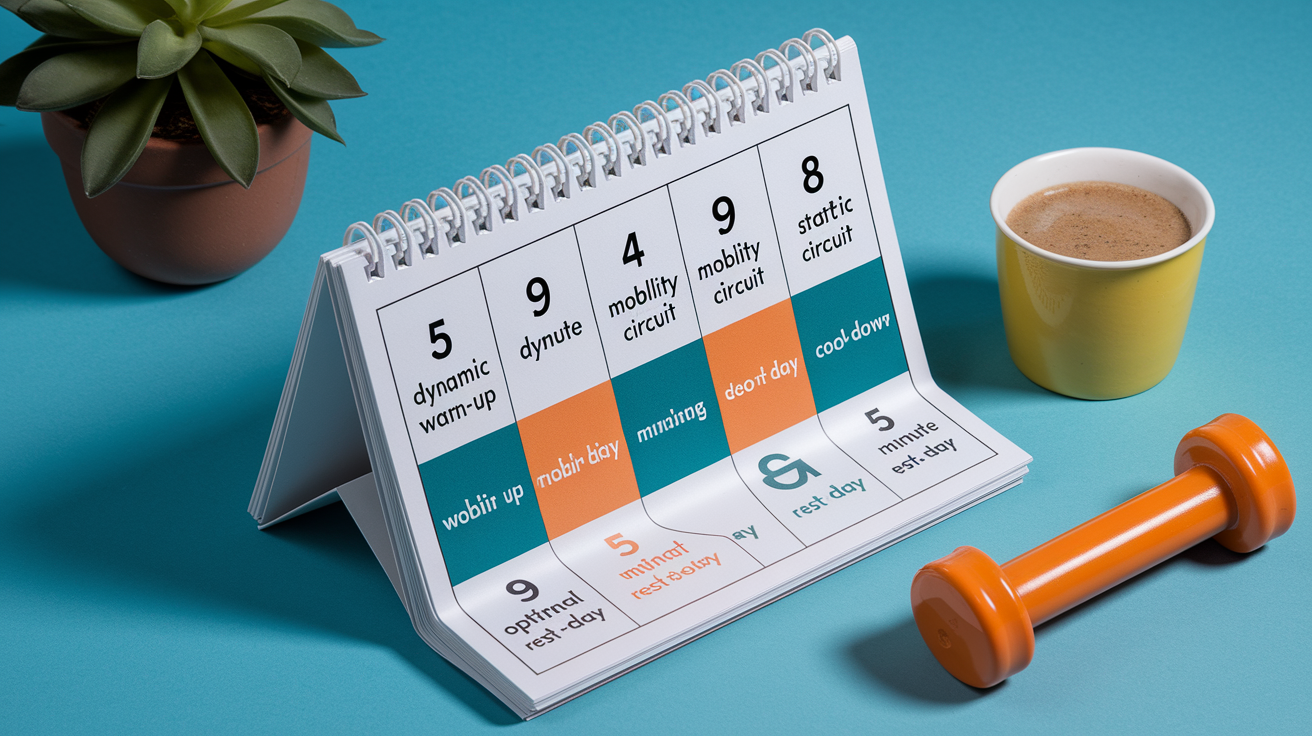
Beginners see the best results when they practice mobility 2 to 4 times per week on strength training days, with optional short daily sessions of 5 to 10 minutes on rest days. A focused 19-minute routine breaks down as 5 minutes of dynamic warm-up, 9 minutes of mobility circuits, and 5 minutes of static cool-down and breathing. That structure fits easily before or after a 30 to 45 minute strength circuit.
Consistency beats duration. Doing 5 to 10 minutes of mobility 4 days per week produces faster and more lasting improvements than a single 60-minute session once per week. Your nervous system and connective tissue adapt to frequent, repeated exposure. Track simple metrics like knee-to-wall distance during ankle mobilization or how long you can hold a deep squat. Aim to improve knee-to-wall clearance by 2 to 4 centimeters over 4 to 6 weeks, or extend your squat hold from 20 seconds to 45 seconds in the same timeframe.
- Schedule mobility on strength training days – Pair mobility drills with the lift they support. Squat day gets ankle and hip mobility. Press day gets thoracic and shoulder mobility.
- Add optional 5 to 10 minute sessions on rest days – Focus on areas that feel stiff or were trained hard the day before. Keep intensity light.
- Use a 19-minute full routine once or twice per week – Combine 5 minutes dynamic warm-up, 9 minutes mobility circuit rotating through all major joints, and 5 minutes static stretching with deep breathing.
- Track one or two measurable goals – Write down your starting knee-to-wall distance or deep squat hold time. Retest every 2 weeks.
- Stick with the same drills for at least 3 sessions straight – Changing exercises every workout stops you from measuring progress. Repeat the same 4 to 6 drills for 2 to 3 weeks, then swap one or two if needed.
- Prioritize mobility for your weakest movement – If your squat depth is limited, spend extra time on ankle and hip drills. If overhead press feels stiff, add a second round of thoracic rotations and wall slides each week.
Final Words
Get moving: start with the 5–10 minute warm-up and 3–6 targeted drills. Pair simple mobility moves with your squats, hinges, lunges, presses, and rows so your body shows up ready.
Use mobility before a circuit and short drills between sets. Progress by adding time or range, regress with smaller ranges or supports. Bands and a broomstick work fine if you don’t have weights.
Use these mobility exercises to pair with beginner strength circuits to protect joints, improve form, and get steady gains. You’ve got this.
FAQ
Q: How to combine strength and mobility training? Should I do strength or mobility first?
A: You combine strength and mobility by doing 3–7 minutes of targeted mobility before lifts, adding 30–60 seconds mobility between sets, and choosing order by goal: mobility first if you’re stiff, strength first if warmed.
Q: What is the 3-3-3 rule at the gym? What is the 2 2 2 rule in gym?
A: The 3-3-3 and 2-2-2 rules are simple gym templates: 3-3-3 can mean three minutes/moves for warm-up or a 3×3 set scheme; 2-2-2 often means two warm-up sets, two working sets, two accessory exercises.