

You don’t need hours in the gym to get stronger in a month.
This 4-week progressive beginner strength circuit program runs four 20 to 30 minute sessions a week, with two strength days, one cardio circuit, and one steady-state day.
Each week you add a bit more volume or time so you keep improving without burning out.
If you want a short, clear plan that teaches safe movement, builds real strength, and fits a busy life, this program is for you.
Complete Overview of the 4-Week Beginner Strength Circuit Framework

This 4-week strength circuit runs on four workouts a week. Two strength days (Strength A and Strength B), one cardio circuit, and one steady-state cardio session. Each week you’ll add a bit more volume or time. Sessions take 20 to 30 minutes. Rest days and optional light movement fill the gaps.
Here’s how the week looks. Monday: Strength A. Tuesday: Cardio Circuit. Wednesday: Rest or a 20-minute walk. Thursday: Strength B. Friday: Steady-State Cardio (20 to 30 minutes at a pace where you can hold a conversation). Saturday and Sunday: Rest or easy movement like stretching or a short walk. You can shift days around to fit your life, but keep at least one rest day between your two strength sessions.
Circuit format means you move through exercises with minimal rest, then repeat the round. Strength days use straight sets with 45 to 60 seconds between exercises. Cardio circuits use timed intervals that get longer each week. Week 1 starts at 30 seconds work and 15 seconds rest for two rounds. By Week 4, you’re at 45 seconds work, 15 seconds rest, for three rounds.
Weekly progression:
- Week 1 builds the habit. You’ll use 2 to 3 sets per exercise, lower reps, and lighter intervals to learn the movements.
- Week 2 adds one more set to most exercises and bumps reps slightly (chair squats move from 2 to 3 sets of 8 to 10 up to 3 sets of 10 to 12).
- Week 3 raises circuit intervals from 30 to 40 seconds and adds a third round option on cardio days.
- Week 4 pushes you with 45-second work intervals, three full circuit rounds, and an extra set on core finishers.
- Strength exercises progress by adding 1 to 2 reps when the current target feels easy. If you can do more than 12 reps on an exercise, increase resistance next week.
- Rest intervals stay the same (45 to 60 seconds on strength days, built-in timing on cardio circuits). You control intensity by choosing harder variations or adding light resistance like water bottles or bands.
Essential Warm-Up Protocol for Strength Circuit Beginners

Dynamic warm-ups prep your joints, raise your heart rate, and lower injury risk without wearing you out before the real work. You’ll spend 3 to 5 minutes moving through 4 to 6 movements for 20 to 30 seconds each. Skip static stretching here. Save that for after.
These movements wake up the patterns you’ll use in the workout. Arm swings before push-ups. Leg swings before squats. Hip circles before lunges. You’re rehearsing the session.
Dynamic warm-up movements:
- Arm swings (forward and across the body) for 20 seconds
- Leg swings (front to back and side to side, hold a wall for balance) for 20 seconds per leg
- Hip circles (hands on hips, make slow circles) for 20 seconds each direction
- Marching in place with high knees for 30 seconds
- Light bodyweight squats or slow lunges for 20 seconds
Structural Logic Behind the Weekly Workout Schedule
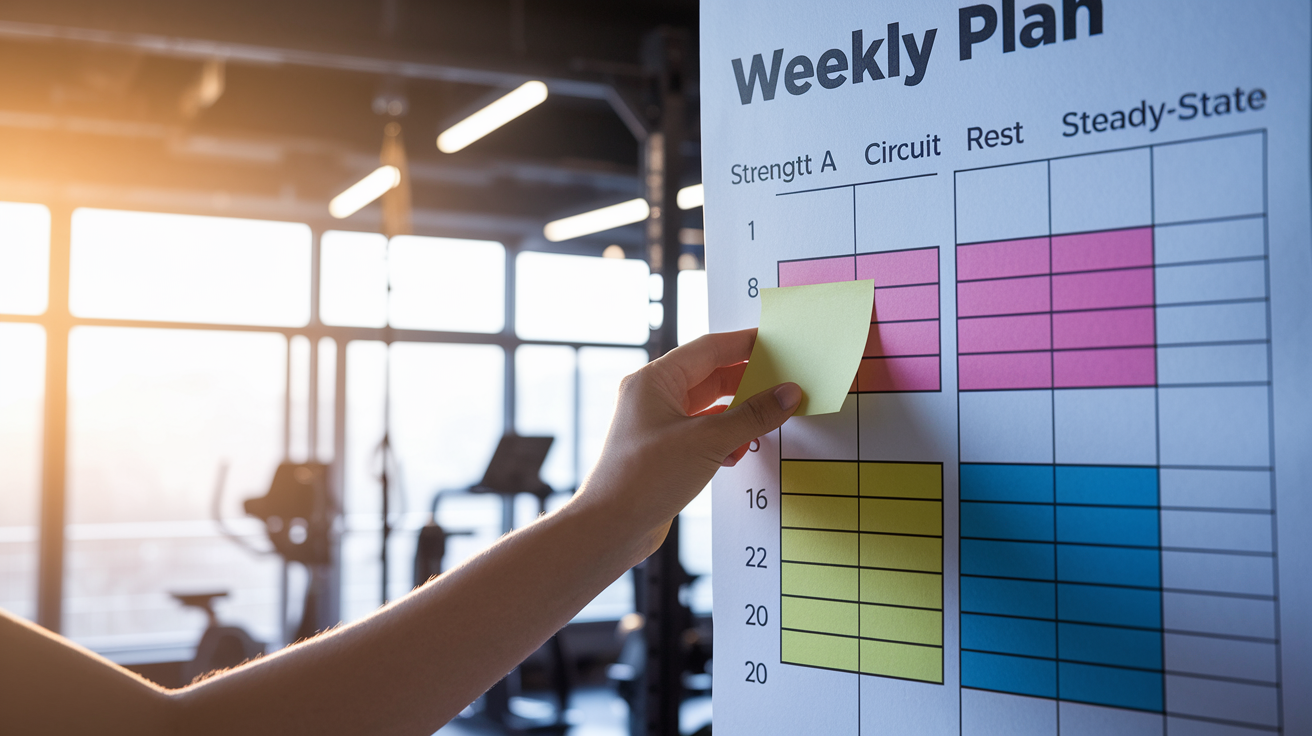
The 4-day schedule keeps the workload manageable while giving you enough stimulus to adapt. Two strength days hit all your major muscle groups without overlap fatigue. Cardio and circuit work raise your heart rate and build endurance without messing with strength recovery. Rest days let your muscles repair.
Spacing the two strength sessions (Monday and Thursday in the sample layout) gives you 72 hours between similar movements. That’s enough time for soreness to drop and muscle protein synthesis to peak. Cardio circuit day (Tuesday) and steady-state day (Friday) don’t tax the same energy systems heavily, so you can train the next day without dragging.
Beginners benefit from this rhythm because it builds consistency without burnout. You’re not sore every day. You’re not bored with the same session on repeat. Four training days leave room for life. Miss a session? Slide it into a rest day and keep the pattern rolling. Flexibility beats perfection when you’re starting out.
Strength Circuit A: Beginner-Friendly Full-Body Foundations
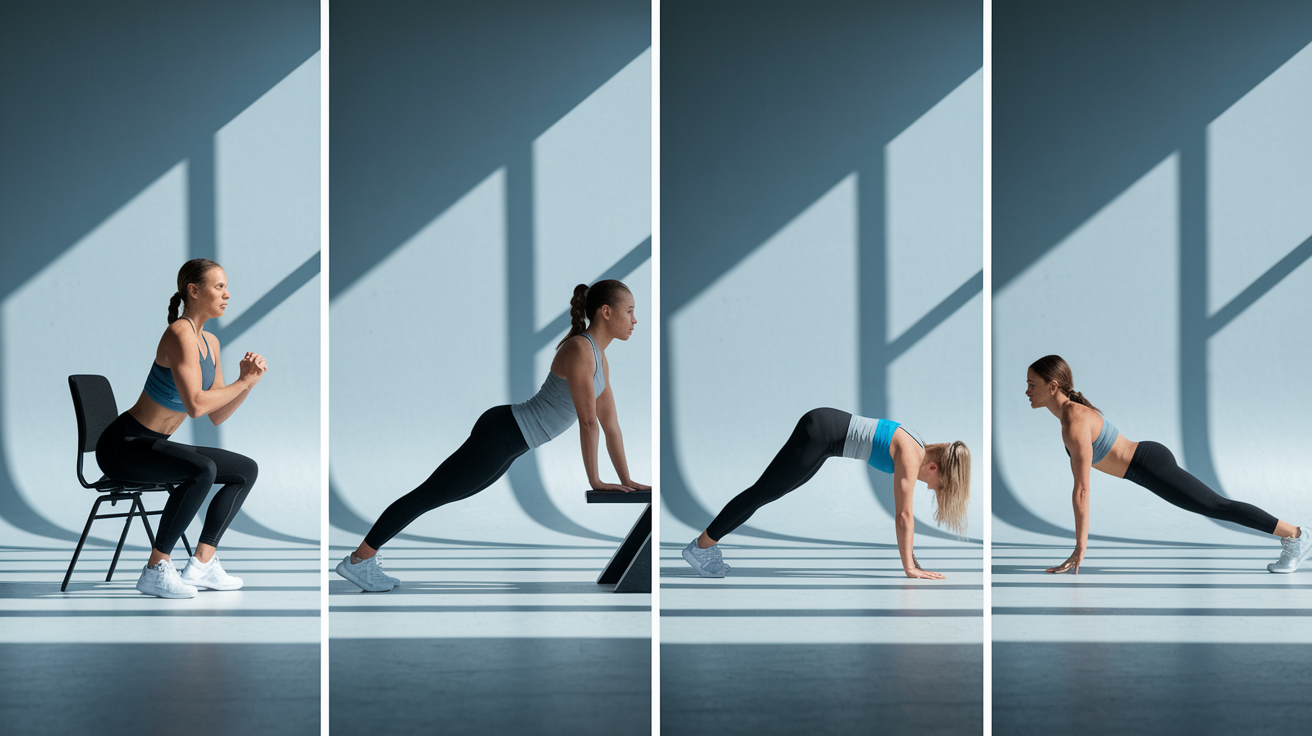
Strength A targets your legs, chest, glutes, and core in four foundational movements. The exercises use bodyweight or minimal support (a chair, a wall, the floor). Weeks 1 and 2 start with 2 to 3 sets of 8 to 10 reps on most moves. By Weeks 3 and 4, you’ll do 3 sets of 10 to 12 reps with better form and more control.
Progression happens by adding reps first, then sets, then resistance if you have it. If chair squats feel too easy at 10 reps, aim for 12. If 12 feels light, hold a backpack with books or a water jug at chest height. Small jumps add up.
Strength A exercises:
- Chair squats (sit back to a chair, stand up without using your hands). Weeks 1 to 2: 2 to 3 sets of 8 to 10; Weeks 3 to 4: 3 sets of 10 to 12
- Incline push-ups (hands on a chair or countertop, body in a straight line). Weeks 1 to 2: 2 to 3 sets of 6 to 8; Weeks 3 to 4: 3 sets of 8 to 10
- Glute bridges (lie on your back, feet flat, lift hips until knees, hips, shoulders form a line). Weeks 1 to 2: 2 to 3 sets of 10 to 12; Weeks 3 to 4: 3 sets of 12 to 15
- Bird dogs (on hands and knees, extend opposite arm and leg, hold 2 seconds). Weeks 1 to 2: 2 sets of 8 per side; Weeks 3 to 4: 3 sets of 8 to 10 per side
Optional Finisher for Strength A
If you have energy left, add 2 rounds of 30 to 40 seconds marching in place with high knees or fast feet (quick steps in place). This spikes your heart rate and wraps the session with a small conditioning bump. Skip it if you’re wiped. It’s a bonus.
Strength Circuit B: Lower Body, Pulling Strength, and Core Integration

Strength B balances Strength A by emphasizing single-leg work, hip hinge patterns, pulling movements, and anti-rotation core stability. The exercises prepare you for more advanced lifting later while building coordination and balance now.
Reverse lunges teach you to control one leg at a time without the balance challenge of a forward lunge. Doorway rows (grab the sides of a doorframe, lean back, pull yourself upright) build your back and biceps with zero equipment. Dead bugs train your core to resist rotation while your limbs move.
Strength B exercises:
- Reverse lunges (step back, lower back knee toward the floor, push through front heel to stand). Weeks 1 to 2: 2 to 3 sets of 6 to 8 per leg; Weeks 3 to 4: 3 sets of 8 to 10 per leg
- Hip hinge progression (hinge at hips, push butt back, keep back flat, stand up by squeezing glutes). Weeks 1 to 2: 2 to 3 sets of 10; Weeks 3 to 4: 3 sets of 12 to 15
- Doorway rows (lean back holding doorframe, pull chest toward hands, keep body straight). Weeks 1 to 2: 2 to 3 sets of 6 to 8; Weeks 3 to 4: 3 sets of 8 to 10
- Dead bugs (lie on back, arms up, knees bent 90°, lower opposite arm and leg slowly without arching back). Weeks 1 to 2: 2 sets of 8 per side; Weeks 3 to 4: 3 sets of 8 to 10 per side
The Hip Hinge Progression and Why It Matters
The hip hinge is the foundation for deadlifts, kettlebell swings, and any movement that loads your posterior chain. You’re teaching your hips to do the work instead of rounding your lower back. Start with bodyweight. Focus on pushing your hips back like you’re closing a car door with your butt. Keep your shins vertical and chest proud. When you can do 15 reps with a flat back, hold a water jug or backpack at chest height to add resistance.
Progressive Cardio Circuit Training for Beginners

Cardio circuits blend short bursts of movement with brief rest to build endurance and burn energy without long boring sessions. You’ll pick 6 to 8 moves, cycle through them for the prescribed work and rest intervals, then repeat the round. Each week, the work interval grows or the rest shrinks or you add another round.
Week 1 starts gentle: 30 seconds work, 15 seconds rest, two rounds through your chosen moves. Week 4 finishes at 45 seconds work, 15 seconds rest, three full rounds. That’s a 50 percent jump in total work time over four weeks, built gradually so your lungs and legs can keep up.
Sample circuit moves (pick 6 to 8):
- Marching in place with high knees
- Shadow boxing (throw punches in the air, keep moving)
- Skater steps (side to side hops or steps, like a speed skater)
- Low-impact jacks (step one foot out at a time instead of jumping)
- Plank taps (in plank position, tap one hand to opposite shoulder, alternate)
- Glute bridge march (hold bridge position, lift one foot at a time)
Steady-State Cardio and Active Recovery for Beginners

Steady-state cardio days are low-pressure. You move at a conversational pace for 20 to 30 minutes. If you can talk in full sentences without gasping, you’re in the right zone (RPE 4 to 6 on a 1 to 10 scale). These sessions improve your aerobic base, help you recover from strength work, and give your joints a break from loaded movements.
Pick an activity you can sustain without hating it. Brisk walking works for most people. Incline walking on a treadmill or outside adds a small challenge without impact. Cycling is joint-friendly. Shadow boxing keeps it interesting if you get bored easily.
Steady-state cardio options:
- Brisk walking outdoors or on a treadmill (flat or slight incline) for 20 to 30 minutes
- Cycling (stationary bike or road) at a pace where you can hold a conversation
- Shadow boxing with light footwork and continuous arm movement for 20 to 30 minutes
Progressive Overload and Load Selection for New Lifters
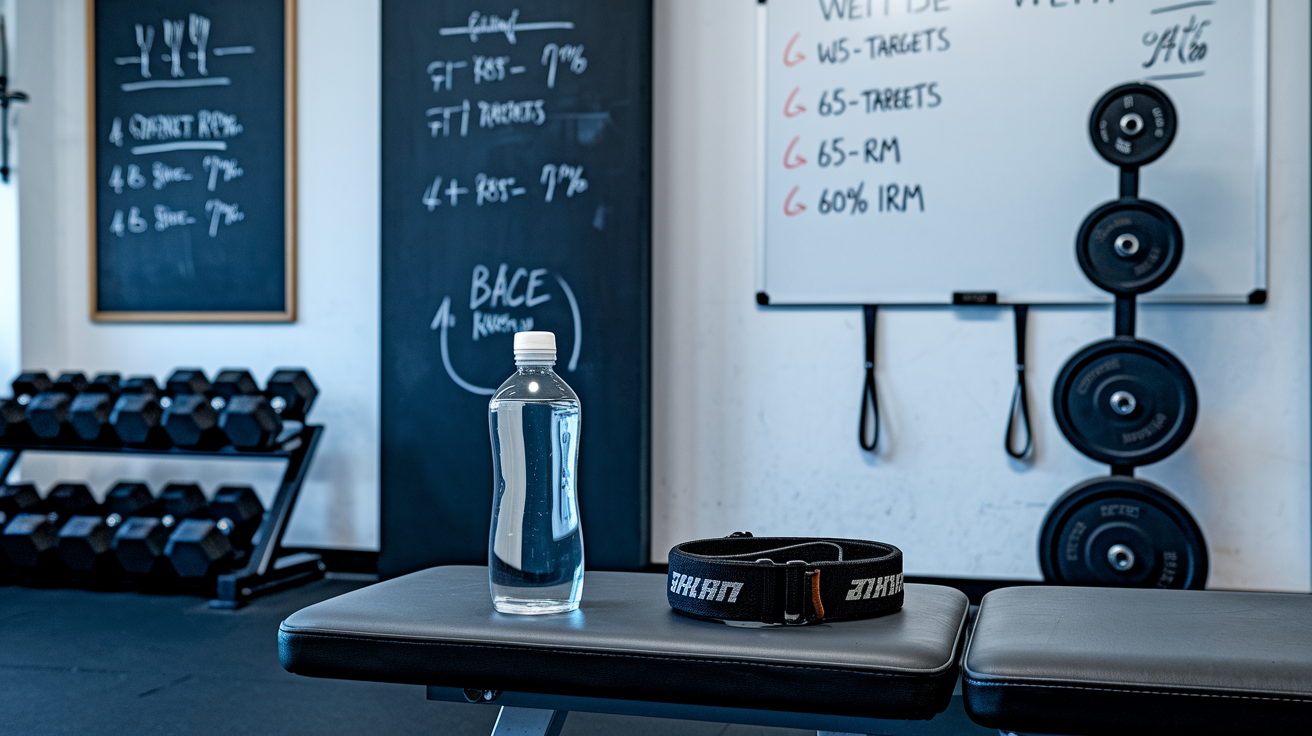
Progressive overload means adding a little more stress over time so your body adapts. For beginners, that usually means more reps, then more sets, then a bit more resistance. This program progresses weekly by increasing volume (sets and reps) and suggested load percentages if you have access to weights.
Week 1 targets 65 to 70 percent of your one-rep max (1RM) if you know it. Most beginners don’t, so start with a weight or resistance that feels moderate, around a 6 or 7 out of 10 effort. Week 2, if you can do more than 12 reps on an exercise, add 5 percent to upper-body moves (or 2.5 to 5 pounds) and 10 percent to lower-body moves (or 10 pounds). Week 3 moves to 70 to 75 percent of 1RM. Week 4 pushes to 75 to 80 percent.
Here’s a practical example. If your estimated 1RM on a dumbbell press is 40 pounds, 65 percent is about 26 pounds. Round to the nearest dumbbell you have, say 25 pounds. By Week 4, you’d aim for 32 pounds (80 percent of 40), so grab the 30s or 35s depending on availability.
| Week | %1RM Target | What to Adjust |
|---|---|---|
| 1 | 65 to 70% | Learn the movement, moderate effort |
| 2 | Same or +5 to 10% | If >12 reps, add 2.5 to 5 lb upper / 10 lb lower |
| 3 | 70 to 75% | Increase load slightly, keep reps in target range |
| 4 | 75 to 80% | Final week intensity, aim for upper end of rep ranges |
Exercise Modifications and Regressions for True Beginners

Not every version of an exercise will suit you on day one. That’s fine. Use regressions to match your current strength and mobility, then progress when you’re ready. Wall push-ups are easier than incline push-ups. Chair squats are easier than bodyweight squats without support. Shorter work intervals and fewer rounds make circuits manageable.
If 30-minute sessions feel too long, split them into two 10-minute blocks. Do half the workout in the morning, half at lunch or evening. If balance is shaky during reverse lunges, hold the back of a chair with one hand. If plank taps are too hard, hold a simple plank or drop to your knees.
Common modifications:
- Wall push-ups instead of incline push-ups (hands on wall, step feet back until body is angled)
- Chair squats with a taller chair or box so you don’t have to lower as far
- Reduce circuit work intervals to 20 seconds instead of 30 if you’re gasping for air
- Break workouts into two 10-minute sessions if time or energy is limited
- Hold a countertop or chair back during single-leg moves for balance support
Tracking Progress Throughout the 4-Week Strength Circuit Program

Progress tracking keeps you honest and motivated. Write down what you did after each session. Note the sets, reps, and how the last set felt. If you added a round to the circuit or held a plank 10 seconds longer, that’s progress. If you finished the week without skipping a session, celebrate that too.
You’re not chasing dramatic changes in four weeks. You’re proving to yourself that you can stick to a plan and get a little stronger each week. Energy and stamina improvements usually show up in 2 to 4 weeks. Body composition shifts take 8 to 12 weeks to measure reliably, so don’t obsess over the mirror yet.
Five ways to track progress:
- Write down sets, reps, and resistance (even if it’s “bodyweight” or “5 lb dumbbell”) after every workout.
- Note when you add a rep, set, or round compared to the previous week.
- Track adherence by checking off completed sessions on a calendar or app.
- Record how the last set of each exercise felt (easy, moderate, hard, couldn’t finish).
- Measure strength milestones like completing your first full push-up from the floor or holding a plank for 60 seconds without breaking.
Essential Cool-Down and Recovery Strategies
Cool-downs bring your heart rate down gradually and start the recovery process. Spend 3 to 5 minutes walking slowly or marching in place, then move into static stretches. Hold each stretch for 15 to 30 seconds without bouncing. Target the muscles you just used.
Soreness is normal, especially in the first two weeks. Pain is not. Soreness feels like a dull ache or tightness that peaks 24 to 48 hours after training (delayed onset muscle soreness). Pain is sharp, localized, or gets worse during movement. If you feel pain, rest and regress the exercise next session.
Post-workout static stretches:
- Quad stretch (stand on one leg, pull opposite heel toward butt, hold 20 seconds per side)
- Hamstring stretch (sit on floor, one leg extended, reach toward toes, hold 20 seconds per side)
- Chest stretch (stand in doorway, arm against frame at shoulder height, gently turn body away, hold 20 seconds per side)
- Child’s pose (kneel, sit hips back toward heels, reach arms forward on floor, hold 30 seconds)
Final Words
Start the plan this week: 4 days per week—Strength A, Strength B, a cardio circuit, and a steady-state or active recovery day. Get going with the full weekly layout and the short 20–30 minute sessions.
Use a 3–5 minute dynamic warm-up, follow the circuit templates, and finish with a quick cool-down. Progress by adding sets, reps, or circuit rounds. Track sets, RPE, and how you feel.
Follow the 4-week progressive beginner strength circuit program as written, aim for small gains each week, and rest well. You’ll build strength and confidence.
FAQ
Q: What is the 4-week beginner strength circuit framework?
A: The 4-week beginner strength circuit framework is a 4-day-per-week plan with 20–30 minute sessions: two strength days and two cardio/circuit days, plus brief dynamic warm-ups, cool-downs, and weekly progression.
Q: How is the weekly schedule structured and how often do I train?
A: The weekly schedule is two strength sessions, one cardio circuit, and one steady-state or active recovery day, with three rest or light movement days to balance work, recovery, and steady progress.
Q: How does the program progress week to week?
A: The program progresses by adding sets, reps, or duration each week, increasing intensity modestly, and using RPE/talk test cues so you get slightly harder but still recover well.
Q: What should I do for a warm-up?
A: The warm-up is 3–5 minutes of dynamic moves that prep joints and raise heart rate, like arm swings, leg swings, hip circles, marching, and mobility drills for 20–30 seconds each.
Q: What exercises are in Strength Circuit A and how do they progress?
A: Strength Circuit A includes chair squats, incline push-ups, glute bridges, and bird dogs, progressing from lower sets/reps in Weeks 1–2 to higher sets/reps by Week 4 for strength and movement quality.
Q: What exercises are in Strength Circuit B and how do they progress?
A: Strength Circuit B includes reverse lunges, a hip-hinge pattern, doorway rows, and dead bugs, progressing reps and sets over four weeks to build lower-body, pulling strength, and core control.
Q: How do the cardio circuits change across the four weeks?
A: The cardio circuits progress from 30/15×2 rounds in Week 1 to 45/15×3 rounds by Week 4, gradually increasing work time, rounds, or short rest to boost endurance and muscular stamina.
Q: What are easy exercise modifications if I’m a true beginner?
A: Easy modifications include wall push-ups, chair squats, shorter circuit durations, incline push-ups instead of floor, and splitting workouts into 10-minute blocks when time or energy is limited.
Q: How should I choose weights and apply progressive overload?
A: Weight selection targets roughly 65–80% 1RM across four weeks, increasing load when you exceed rep targets; add small weight jumps or more reps to keep steady, safe progress.
Q: How should I track progress during the 4 weeks?
A: Track progress by noting sets, reps, rounds completed, perceived difficulty, weekly adherence, and small strength gains—use a simple log or app to record changes and consistency.
Q: What should I do on steady-state cardio and active recovery days?
A: Steady-state cardio and recovery days are 20–30 minutes of conversational pace walking, cycling, or shadow boxing, plus light stretching to aid recovery without taxing the body.
Q: How should I cool down and manage recovery after workouts?
A: The cool-down is 3–5 minutes, including easy walking then 15–30 second static stretches for major muscles; focus on hydration, sleep, and gradual mobility to reduce soreness and speed recovery.