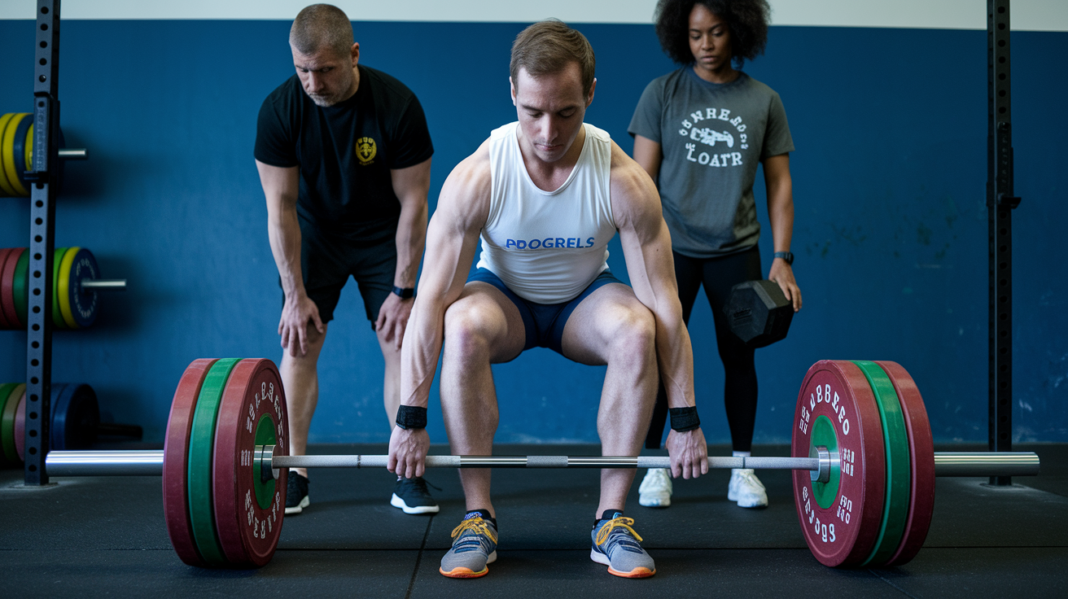
Think resistance bands are just for physical therapy or light warm-ups? Wrong.
If you’re new to strength training and short on time, this full-body band circuit builds real strength in 20–35 minutes.
It uses eight compound moves, steady tension, and simple sets you can repeat.
No confusing equipment, no guessing which band to use, just a clear routine that hits every major muscle.
Start with a medium band, follow the tempo, and you’ll develop movement and strength that show up in daily life.
This is the exact circuit that works.
Complete Beginner Full-Body Circuit With Resistance Bands

Most beginner strength circuits overthink it. You just need compound movements, steady tension, and a structure that doesn’t leave you guessing.
This full-body band circuit uses 8 exercises that hit every major muscle group. You’ll knock out 3 rounds total, working 8–12 reps per exercise (or 30–45 seconds for holds). Rest 15–30 seconds between exercises and 60–90 seconds between rounds. Total time? 20–35 minutes with warm-up and cool-down.
Band tension matters right away. Light bands give you roughly 5–15 pounds of resistance at full stretch, medium bands offer 15–35 pounds, heavy bands reach 35–60 pounds. Start with a medium band for compound moves like squats and rows. Use a light band for isolation work like lateral raises until the pattern feels natural.
The 8-Exercise Full-Body Band Circuit:
-
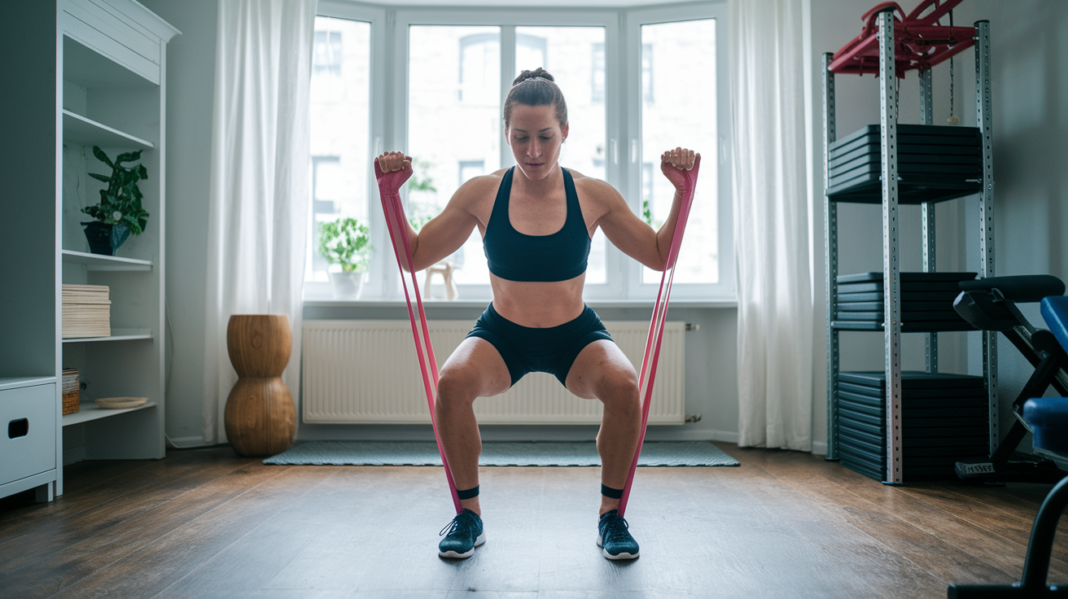
Band Squat – Stand on band center, handles at shoulders. Squat to 90 degrees, knees tracking toes. Tempo 2-0-2. 8–12 reps. Hits quads, glutes, core.
-
Banded Romanian Deadlift – Stand on band, hinge at hips with neutral spine, feel hamstring stretch. Drive hips forward to return upright. 8–12 reps. Hits hamstrings, glutes, lower back.
-
Banded Chest Press – Anchor band at mid-back height or loop around a sturdy post. Press forward at chest level, don’t let elbows flare. 8–12 reps. Hits chest, triceps, shoulders.
-
Banded Row – Stand on band, hinge slightly, pull handles to ribs. Squeeze shoulder blades at top. Tempo 2-0-2. 8–12 reps. Hits lats, rhomboids, biceps.
-
Banded Overhead Press – Stand on band center, handles at shoulders. Press overhead without arching lower back. 8–12 reps. Hits shoulders, triceps, upper chest.
-
Glute Bridge With Band – Lie on back, feet in handles or band looped above knees. Drive hips up, hold top for 1–2 seconds. 12–15 reps. Hits glutes, hamstrings, core.
-
Lateral Band Walk – Mini band above knees or long band under feet. Walk sideways in quarter-squat, 10–15 steps per direction. Hits glute medius, hip stabilizers.
-
Pallof Press or Banded Plank – Anchor band at chest height. Hold handle at sternum and press straight out, resisting rotation. Hold 20–40 seconds or perform 8–12 presses per side. Hits core, obliques, anti-rotation stability.
Equipment and Band Selection for Beginner Strength Circuits
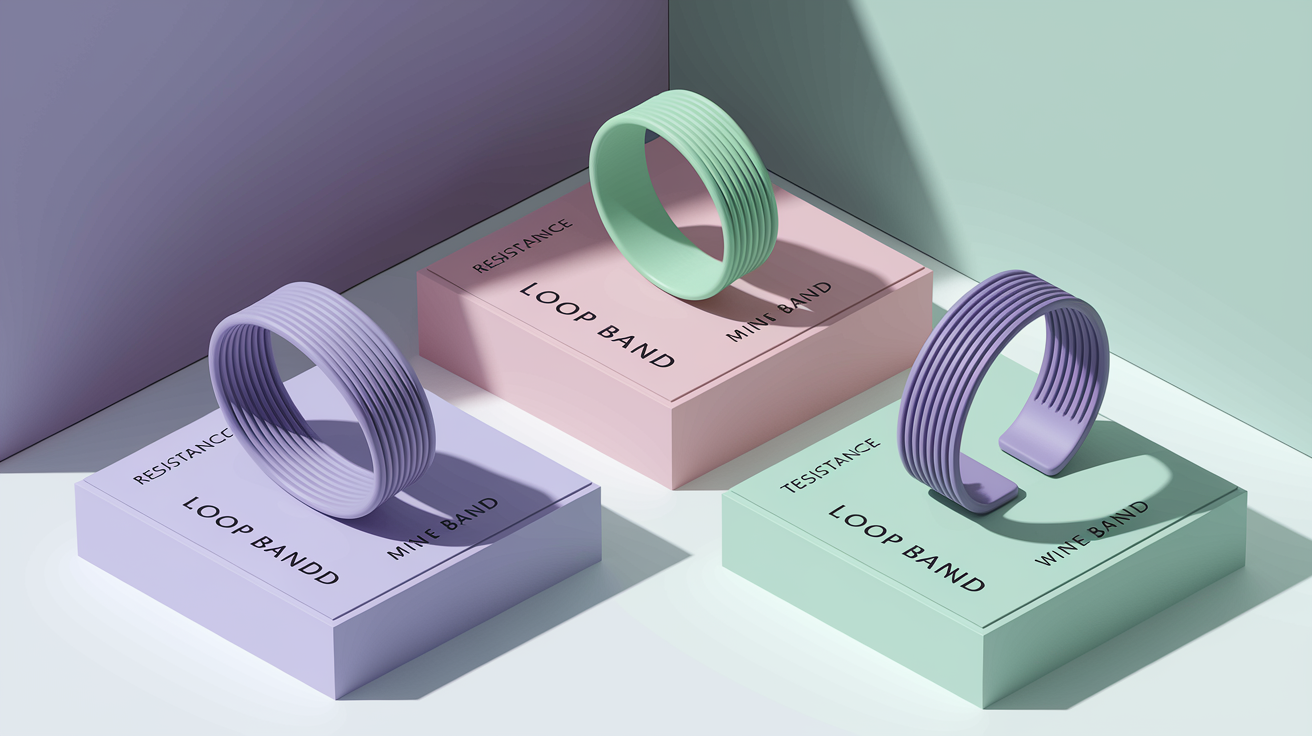
You don’t need a full home gym to run an effective resistance band circuit. A starter set covering light, medium, and heavy resistance, one tube band with handles, a door anchor, and an exercise mat will cover every movement in this program. Total cost runs $20–60 depending on brand and bundle deals.
Quality beats variety. Inspect bands for even thickness, smooth edges, and no visible nicks or abrasions before you buy. Cheap latex tears within weeks. Durable layered bands or fabric-wrapped loop bands last years.
Band types and best-use cases:
Sheet bands (therapy bands) – Thin latex sheets, lowest resistance. Best for rehab, mobility warm-ups, or very early-stage strength work.
Loop bands (closed loops) – Continuous bands in various tensions. Best for lower-body work, glute activation, and banded squats or bridges.
Mini bands – Short loop bands, typically 12–18 inches. Best for lateral walks, clamshells, and hip stability drills.
Tube bands with handles – Dense tubing with plastic or foam grips. Most versatile option for upper-body presses, rows, and curls. Recommended for this full-body circuit.
| Band Type | Best Use Case | Typical Resistance Range |
|---|---|---|
| Loop bands | Squats, deadlifts, glute bridges | 5–60 lb equivalent |
| Mini bands | Lateral walks, hip abduction, activation | 5–25 lb equivalent |
| Tube bands with handles | Rows, presses, curls, full-body circuits | 10–60 lb equivalent |
Warm-Up Routine to Prepare for a Full-Body Band Circuit

Jumping straight into loaded squats or rows with cold muscles increases injury risk and limits performance. A structured 5–7 minute warm-up raises core temperature, gets joints moving, and activates the muscle groups you’re about to load.
Dynamic movement works better than static stretching before strength work. You’re looking for controlled range of motion, not deep holds. Light band work during the warm-up also primes your nervous system for tension and stabilization patterns you’ll use in the circuit.
Five-part dynamic warm-up sequence:
-
Marching in place – 60–90 seconds. Lift knees to hip height, swing arms naturally. Focus on staying upright and breathing steady.
-
Arm circles – 10–15 circles forward, 10–15 backward. Start small, gradually increase diameter. Wakes up shoulders and upper back.
-
Band pull-aparts – 10–15 reps. Hold light band at chest height, arms extended. Pull band apart to chest level, squeezing shoulder blades. Activates rear delts and scapular retractors.
-
Bodyweight squats – 10–15 reps. Feet shoulder-width, squat to comfortable depth. No load, just movement quality and hip mobility.
-
Bodyweight hip hinges – 8–12 reps. Hinge at hips, reach hands toward shins, keep back flat. Prepares hamstrings and glutes for loaded hinge patterns like the RDL.
Exercise Form Breakdown for Full-Body Resistance Band Strength
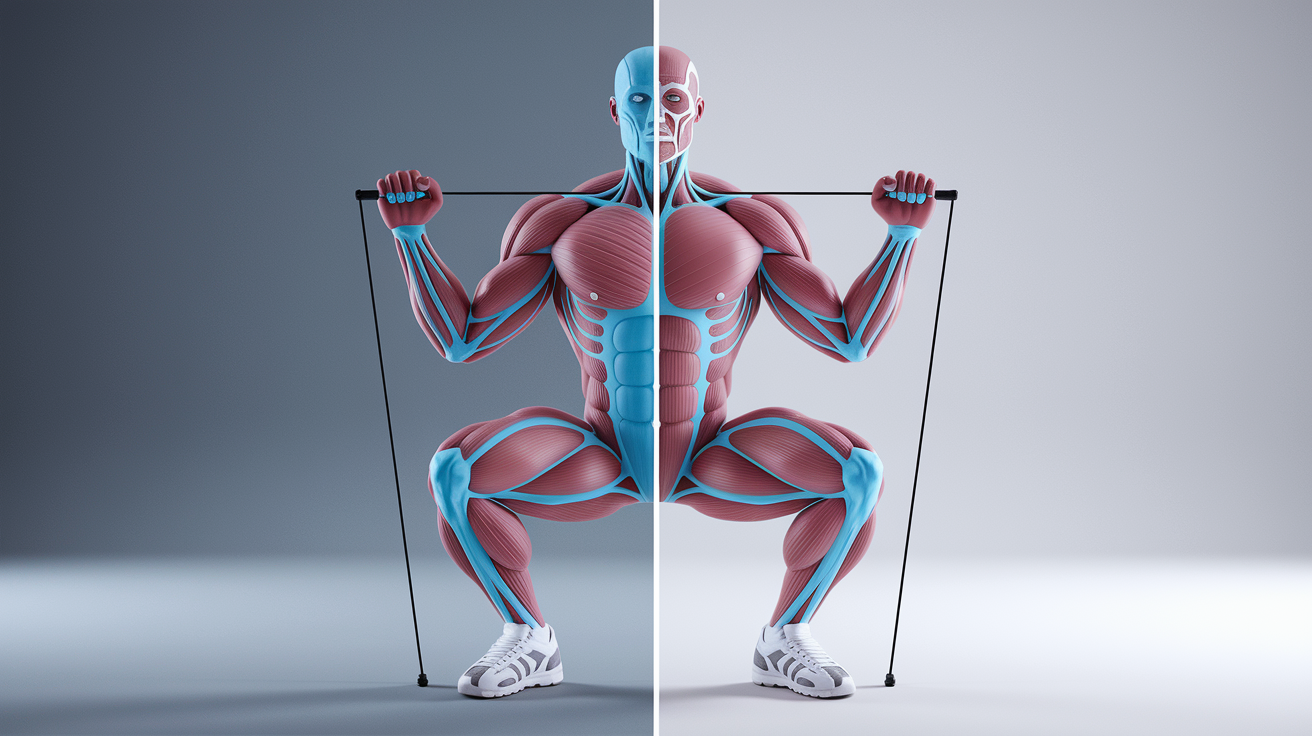
Good form under band tension looks different than barbell or dumbbell lifting. Bands pull hardest at full stretch, so you need constant tension and control through the entire range. Jerky reps or momentum kills the training effect and increases injury risk.
Band Squat
Stand on the center of the band with feet shoulder-width apart. Bring handles up to shoulder height, palms facing inward or forward depending on comfort. Squat down by pushing hips back and bending knees, keeping your chest up and knees tracking over toes. Descend until thighs are roughly parallel to the floor or as low as your mobility allows without rounding your lower back. Push through your heels to stand. Use a 2-0-2 tempo (two seconds down, no pause, two seconds up).
Don’t let knees cave inward. Fix it by pressing knees slightly outward throughout the movement. To make it easier, use a lighter band or reduce depth. To make it harder, pause for two seconds at the bottom.
Banded Romanian Deadlift
Stand on the band with feet hip-width apart. Hold handles at your sides, palms facing your thighs. Hinge at the hips by pushing your glutes backward, keeping a slight bend in your knees and a neutral spine. Lower the handles toward mid-shin, feeling a stretch in your hamstrings. Return to standing by driving your hips forward and squeezing your glutes at the top. Tempo is controlled, 2-0-2.
Rounding the lower back is the most common error. Keep your chest proud and shoulder blades pulled back slightly. If you feel this only in your lower back, reset your hinge pattern with bodyweight drills first. For progression, slow the eccentric to three seconds or use a heavier band.
Banded Chest Press
Anchor the band at mid-back height using a door anchor or loop it around a sturdy post. Face away from the anchor, handles in each hand at chest level, elbows bent at 90 degrees. Step forward to create tension. Press both handles forward until arms are fully extended, keeping your core tight and ribs down. Don’t shrug shoulders or let elbows flare wide. Retract slowly with control. Tempo 2-0-2, 8–12 reps.
Overarching the lower back when pressing is the main mistake. Brace your abs like you’re about to take a punch. Make it easier by stepping closer to the anchor. Make it harder by stepping farther away or adding a one-second hold at full extension.
Banded Row
Stand on the band, feet hip-width apart. Hold handles with arms extended down, palms facing each other. Hinge slightly forward at the hips, keeping your back flat. Pull the handles toward your lower ribs, leading with your elbows and squeezing your shoulder blades together at the top. Lower with control. Tempo 2-0-2, 8–12 reps.
Using momentum or letting shoulders round forward is the biggest error. Think about pulling your elbows behind your torso, not just bending your arms. To make it easier, reduce the hinge angle and stand more upright. To make it harder, pause for two seconds at peak contraction or use a single-arm variation.
Banded Overhead Press
Stand on the center of the band, feet shoulder-width apart. Bring handles to shoulder height, palms facing forward. Press both handles straight overhead until arms are fully extended, without leaning back or arching your lower back. Lower with control to shoulder height. Tempo 2-0-2, 8–12 reps.
Overextending the lumbar spine to compensate for limited shoulder mobility is the common mistake. Keep your core engaged and ribs pulled down throughout the press. If you can’t press without arching, use a lighter band or perform a kneeling overhead press to reduce compensation. Progress by adding a three-second eccentric or using a heavier band.
Glute Bridge With Band
Lie on your back with knees bent and feet flat on the floor, hip-width apart. Loop the band above your knees or place your feet inside handles for added resistance. Drive through your heels and lift your hips toward the ceiling, squeezing your glutes hard at the top. Hold for 1–2 seconds, then lower with control. Don’t push with your hands. Keep them flat on the floor for balance only. Perform 12–15 reps.
Overextending the lower back at the top instead of using the glutes is the main error. Focus on a posterior pelvic tilt and think about driving your knees slightly outward. Make it easier by removing the band. Make it harder by performing single-leg bridges or adding a five-second hold at the top.
Lateral Band Walk
Place a mini band above your knees or stand on a long loop band to create resistance. Stand in a quarter-squat position with feet shoulder-width apart, knees slightly bent, and core engaged. Step sideways 10–15 steps in one direction, keeping tension on the band throughout. Step back 10–15 steps in the opposite direction. Keep your hips level and don’t bounce.
Standing too upright or letting knees collapse inward is the common mistake. Stay low, push knees out against the band, and keep tension constant. To make it easier, use a lighter band or reduce the number of steps. To make it harder, use a heavier band or hold the quarter-squat lower.
Pallof Press or Banded Plank
For the Pallof press, anchor the band at chest height. Stand perpendicular to the anchor, feet shoulder-width apart, and hold the handle at your sternum with both hands. Press the handle straight out in front of you, resisting the rotational pull of the band. Hold for 1–2 seconds, then bring it back to your chest. Perform 8–12 presses per side, then switch.
For the banded plank variation, anchor the band low, get into a plank position on your forearms, and loop the band around your torso or hold a handle. Resist the pull by keeping your hips square. Hold for 20–40 seconds.
Rotating your torso or letting your hips sag is the main error. Brace your core like you’re bracing for impact and keep everything aligned. Make it easier by reducing hold time or stepping closer to the anchor. Make it harder by increasing hold time or adding a slow press-out-and-return tempo.
Modifications and Exercise Scaling for Beginner Band Circuits

Not every beginner starts at the same strength or mobility level. Some people breeze through 12 reps with a medium band. Others need a lighter band and fewer rounds to maintain good form. Both are fine. The goal is to match intensity to your current capacity and build from there.
Five ways to make the circuit easier:
Reduce range of motion (partial squats, shorter RDL descent). Switch to a lighter resistance band or remove the band entirely for bodyweight-only reps. Drop total rounds from 3 to 2 and focus on movement quality. Increase rest between exercises to 45 seconds instead of 15–30. Replace high-skill moves (Pallof press) with simpler holds (standard plank).
Five ways to make the circuit harder:
Use a heavier band or double up two bands for compound moves. Slow the tempo to 3-1-3 (three seconds down, one-second pause, three seconds up). Add five pulses at the end of each set (small reps at peak contraction). Increase total rounds from 3 to 4 without extending rest periods. Reduce rest between exercises to 10 seconds for a conditioning effect.
Circuit Timing, Structure, and Rest Intervals for Full-Body Band Work
Circuit structure controls intensity, recovery, and total session duration. A beginner who rests 60 seconds between every exercise will finish the same workout in twice the time as someone resting 15 seconds. Neither approach is wrong, but the training stimulus changes.
The standard beginner template balances muscle fatigue with enough recovery to maintain form. You perform one set of each exercise back-to-back with short rest, complete all eight movements, then rest longer before starting the next round. This keeps your heart rate elevated while giving individual muscle groups time to recover.
After testing this structure with beginners for years, the sweet spot is 3 rounds, 8–12 reps per exercise (or 30–45 seconds for holds), 15–30 seconds of rest between exercises, and 60–90 seconds of rest between rounds. Total work time runs 18–24 minutes. Add a 5-minute warm-up and 5-minute cool-down, and you’re done in 30–35 minutes.
Four example circuit timing templates:
Strength-focus template – 3 rounds, 10–12 reps per exercise, 30 seconds rest between moves, 90 seconds rest between rounds. Total time: ~28 minutes.
Conditioning-focus template – 3 rounds, 30–45 seconds work per exercise, 15 seconds rest between moves, 60 seconds rest between rounds. Total time: ~22 minutes.
Endurance-focus template – 4 rounds, 12–15 reps per exercise, 20 seconds rest between moves, 60 seconds rest between rounds. Total time: ~32 minutes.
Beginner-friendly template – 2 rounds, 8–10 reps per exercise, 45 seconds rest between moves, 90 seconds rest between rounds. Total time: ~18 minutes.
Four-Week Beginner Progression for Resistance Band Full-Body Circuits

Progressive overload means adding a small controlled stress each week. With bands, you increase reps, add rounds, reduce rest, or step up to heavier resistance. The mistake most beginners make is changing too many variables at once. Pick one lever per week.
This four-week plan starts conservative and builds volume and intensity gradually. Week one establishes your baseline with lighter bands and lower volume. Week two adds a round. Week three increases reps and tension. Week four pushes total workload and reduces rest slightly for a conditioning effect.
| Week | Rounds | Reps | Band Tension | Notes |
|---|---|---|---|---|
| 1 | 2 | 8–10 | Light to medium | Focus on form and movement quality; rest 30 sec between exercises, 90 sec between rounds |
| 2 | 3 | 8–12 | Medium | Add one round; maintain rest intervals; aim for 10–12 reps on compound moves |
| 3 | 3 | 10–15 | Medium to heavy (compound moves) | Increase band tension on squats, RDLs, rows; keep lighter bands for presses and isolation work |
| 4 | 3–4 | 12–15 | Medium to heavy | Add optional fourth round or reduce rest between exercises by 10–20 sec for conditioning; target upper rep range |
Safety Guidelines, Injury Prevention, and Band Maintenance

Resistance bands are low-impact and joint-friendly, but they’re not foolproof. Bands snap when they’re worn out. Anchors fail when they’re secured to weak points. Form breaks down when fatigue sets in. A few simple checks before every session prevent most problems.
Inspect your bands every time you train. Look for small tears, fraying edges, discoloration, or thin spots. If you see any damage, replace the band. A snapped band under tension can whip back and cause cuts, bruises, or eye injuries. Store bands away from direct sunlight and heat, which degrade latex over time.
Anchor points matter as much as the bands themselves. Door anchors work well when placed over the hinge side of a solid door, not the handle side. Don’t loop bands over sharp furniture edges or hooks. Test the anchor with a firm pull before you start your set. If it shifts or feels unstable, find a better point.
Six essential safety checks:
Inspect all bands for visible tears, nicks, or worn sections before each workout. Secure anchors on stable, smooth surfaces; don’t use sharp edges or weak furniture. Maintain a neutral spine on all hinge and squat patterns; stop immediately if you feel sharp pain. Control the eccentric (lowering) phase of every rep; never let the band snap back. Wear supportive shoes on smooth flooring to prevent slipping during anchored or standing exercises. Consult a healthcare provider before starting if you’re pregnant, recovering from surgery, or managing cardiovascular or orthopedic conditions.
Cool-Down and Recovery After a Full-Body Resistance Band Circuit

Your muscles are warm, your heart rate is elevated, and your nervous system is still firing. Stopping abruptly and sitting down feels tempting, but a structured cool-down helps clear metabolic waste, reduces soreness, and signals your body to shift into recovery mode.
Spend 5–7 minutes on static stretching after your final round. Hold each stretch for 30–45 seconds without bouncing. Focus on the muscle groups you just trained: hamstrings, quads, glutes, chest, shoulders, and thoracic spine. Breathing should be slow and controlled. This isn’t a flexibility session. You’re just returning muscles to resting length and lowering your heart rate gradually.
Six-part static cool-down sequence with hold times:
Standing hamstring stretch – 30–45 seconds per leg. Place one heel on a low step or bench, hinge at hips, reach toward toes.
Standing quad stretch – 30–45 seconds per leg. Pull one foot toward glutes, keep knees together, stand tall.
Glute stretch (figure-4) – 30–45 seconds per side. Sit or lie on back, cross one ankle over opposite knee, pull knee toward chest.
Doorway chest stretch – 30–45 seconds. Place forearm on doorframe at shoulder height, step forward gently until you feel stretch across chest and front shoulder.
Overhead shoulder stretch – 30–45 seconds per arm. Reach one arm overhead, bend elbow, use opposite hand to gently pull elbow behind head.
Thoracic rotation stretch – 30–45 seconds per side. Lie on side with knees bent, open top arm across body, rotate upper back toward floor.
Weekly Training Frequency and Full-Body Band Workout Scheduling
Training frequency depends on recovery capacity, training age, and total weekly volume. Beginners recover faster from band work than heavy barbell training, but you still need at least 48 hours between full-body sessions to allow muscle repair and adaptation.
Two to three sessions per week hits the sweet spot for most beginners. Two sessions work well if you’re combining band circuits with other activity like walking, yoga, or sports. Three sessions per week speed up strength and muscle endurance gains without overtraining. Anything beyond three full-body sessions per week risks accumulated fatigue and reduced performance unless you’re an advanced trainee managing volume carefully.
| Day | Workout | Notes |
|---|---|---|
| Monday | Full-body band circuit | Perform all 8 exercises, 3 rounds, follow progression plan |
| Tuesday | Active recovery or rest | Light walking 20–30 min, mobility work, or complete rest |
| Wednesday | Full-body band circuit | Same structure as Monday; track reps and band tension |
| Thursday | Active recovery or rest | Light walking, stretching, or yoga |
| Friday | Full-body band circuit | Optional third session; reduce to 2 rounds if fatigued |
| Saturday | Active recovery | Walk, hike, or recreational activity |
| Sunday | Rest | Full rest day; prioritize sleep and hydration |
Final Words
Get moving: start with the 5 to 7 minute warm-up, then run the 8-exercise circuit for 3 rounds using the suggested reps, rest, and band tensions. Keep tempo and form simple.
Follow the four-week progression. Add reps or increase band tension gradually, track what you do, and use easier or harder options as needed. Do safety checks and finish with a short cool-down.
Aim to do the resistance band beginner strength circuit full body 2 to 3 times a week. Stay consistent and you’ll see steady, real progress.
FAQ
Q: What is a complete beginner full-body circuit with resistance bands?
A: The complete beginner full-body circuit with resistance bands is a short, balanced routine of 6–10 band exercises that train all major muscles, set up as rounds with simple reps, tempo, and short rests for 20–40 minutes.
Q: How many exercises, rounds, reps, and rest should I do?
A: The recommendation is 6–10 exercises, 3 rounds, 8–12 reps or 30–45 seconds per move, 15–30 seconds rest between exercises, and 60–90 seconds rest between rounds.
Q: What band tensions should beginners choose?
A: Beginners should use light (≈5–15 lb) or medium (≈15–35 lb) bands so the last 2–3 reps feel challenging but doable—move up in tension once reps become easy with good form.
Q: How long will a typical session take?
A: A typical session lasts about 20–40 minutes total, including a 5–7 minute warm-up, 15–30 minutes for the circuit depending on rounds/rest, plus a 5–7 minute cool-down.
Q: How do I progress over four weeks?
A: Progress by Week 1: 2 rounds, Week 2: 3 rounds, Week 3: raise reps to 10–15 or increase tension, Week 4: 3–4 rounds and slightly reduce rest to increase load.
Q: What equipment do I need and how do I choose bands?
A: You need loop bands (light/medium/heavy), a long tube band with handles, a door anchor, and a mat; pick tube bands for versatility and match band color to the resistance chart.
Q: What warm-up should I do before the circuit?
A: Warm up 5–7 minutes with marching (60–90 sec), arm circles (10–15 each), band pull-aparts (10–15), bodyweight squats (10–15), and hip-hinge reps (8–12) to raise heart rate and activate muscles.
Q: How do I scale exercises to be easier or harder?
A: Scale easier by reducing range of motion, using lighter bands, or cutting rounds; scale harder by increasing band tension, adding reps, slowing tempo, or adding an extra round.
Q: What safety checks and maintenance should I follow?
A: Always inspect bands for tears or fraying, anchor to smooth points or use a door anchor, keep a neutral spine, stop for sharp pain, replace damaged bands, and consult a provider for medical concerns.
Q: How often should I train each week and schedule workouts?
A: Train 2–3 full-body band sessions per week with at least 48 hours between sessions; add light walking or mobility on off days and optional short cardio intervals for conditioning.
Q: What should I do for cool-down and recovery?
A: Cool down 5–7 minutes with static stretches (hamstrings, quads, glutes, chest, shoulders, thoracic rotation, 30–45 seconds each), hydrate, and plan 1–2 easy recovery days after intense sessions.