

Think shorter rests always make you fitter?
That’s not true for beginners.
How long you pause between moves and between rounds, exercise rest vs circuit rest, decides whether you build real endurance or just get sloppy.
This post shows simple rules and ready-to-use templates for beginners: when to use 30 to 90 seconds between exercises, when to take 1 to 3 minutes between rounds, and how to tweak timing for skill, load, and safety.
By the end you’ll have a clear plan to progress without losing form.
Core Rest Timing Principles for Beginner Strength Circuits
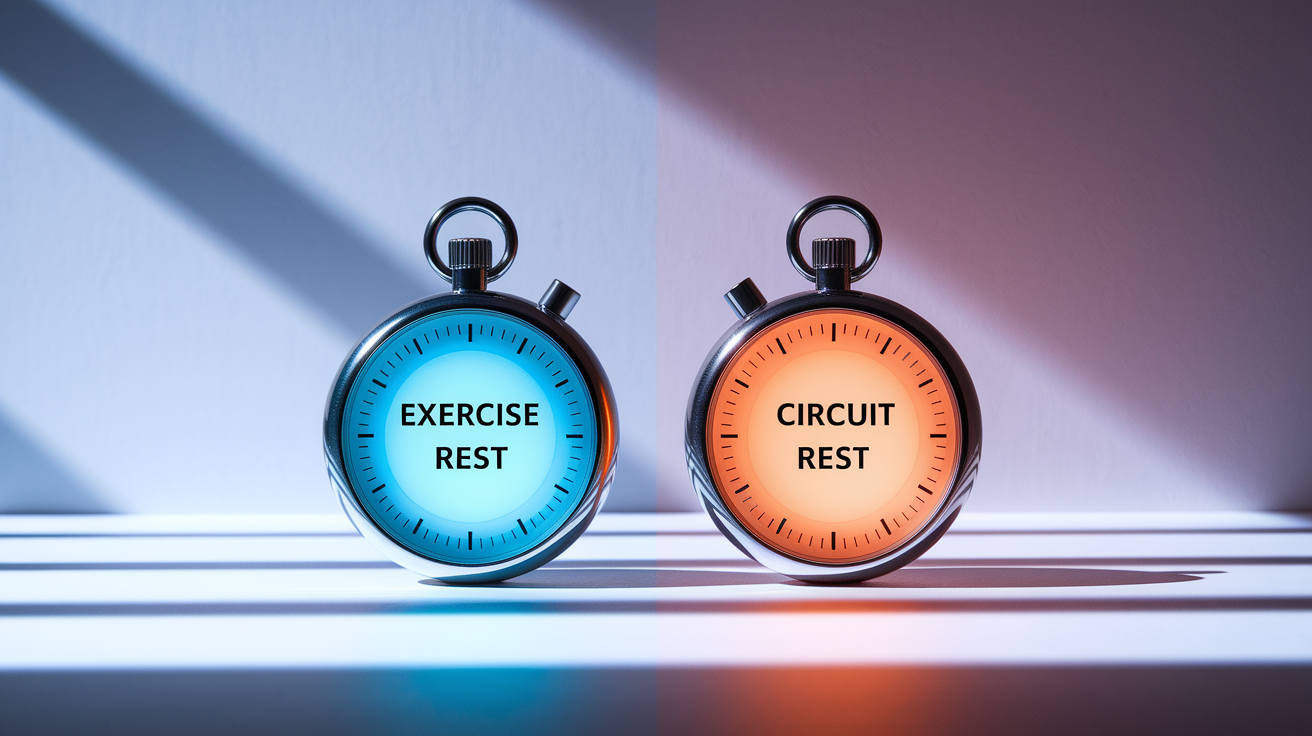
Rest intervals in strength circuits break into two different categories. You’ve got exercise rest, which is the pause after one movement before you start the next one. Then there’s circuit rest, the longer recovery you take after finishing all the exercises in the sequence before you go again.
For most beginners, exercise rest lands somewhere between 30 and 90 seconds. That gives you partial recovery while keeping your heart rate up enough to create a conditioning effect. Circuit rest usually runs 1 to 3 minutes because your body needs more time to clear out metabolic waste and get ready for another full round. Starting with 2 to 3 minutes of circuit rest is totally normal when you’re new to structured training.
The logic ties directly to how your body produces energy and learns movement. Short rests keep metabolic demand high and improve cardiovascular fitness, but they can trash your technique if you’re still learning a lift. Moderate rests protect form while delivering enough cardio challenge to make circuits worth doing. Too short and your technique collapses. Too long and you lose the metabolic benefit.
Here are six common beginner rest structures:
- 1:1 ratio time based – 45 seconds work, 45 seconds rest between exercises, 90 seconds between rounds.
- 1:2 ratio for heavier loads – 30 seconds work, 60 seconds rest between exercises, 2 minutes between rounds.
- Rep based strength focus – 8 to 12 reps per exercise, 60 seconds between exercises, 2 to 3 minutes between rounds.
- Higher rep endurance focus – 12 to 20 reps per exercise, 30 to 45 seconds between exercises, 60 to 90 seconds between rounds.
- Beginner conditioning – 40 seconds work, 40 seconds rest at each of 6 stations, 90 seconds between rounds, 3 rounds total.
- Mixed intensity circuit – compound lifts get 90 seconds rest, bodyweight moves get 45 seconds rest, 2 minutes between full rounds.
Applying Rest Adjustments Based on Skill, Complexity, and Movement Demands

Movement complexity changes how much rest you actually need. When you’re learning a new lift or doing something that demands balance, coordination, or multiple steps in sequence, your nervous system is working as hard as your muscles. Rushing into the next set while your brain’s still processing the last rep leads to sloppy technique and wasted practice.
High skill moves like single leg Romanian deadlifts, Turkish get ups, or even walking lunges with overhead presses require more mental focus than a simple biceps curl. If you’re still figuring out the movement pattern, add an extra 15 to 60 seconds of rest even if your breathing feels fine. Your goal in the first few weeks is building a reliable motor pattern, not chasing fatigue.
Here are four situations where extending rest makes sense:
- First time performing a lift – use 60 to 120 seconds between efforts to allow full mental reset and review of coaching cues.
- Balance or single leg movements – add 15 to 30 seconds if you feel wobbly or need extra time to set your position.
- Movements with external load and coordination demand – stuff like walking lunges with dumbbells or kettlebell swings. Rest 60 to 90 seconds to preserve control.
- Any exercise where your last rep showed noticeable form degradation – immediately add 10 to 30 seconds of rest or reduce load before continuing.
How Exercise Type and Load Influence Rest Duration in Beginner Circuits

Not all exercises tax your body the same way, so treating every station with identical rest sets you up for either poor performance or wasted time. Compound movements that recruit multiple joints and large muscle groups demand more recovery between efforts because they produce greater central nervous system fatigue and higher metabolic cost. Think squats, deadlifts, rows, presses.
Single joint isolation moves and bodyweight exercises typically allow shorter rest because the total system stress is lower and technique’s easier to maintain under fatigue. A biceps curl or glute bridge doesn’t require the same neural coordination or energy output as a barbell back squat. Load plays a major role too. If you’re lifting near your 8 rep max on a goblet squat, you’ll need closer to 90 seconds to recover enough force production for the next set. Air squats for 15 reps? 30 to 45 seconds is usually plenty.
| Exercise Type | Recommended Rest Duration |
|---|---|
| Compound multi-joint (squat, deadlift, row, press) | 60 to 90 seconds between exercises, 90 to 180 seconds between rounds if load is heavy |
| Single joint isolation (biceps curl, lateral raise, leg curl) | 30 to 60 seconds between exercises |
| Bodyweight conditioning (air squat, push-up, plank) | 30 to 60 seconds between exercises |
| High skill or balance heavy (single leg RDL, Turkish get-up) | 60 to 120 seconds until technique is reliable |
| Power or explosive moves (kettlebell swing, box jump) | 60 to 120 seconds to preserve quality and avoid compensatory patterns |
Work to Rest Ratios and Timing Formats for Beginner Strength Circuits

Work to rest ratios give you a simple framework for planning how long you work versus how long you recover, and they change the training effect of your session. A 1:1 ratio means equal work and rest. Like 45 seconds of goblet squats followed by 45 seconds of standing around or light movement. A 1:2 ratio doubles your rest, so 30 seconds of work gets 60 seconds of recovery. Beginners often start with 1:1 or 1:2 ratios because they allow you to maintain decent form while still getting a metabolic challenge.
Three common timing formats show up in beginner programs, and each one handles rest a little differently. Fixed timed circuits give you a set work period at each station and a set rest period, then you rotate. AMRAPs (as many rounds as possible) let you control your own micro rests within a time cap. Can be useful but also risky if you push too hard too early. EMOMs (every minute on the minute) assign a specific task to complete at the top of each minute, and whatever time’s left over becomes your rest.
AMRAP Rest Patterns
In an AMRAP, you’re racing the clock to complete as many full rounds of a circuit as possible within a fixed time window, often 10 to 20 minutes. Rest isn’t programmed. You take it when you need it. Sounds flexible, but it’s easy for beginners to skip rest entirely in the name of more rounds and then hit a wall halfway through the session.
The smarter approach? Build in planned micro rests even inside an AMRAP. After every full round, take 20 to 60 seconds to reset your breathing and check your form. If a movement feels shaky, pause for 10 to 20 seconds before the next rep. You’ll finish fewer rounds, but the work you do will be cleaner and safer.
EMOM and Fixed Round Rest
EMOM formats create built-in rest automatically. If your task is to do 10 goblet squats at the top of every minute and it takes you 30 seconds, you get 30 seconds of rest before the next minute starts. The challenge is that rest shrinks as you fatigue and slow down. Beginners should start with tasks that take no more than 30 to 40 seconds so you have at least 20 seconds of rest per minute.
Fixed round circuits are the most beginner friendly because rest is clearly defined. You might do 6 exercises for 40 seconds each with 40 seconds of rest between them, then take 90 seconds before starting round two. This structure removes guesswork and keeps pacing consistent across the entire session.
Signs You Need More or Less Rest in a Beginner Circuit

Your body will tell you when rest intervals are off, but you have to know what signals to watch. Too little rest shows up fast. Your form starts to break down in ways you can feel. Your squat depth gets shallow, your back rounds on a deadlift, or your push-up turns into a sloppy plank descent. You might feel lightheaded, see spots, or notice your heart rate staying above 85 percent of your max for the entire session with no real recovery between efforts.
Too much rest is quieter but just as problematic. If your breathing returns to normal within 30 seconds and you’re standing around waiting for a timer, you’re losing the conditioning benefit that makes circuits worthwhile. Your heart rate dropping all the way back to baseline between exercises means the session isn’t challenging your cardiovascular system. The workout starts to feel easy, boring, or like it’s dragging on without purpose.
Here are six signs rest is too short and you need to add 10 to 30 seconds:
- Form breakdown that you can feel or see in a mirror, especially on compound lifts.
- Inability to complete your target reps even though the load felt manageable in earlier rounds.
- Dizziness, nausea, or tunnel vision during or immediately after a set.
- Breathlessness so severe you can’t speak more than one or two words at a time.
- Heart rate staying pegged near maximum with no dip between exercises.
- A sharp drop in movement speed or power output from round to round.
Four signs rest is too long and you can safely shorten it by 5 to 15 seconds:
- You can carry on a full conversation within 20 seconds of finishing an exercise.
- Your perceived exertion during the session consistently stays below 4 out of 10.
- The session takes so long that you lose focus or start checking your phone between sets.
- You feel fully recovered and ready to go again well before your rest timer runs out.
Progressing Rest Intervals as Your Fitness Improves

Rest intervals are one of the easiest variables to manipulate as you get stronger and better conditioned, but most beginners change them too fast or not at all. The goal isn’t to sprint toward zero rest. The goal is to gradually increase your work capacity while keeping technique solid and your body able to recover between sessions.
A simple progression plan might look like this. Weeks 1 and 2, you use 60 to 90 seconds of rest between exercises and 2 to 3 minutes between full rounds. Your focus is learning the movements and finishing all planned rounds without form collapse. Weeks 3 and 4, you reduce rest by 10 to 15 seconds between exercises or add one extra round while keeping rest the same. Either option increases total work.
By weeks 5 through 8, you’re targeting 45 to 60 seconds between exercises and 1 to 2 minutes between rounds, or you’ve kept rest steady and increased load by 5 to 10 percent. The key is changing only one variable at a time. If you cut rest and add weight in the same week, you have no idea which change caused a problem if your performance drops or your recovery suffers.
Here are five practical progression steps you can follow:
- Start with rest intervals at the higher end of beginner ranges (60 to 90 seconds between exercises, 2 to 3 minutes between rounds) and complete 2 to 3 rounds per session.
- Once you can finish all rounds with consistent form for two consecutive sessions, reduce rest by 10 seconds between exercises or add one additional round.
- Repeat step two every 1 to 2 weeks until rest between exercises reaches 45 seconds and rest between rounds reaches 60 to 90 seconds.
- At that point, hold rest constant and increase load by 5 percent or reps by 1 to 2 per exercise.
- Track session RPE (rate of perceived exertion). If it jumps above 8 out of 10 and stays there for two sessions in a row, add back 10 to 15 seconds of rest or reduce one round.
Common Mistakes When Planning Rest in Beginner Strength Circuits

The biggest mistake beginners make is treating rest as wasted time and trying to eliminate it as fast as possible. You see this when someone programs 10 to 15 seconds of rest between heavy goblet squats or deadlifts. That’s not enough time for your nervous system to recover or for you to set up properly for the next rep. The result? Sloppy technique, compensatory movement patterns, higher injury risk.
Another common error is the opposite problem. Resting for 3 or more minutes between light bodyweight exercises because you’re chatting, scrolling your phone, or just not paying attention. Circuits are designed to keep your heart rate elevated and create a metabolic effect. If you rest so long that your body fully normalizes, you’re essentially doing straight sets with bad pacing, not a circuit.
Here are six errors to watch for and fix:
- Using extremely short rest (10 to 20 seconds) with compound or technical movements that require setup, stability, and force production.
- Cutting rest too aggressively (more than 15 seconds per week) without monitoring whether form or performance is suffering.
- Ignoring individual recovery factors like age, sleep quality, stress, medications, or recent illness when setting rest times.
- Applying the same rest interval to every exercise in a circuit regardless of complexity, load, or muscle groups involved.
- Skipping the warm up or cooldown and then wondering why fatigue hits harder than expected during the circuit itself.
- Comparing your rest needs to someone else’s without accounting for differences in training age, body size, or current conditioning level.
Sample Beginner Strength Circuits With Exact Rest Intervals

Here are three complete circuits you can use immediately. Each one includes the exercises, rep or time targets, rest between exercises, rest between rounds, and total round count. These are designed for someone with 2 to 6 months of consistent training experience and access to basic equipment like dumbbells or kettlebells.
Strength Focused Circuit
This circuit prioritizes load and control over speed. You’ll use a weight that makes 8 to 12 reps challenging but manageable with good form.
Exercises:
Goblet squat, incline push-up (hands elevated on a bench or box), one arm dumbbell row (each side), Romanian deadlift with light dumbbells, plank hold for 30 seconds, reverse lunge (alternating legs).
Structure:
Perform 8 to 12 reps of each exercise. Rest 60 seconds between exercises. Rest 2 to 3 minutes between full rounds. Complete 3 rounds total. Total session time is about 25 to 30 minutes not including warm up or cooldown.
If 60 seconds feels too short and your form starts breaking down, add 15 to 30 seconds. If you finish all three rounds easily with energy left over, reduce rest to 45 seconds between exercises in your next session.
Time Based Conditioning Circuit
This circuit uses fixed work and rest intervals to keep pacing consistent and build conditioning alongside strength.
Exercises:
Air squat, dumbbell deadlift, dumbbell push press, bent over dumbbell row, mountain climbers (slow and controlled), glute bridge.
Structure:
Work for 40 seconds at each station. Rest for 40 seconds before moving to the next exercise. After completing all 6 stations (one full round), rest 90 seconds. Repeat for 3 rounds total. Total session time is about 22 minutes not including warm up or cooldown.
You can adjust the work time up or down by 5 to 10 seconds depending on your fitness level. If 40 seconds feels too long and you can’t maintain movement quality, drop to 30 seconds of work and keep 40 seconds of rest.
Hybrid Beginner Circuit
This circuit mixes rep based strength work with a timed core hold, giving you practice with both formats in one session.
Exercises:
Split squat (8 to 10 reps each leg), incline push-up (10 to 12 reps), kettlebell or dumbbell Romanian deadlift (10 reps), resistance band row (12 to 15 reps), plank hold (30 to 45 seconds).
Structure:
Complete all reps or time for each exercise, then rest 45 seconds before the next one. After finishing all 5 exercises, rest 2 minutes before starting round two. Complete 2 to 3 rounds depending on available time and energy. Total session time is about 18 to 25 minutes not including warm up or cooldown.
Start with 2 rounds if this is your first week using this format. Add the third round once you can complete 2 rounds with consistent form and an RPE below 7 out of 10.
Final Words
Use the simple rules: 30–90 seconds between exercises, 1–3 minutes between rounds, and match rest to movement complexity.
We covered exercise-rest vs circuit-rest, common work:rest ratios (1:1, 1:2), signs you need more or less rest, and a stepwise plan to reduce rest over weeks.
If you want a quick reminder on how to structure rest intervals in beginner strength circuits, follow the timings, try the sample circuits, and tweak for how you feel. You’ll see steady progress.
FAQ
Q: What rest time should beginners use between exercises in a circuit?
A: The rest time beginners should use between exercises in a circuit is typically 30–90 seconds, with 30–60 seconds for bodyweight or single-joint moves and 60–90 seconds for compound lifts.
Q: How long should rest be between full circuit rounds?
A: The rest between full circuit rounds should be 1–3 minutes to recover breathing and strength, and you can extend it after heavier or high-skill rounds to protect technique and reduce fatigue.
Q: What are common beginner work-to-rest ratios for circuits?
A: The common beginner work-to-rest ratios are 1:1 (for example 45s work / 45s rest) and 1:2 (30s work / 60s rest); pick based on desired intensity and training focus.
Q: What’s the difference between exercise-rest and circuit-rest?
A: The difference is exercise-rest is the pause between individual exercises inside a round, while circuit-rest is the longer pause after finishing a full round before starting the next one.
Q: When should I increase rest because of movement complexity or skill?
A: You should increase rest for higher-skill, balance, or coordination moves so you can learn patterns and keep form, especially during early weeks or when adding load or new techniques.
Q: How does exercise type and load change rest length?
A: Exercise type and load change rest: compound lifts and heavier loads usually need 60–90 seconds (or 90–180s after very heavy rounds), while isolation and bodyweight moves often work with 30–60 seconds.
Q: How do AMRAP, EMOM, and fixed-timed circuits affect rest?
A: AMRAPs encourage short micro-rests as you pace yourself; EMOM and fixed-timed circuits set predictable rest windows, which makes pacing and simple progression easier for beginners.
Q: What signs show I need longer or shorter rest in a circuit?
A: Signs you need longer rest include form breakdown, dizziness, missed reps, or a very high heart rate; signs you can shorten rest include quick recovery, consistent reps, and maintained technique.
Q: How should beginners progress rest intervals over weeks?
A: Beginners should progress by reducing rest 5–15 seconds every 1–2 weeks, moving from 60–90 seconds early on toward about 45–60 seconds by weeks 5–8 while increasing load or rounds slowly.
Q: What common mistakes do beginners make with rest and how do they fix them?
A: Common mistakes are too-short rest for heavy compounds, cutting rest too fast, and ignoring personal recovery; fix by using 30–90s exercise rest, 1–3 minute round rest, and adjusting for age and stress.
Q: What exact rest timings work for sample beginner circuits?
A: Sample rest timings: Strength circuit — 60s between exercises and 2–3 minutes between rounds; Time-based circuit — 40s work / 40s rest per station; Hybrid — 45s work / 45s rest with 90–120s between rounds.